Nature Journalling at Derwent Bank for HF Holidays
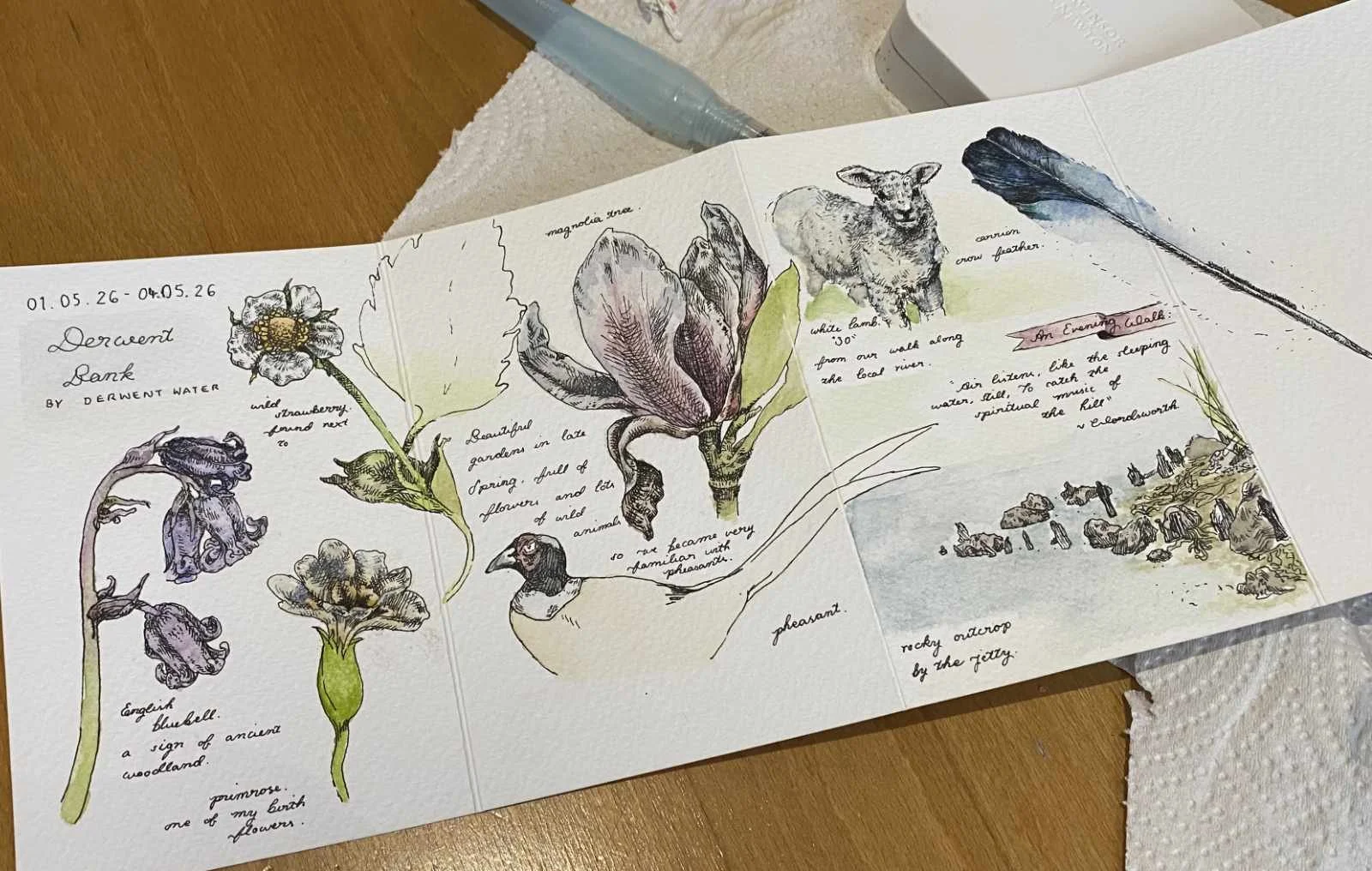
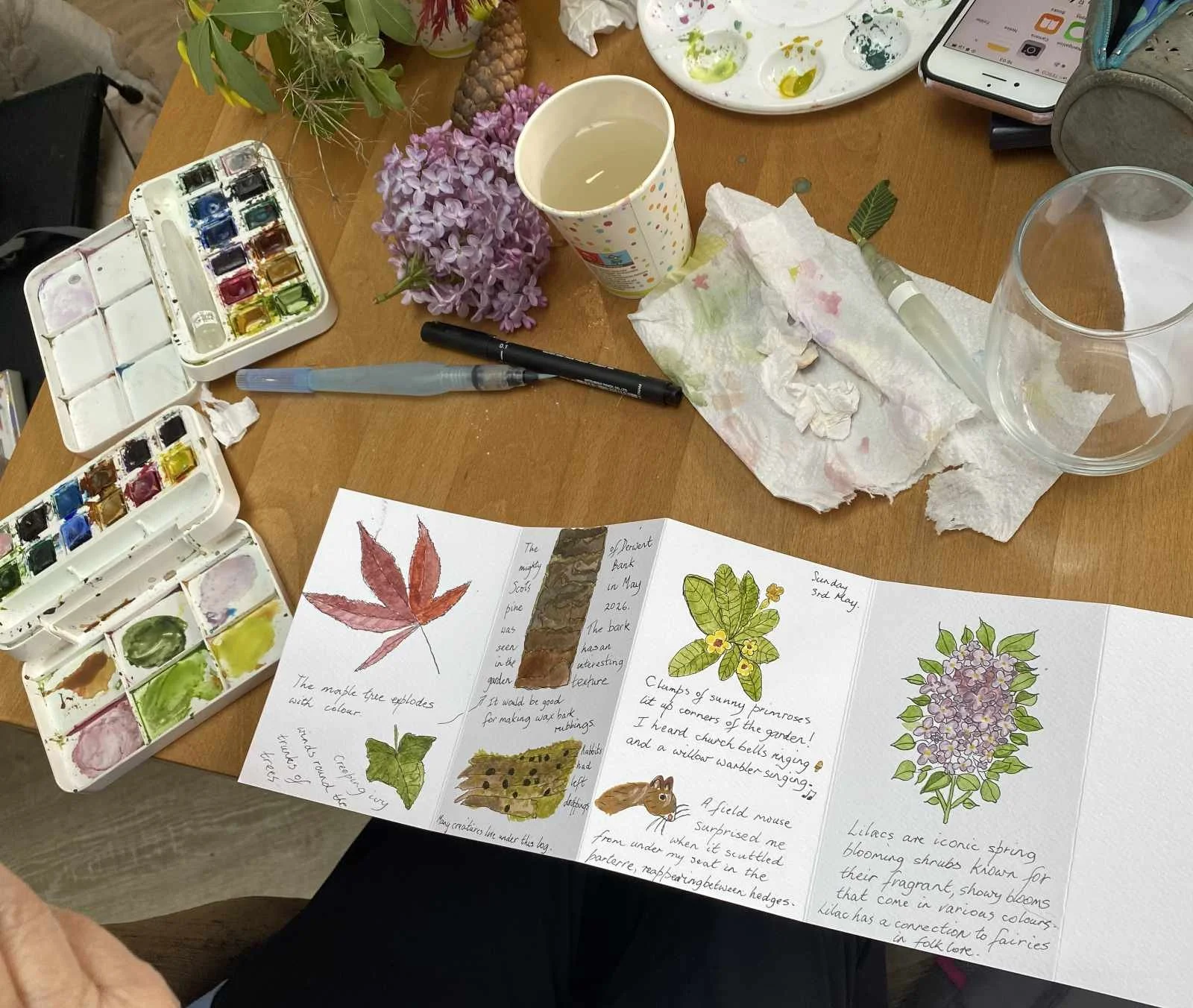
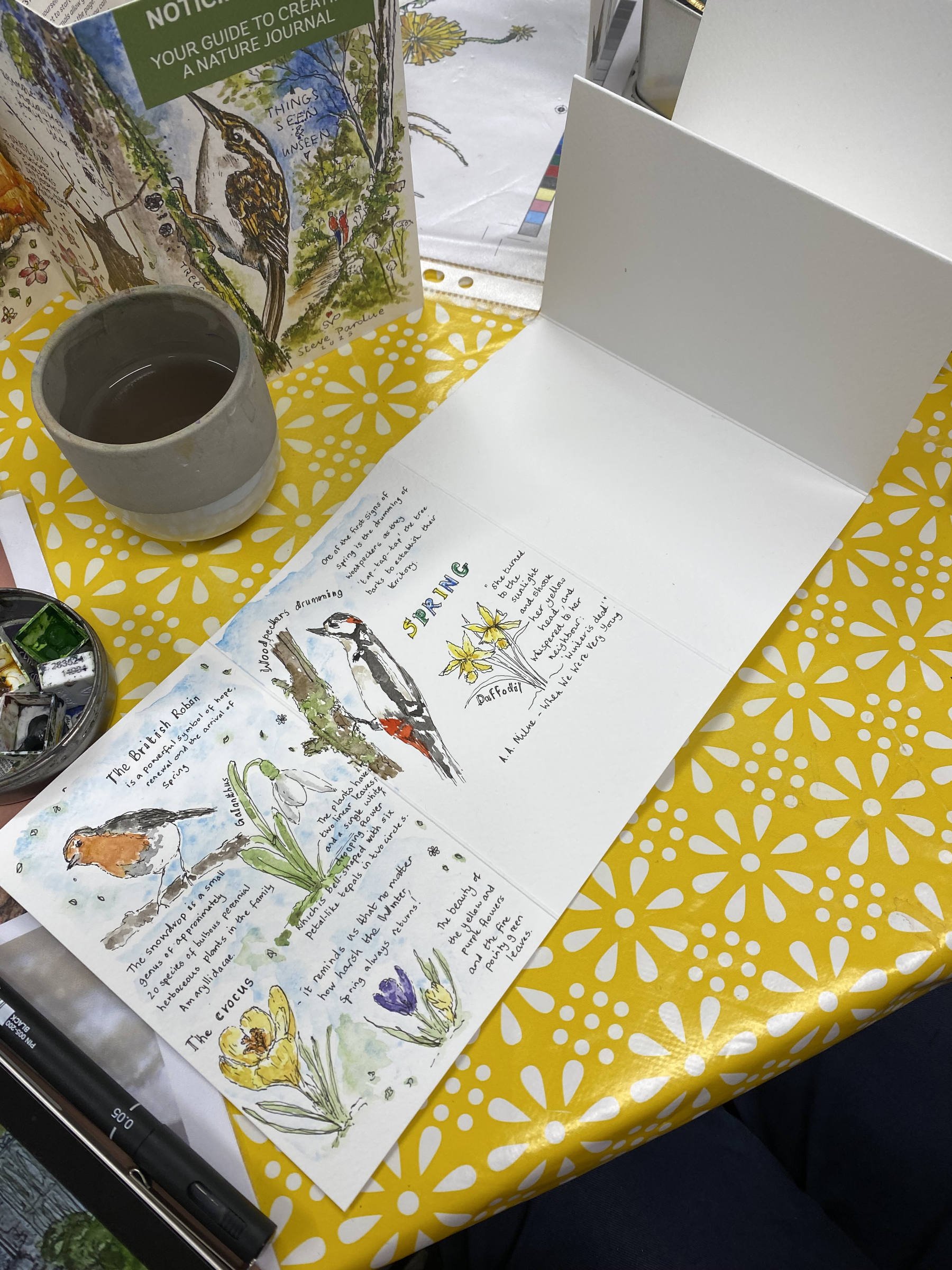
Nature Journalling at Derwent Bank for HF Holidays began with a walk around the lovely grounds of this beautiful location in Keswick, Lake District. We will be spending two days creating nature journals, looking at and enjoying nature. Our motto: N-O-E-L: Notice - Observe - Empathise - Learn. And Noel means “to be born” so we are looking at everything through “new born eyes”.
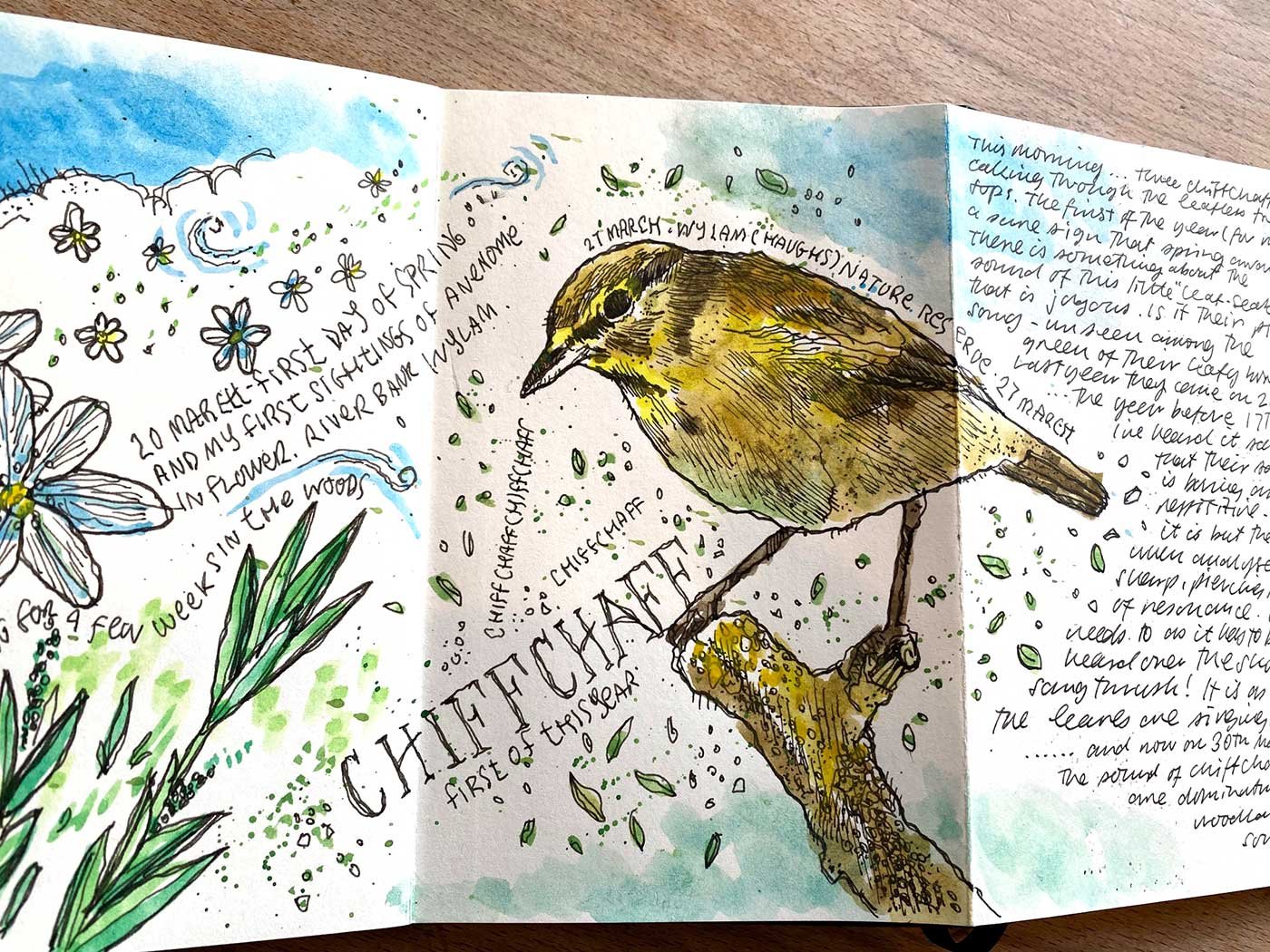
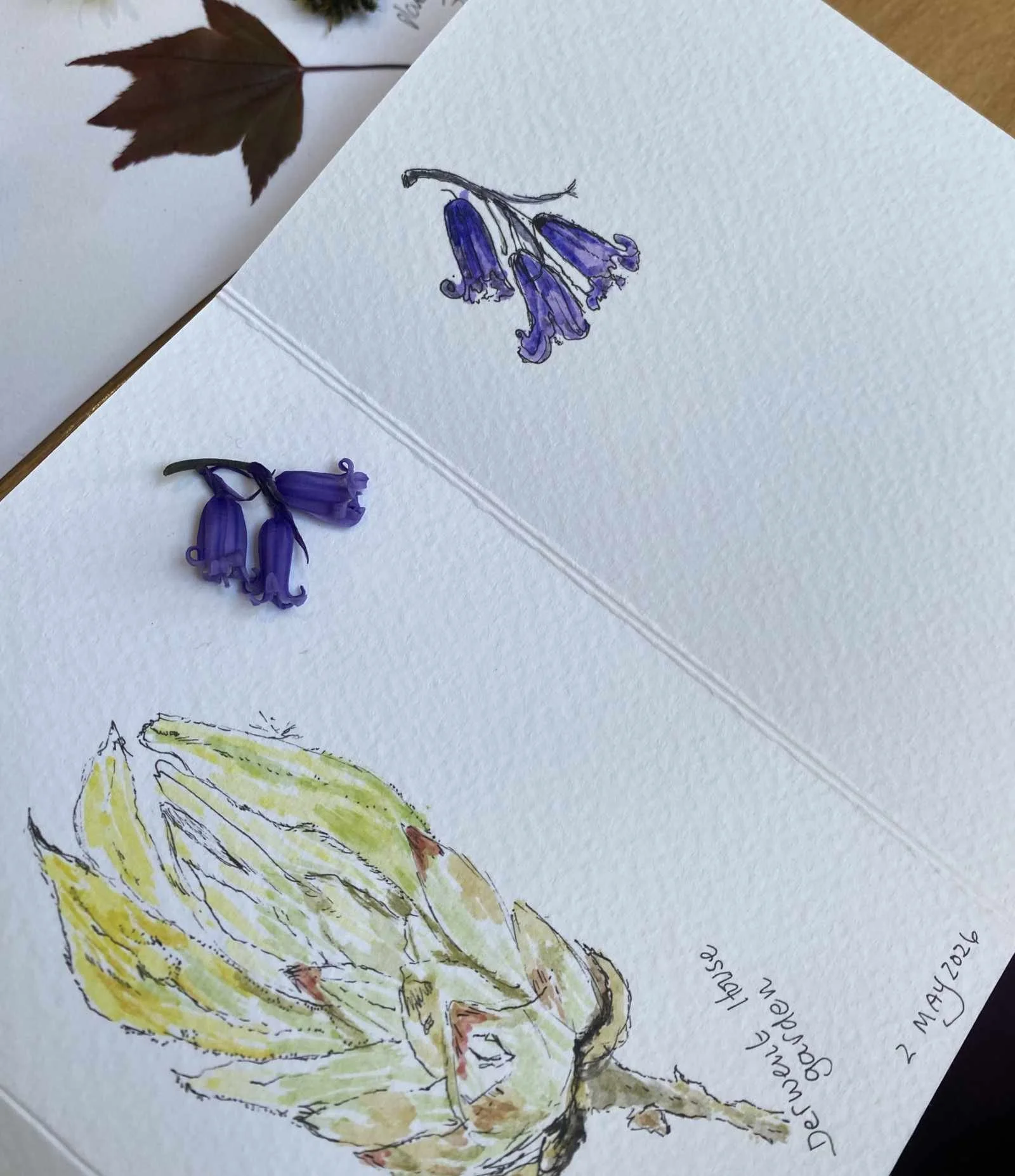
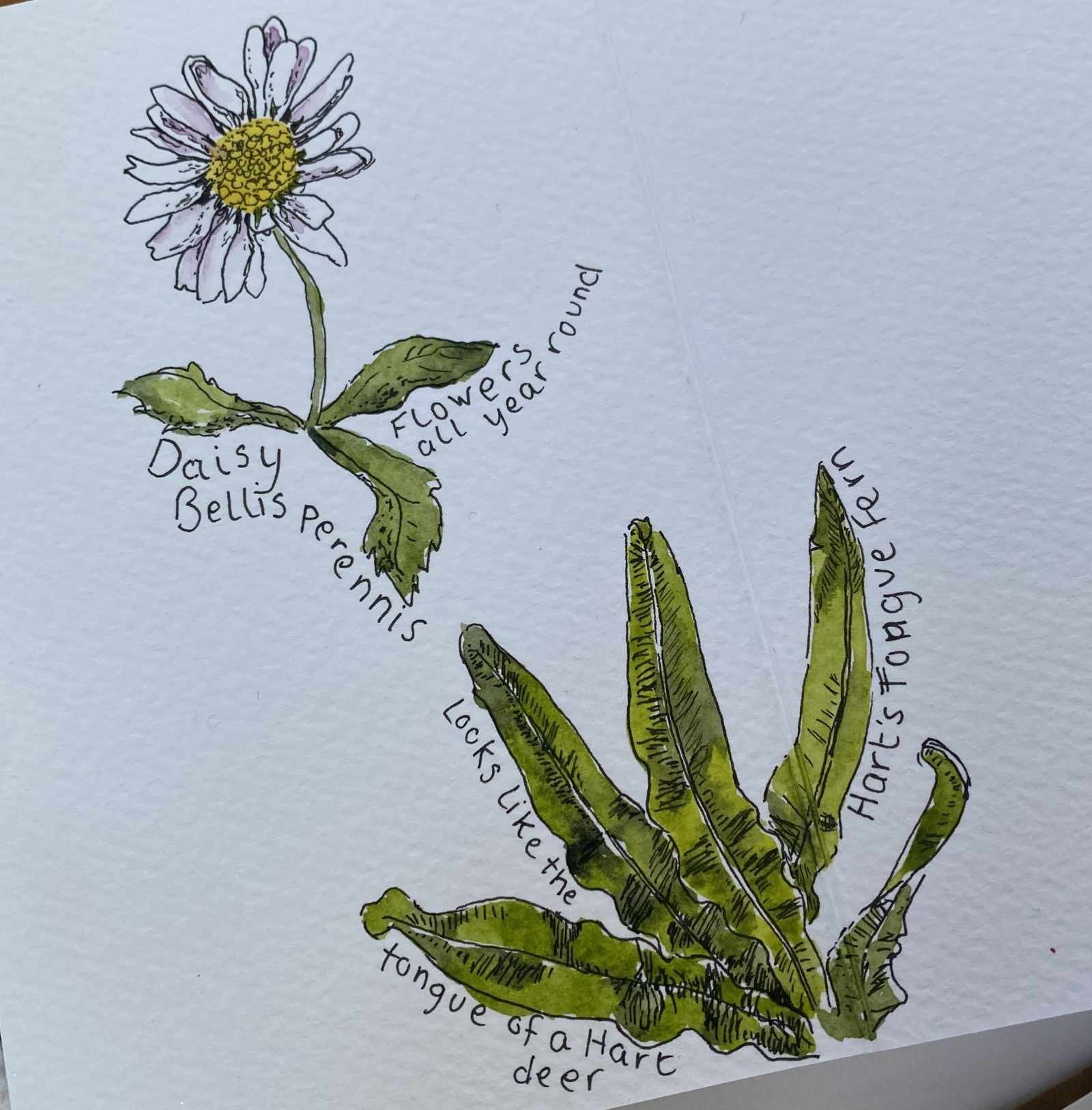
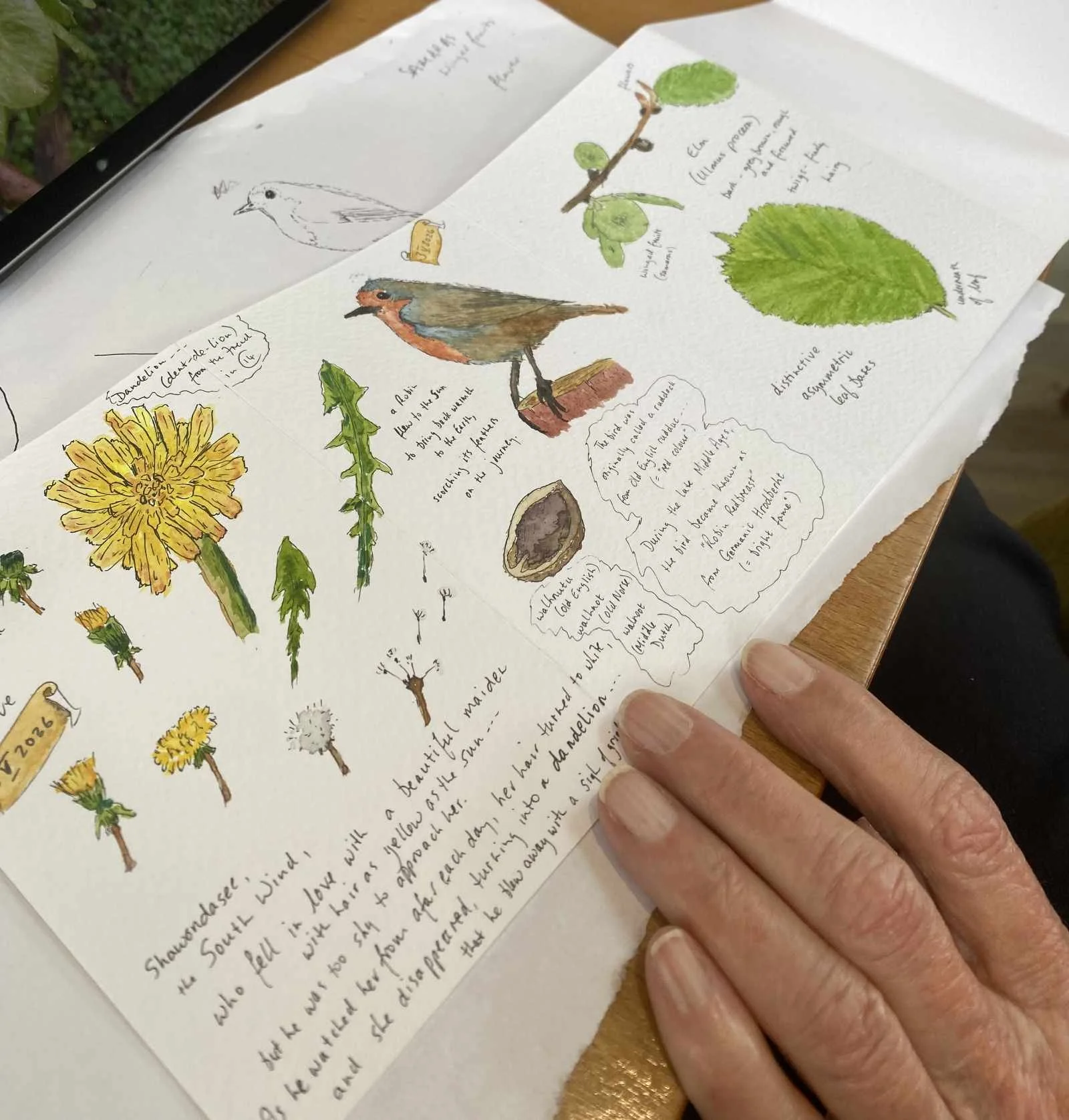
A detail from my journal - I dodn’t get a chance to do as much as everybody else!
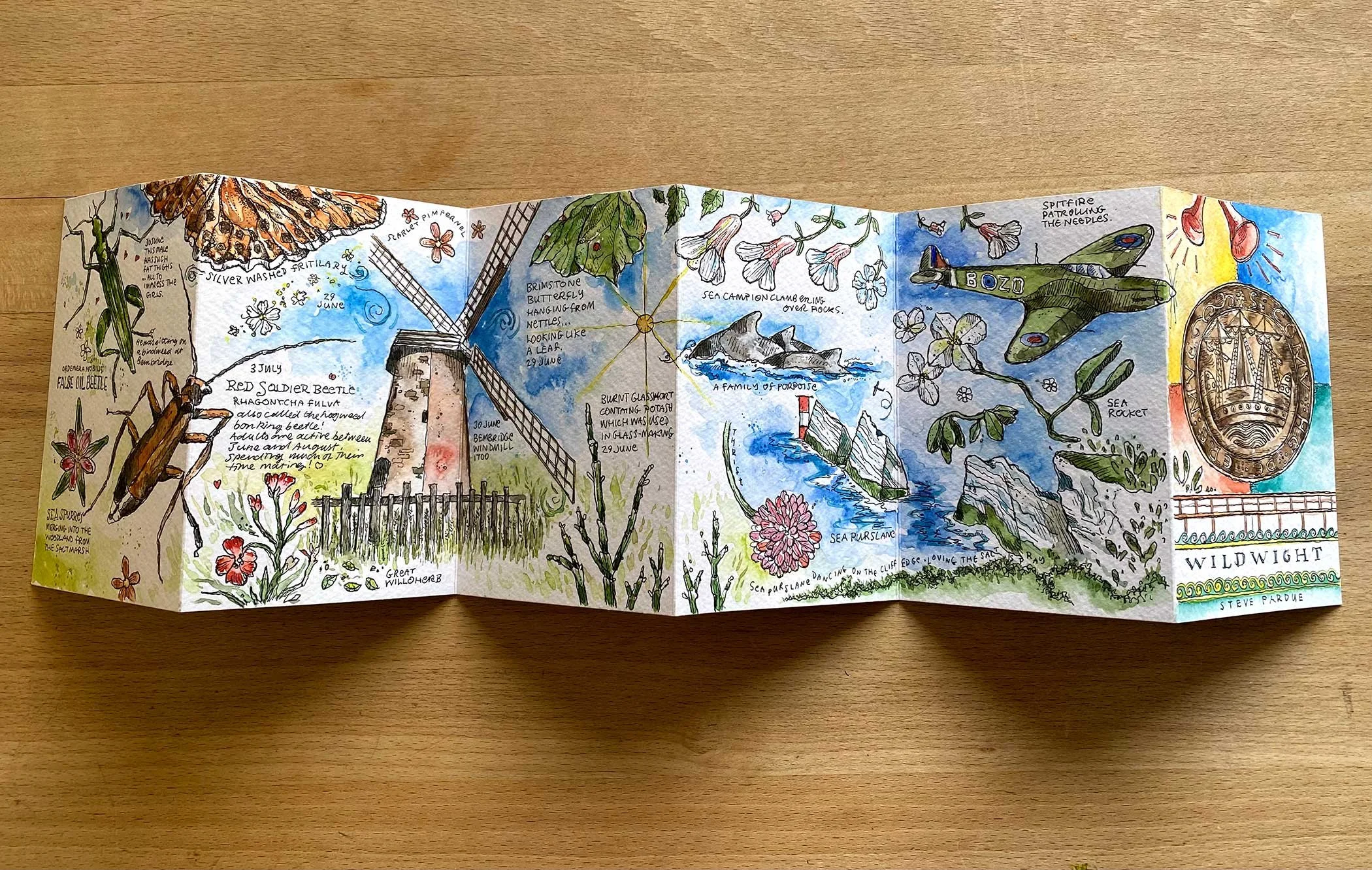
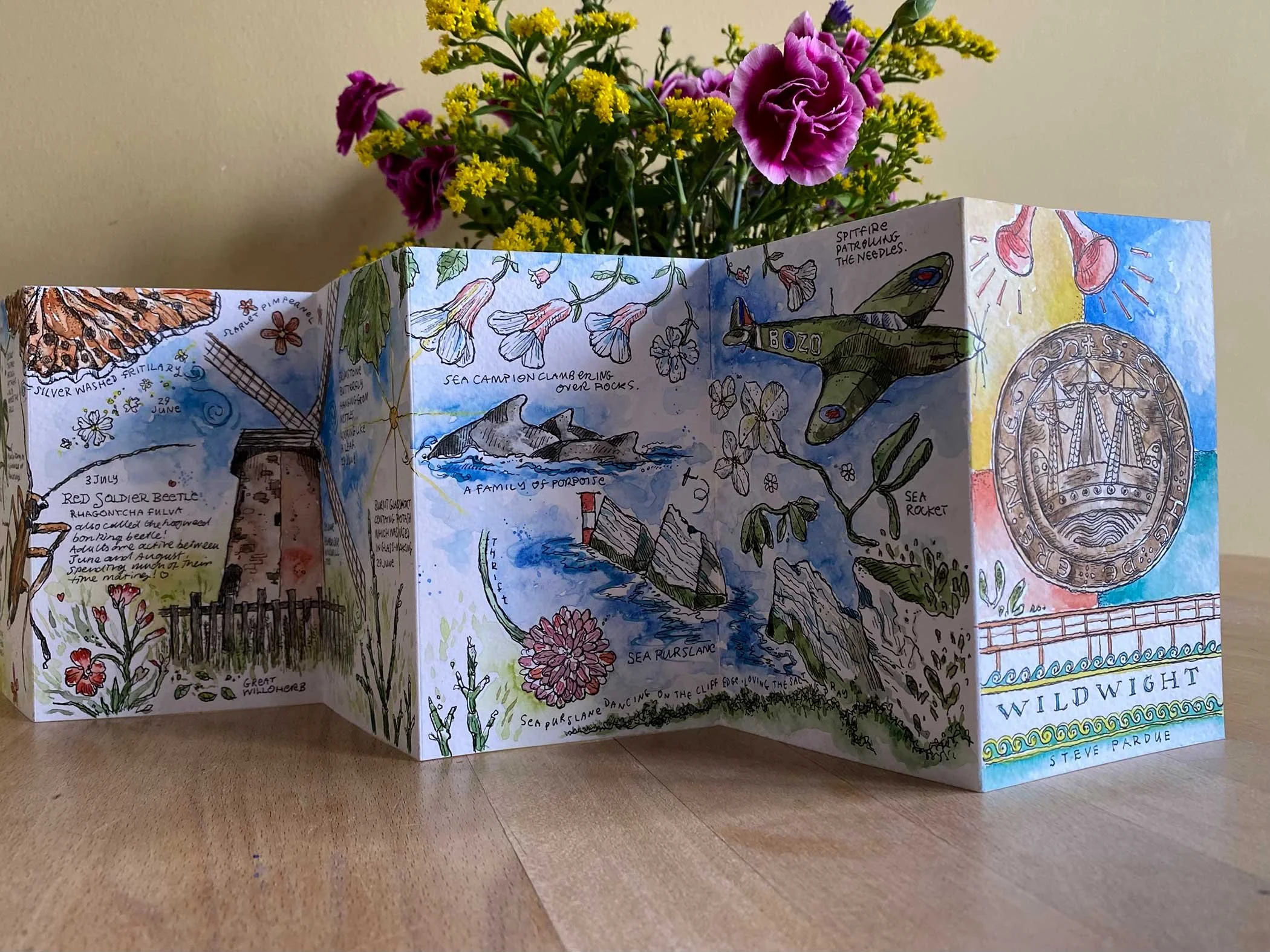
A loosely created log of my Nature Journalling course at Derwent Bank.
Friday evening, I spoke with the group and introduced a little bit about how I teach and the process I follow to allow everyone, whatever their ability, to take part in journalling.
This, in part, includes a little bit of story telling, an exploration of words and their meaning and where to find nature.
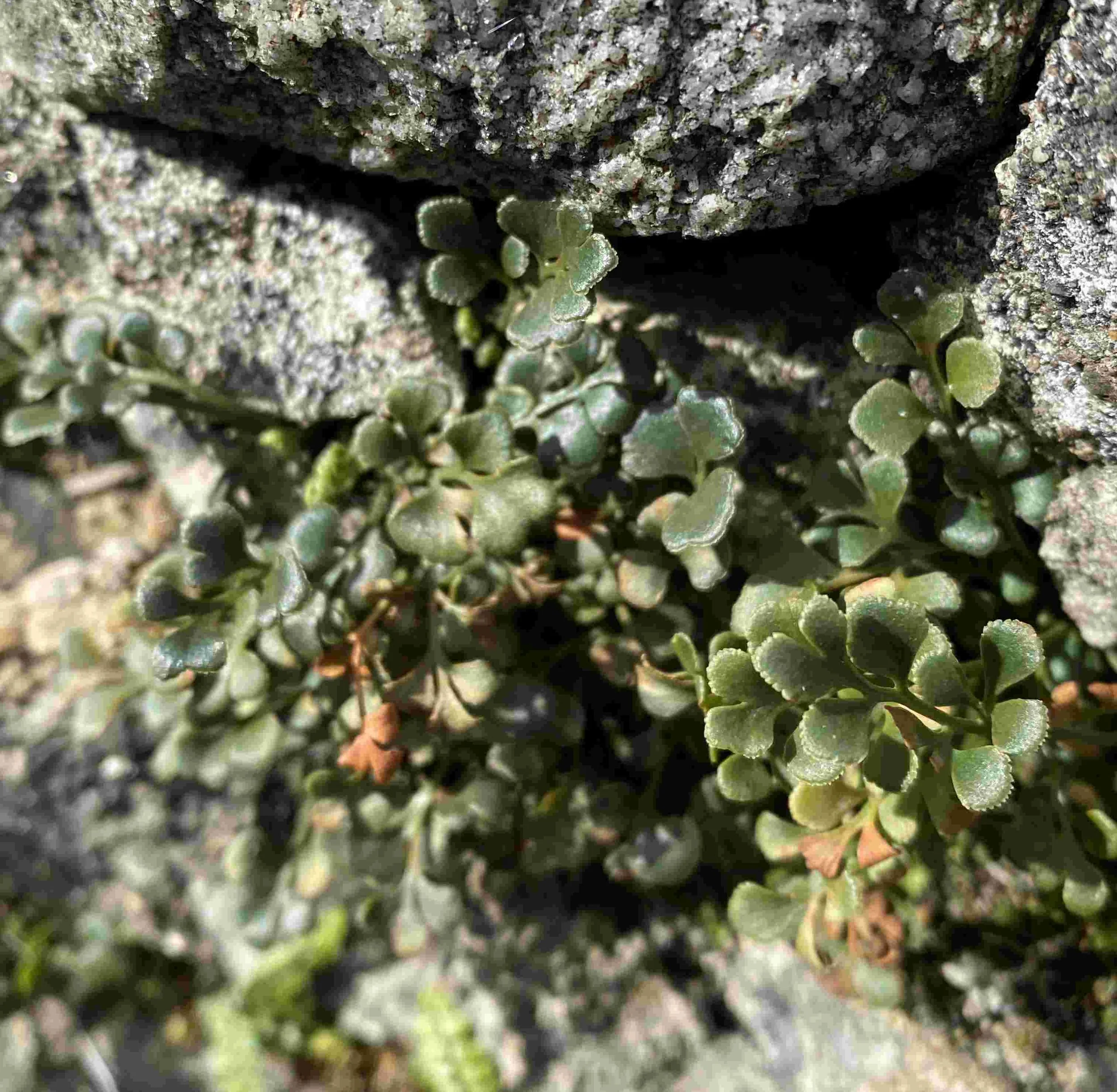
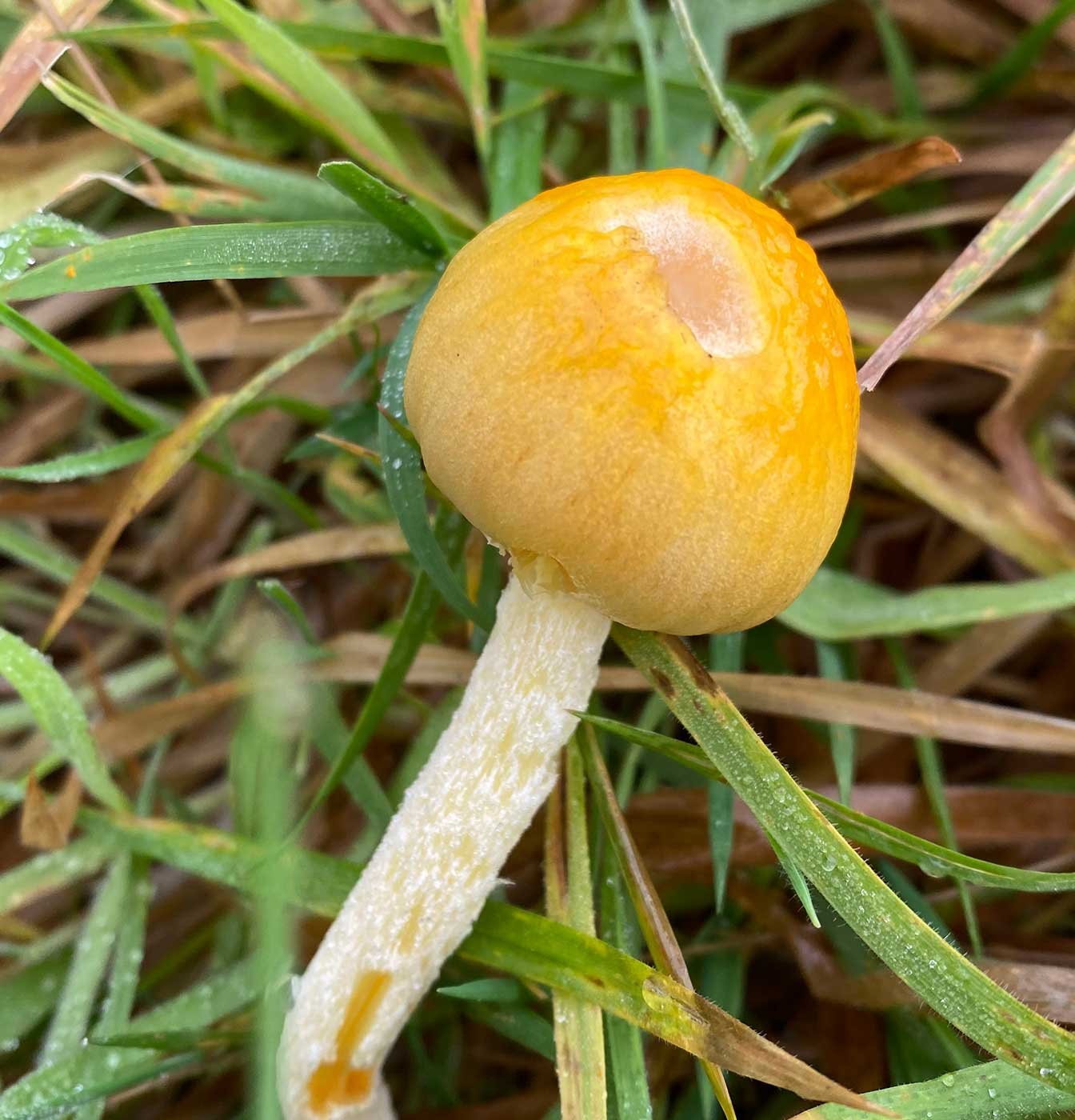
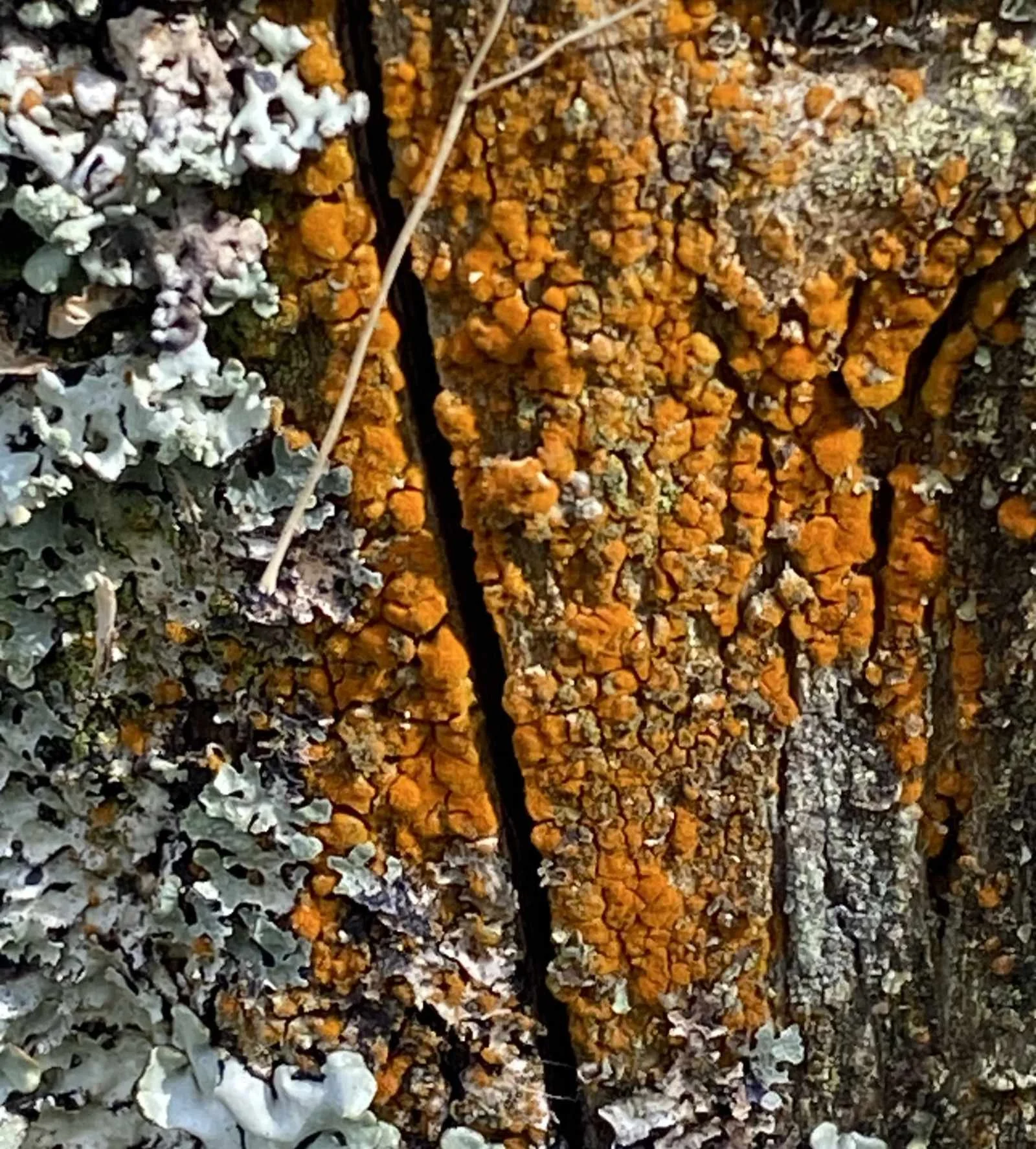
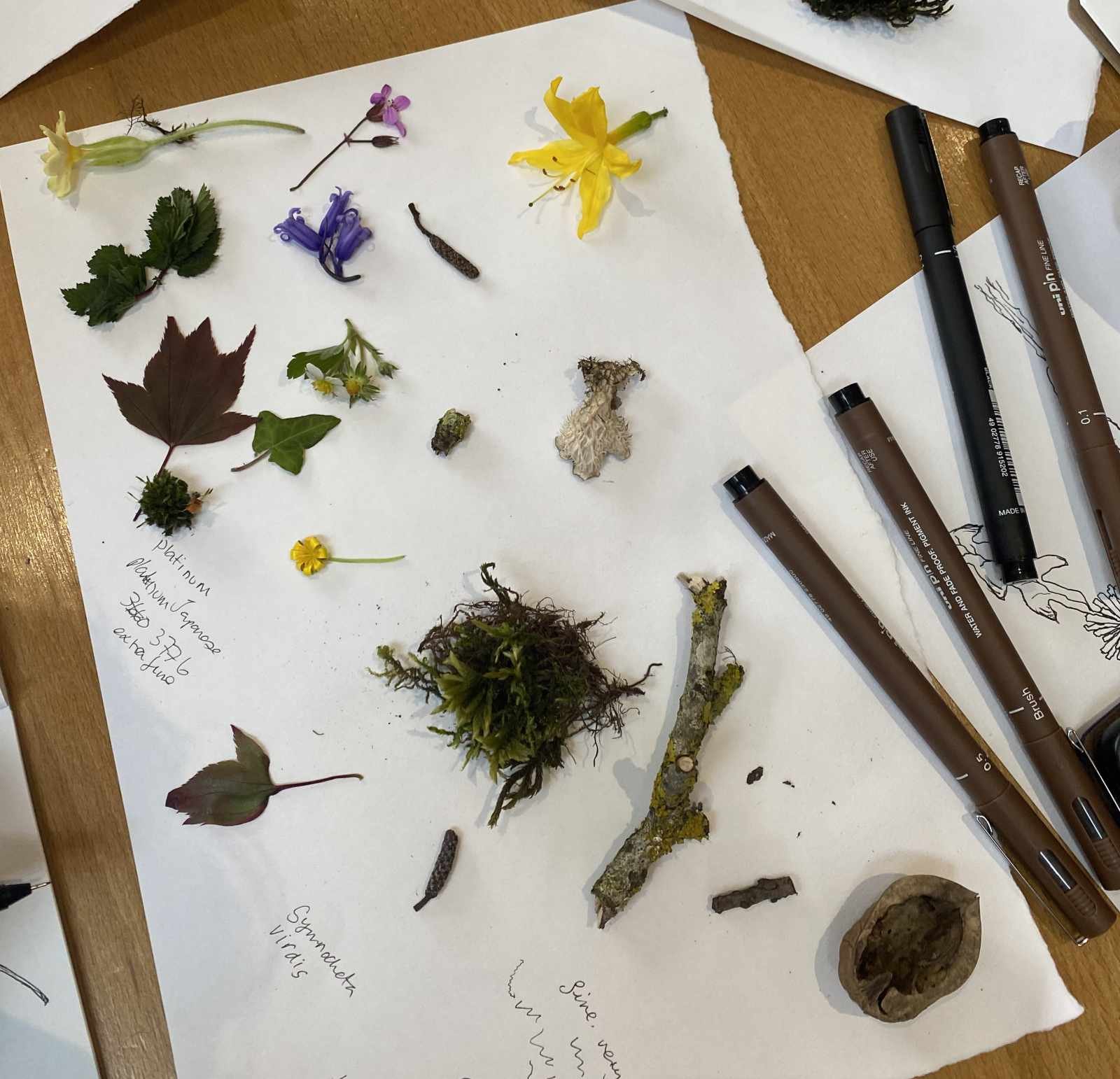
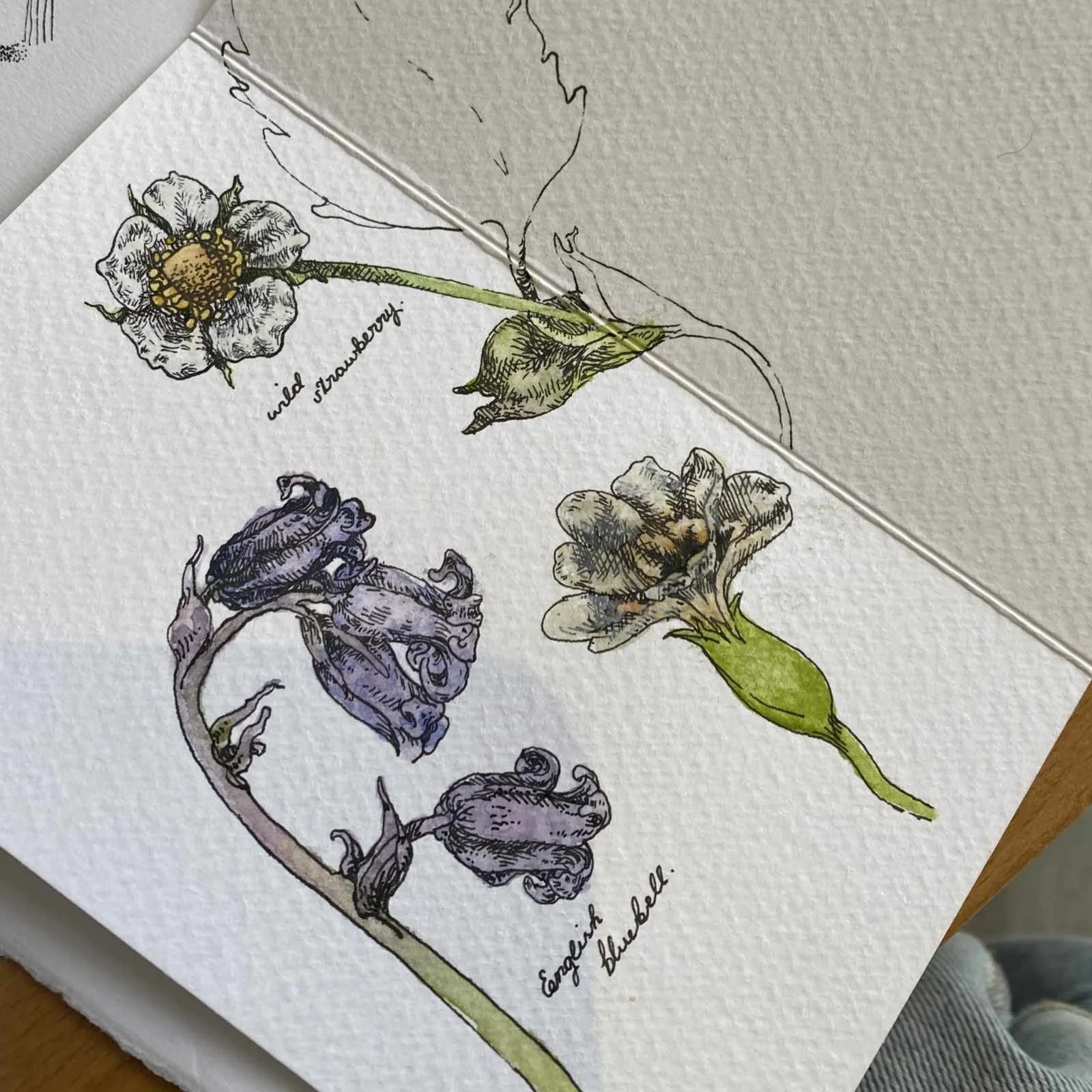
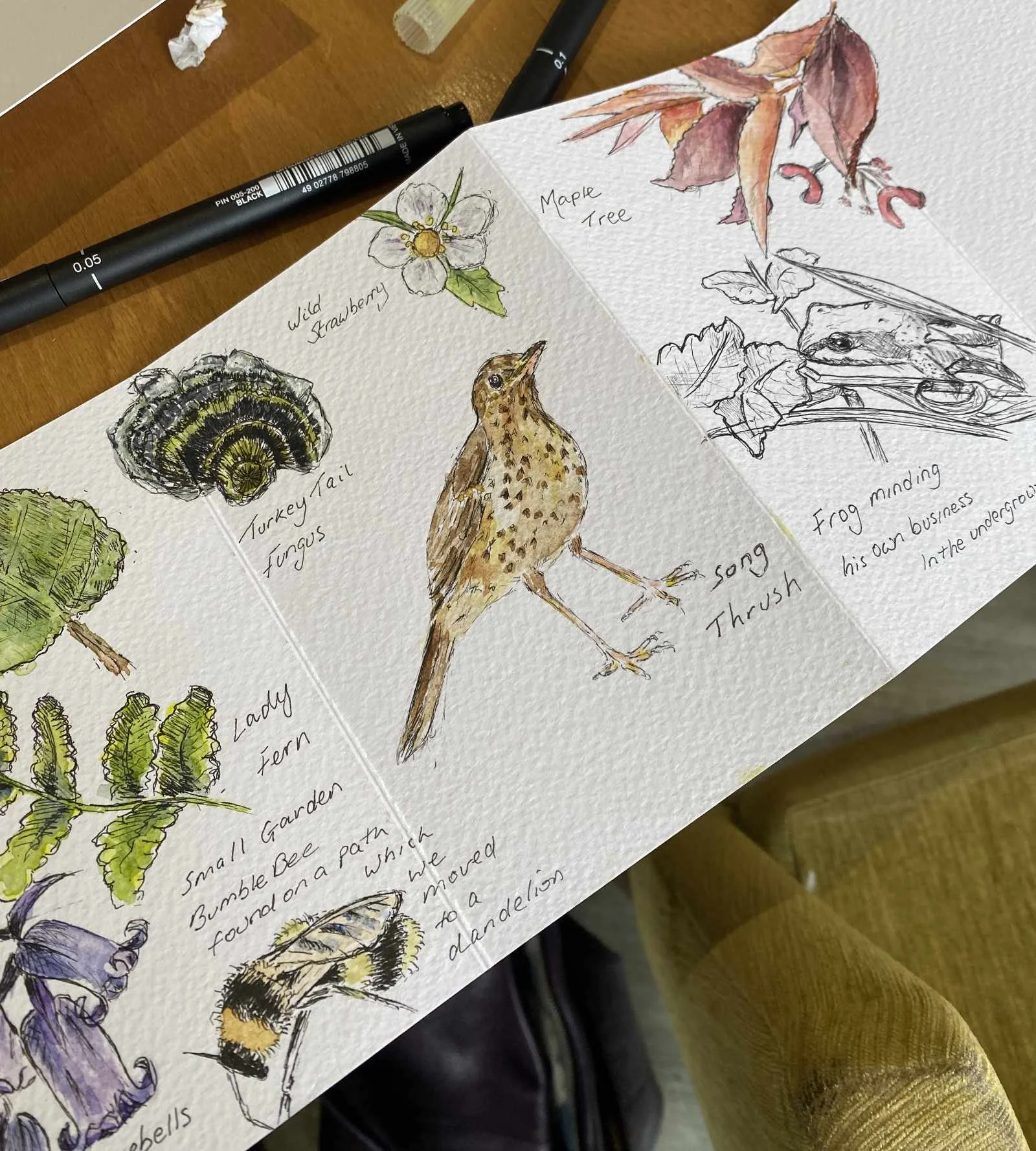
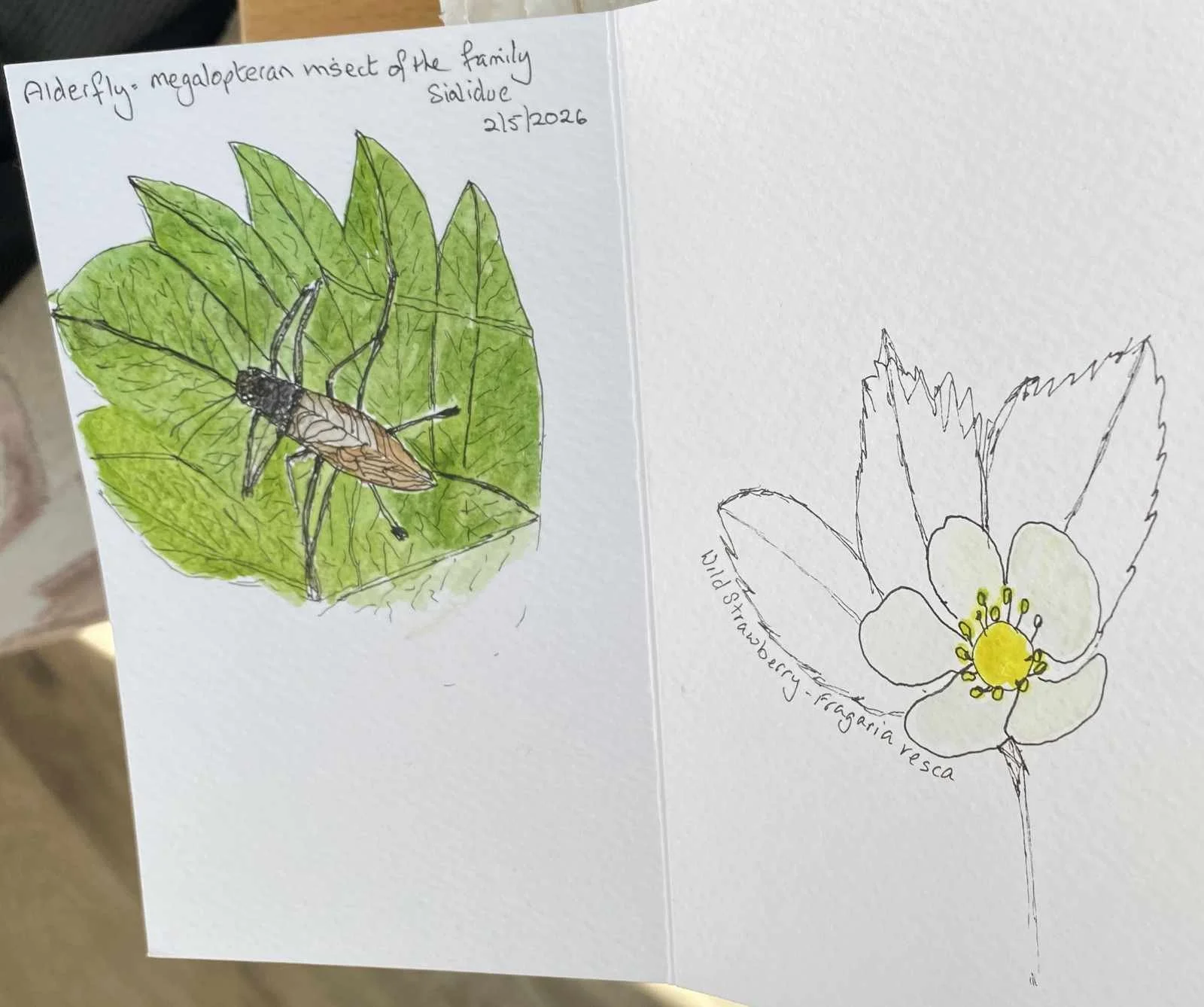
Saturday morning, we walked around the grounds of the hotel and discovered wild strawberry, maidenhair spleenwort growing out of the walls, a beautiful meadow of bugle, lady fern crouching beneath the trees, dog lichen spreading over the lawn, pine cones, a half of a walnut shell with a slug inside trying to be a snail. Dandelions of course and an exciting fine, an alderfly. All over are dandelions and sweet violet and constant chatter of chiffchaff, greenfinch and coal tit.
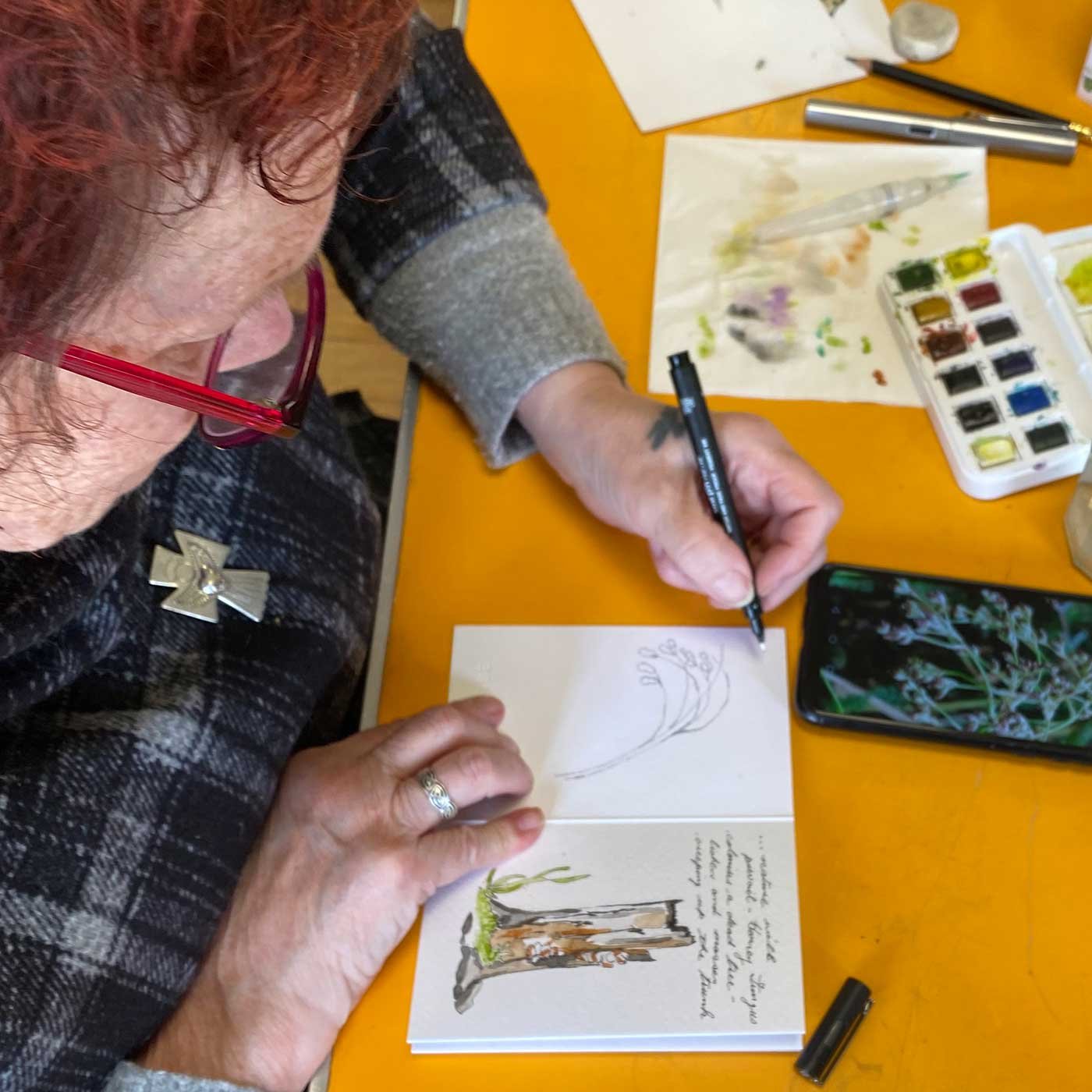
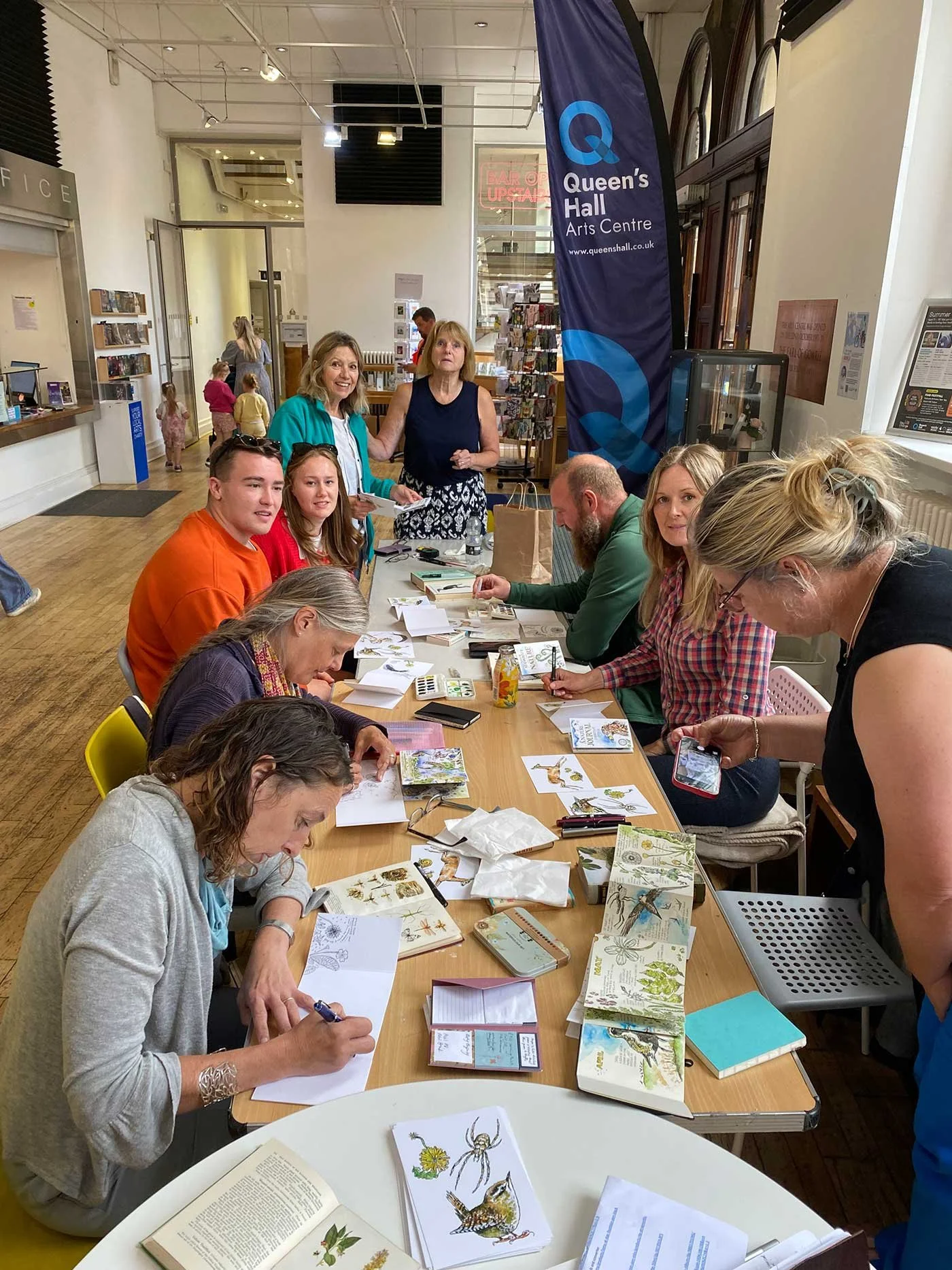
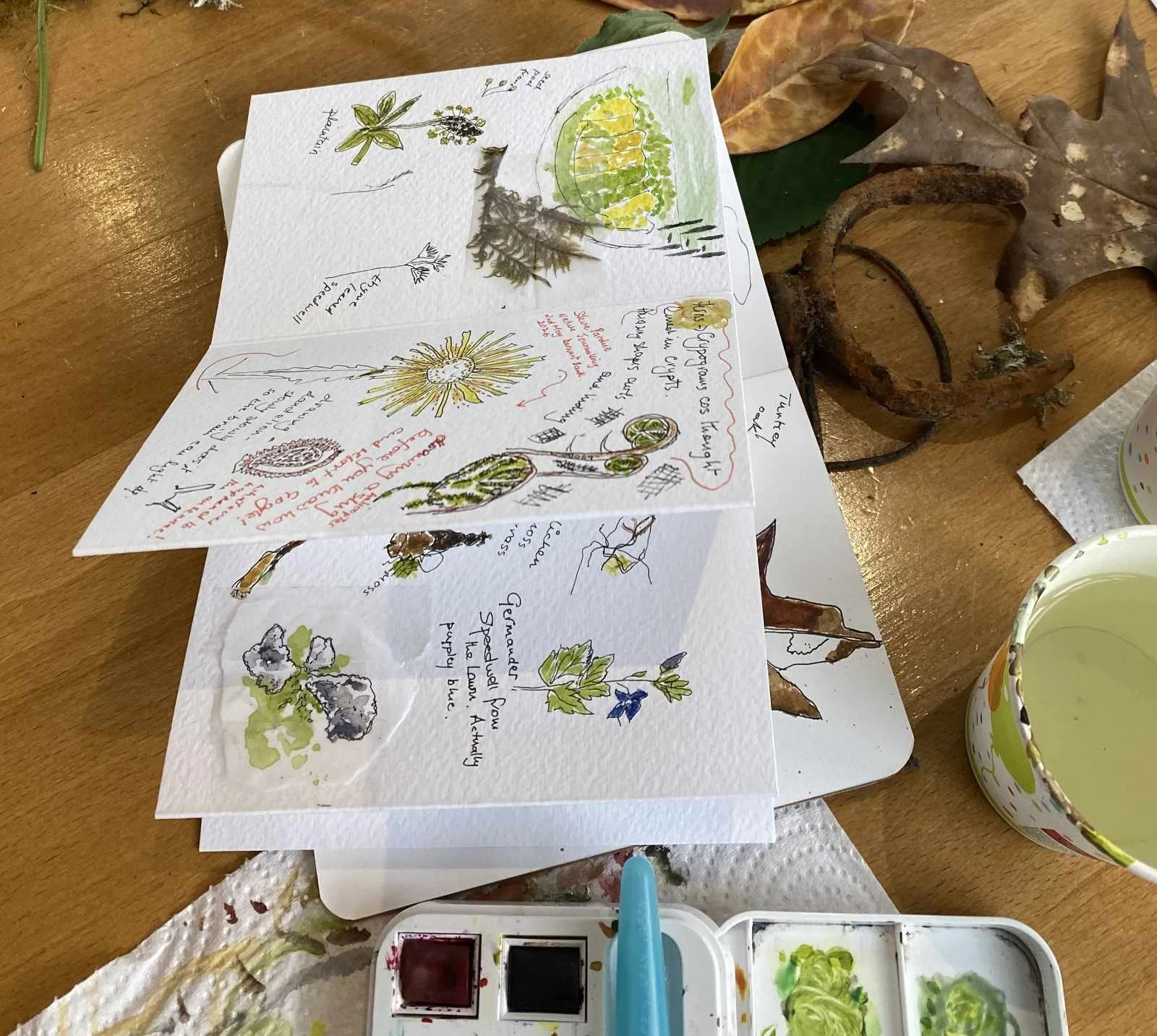
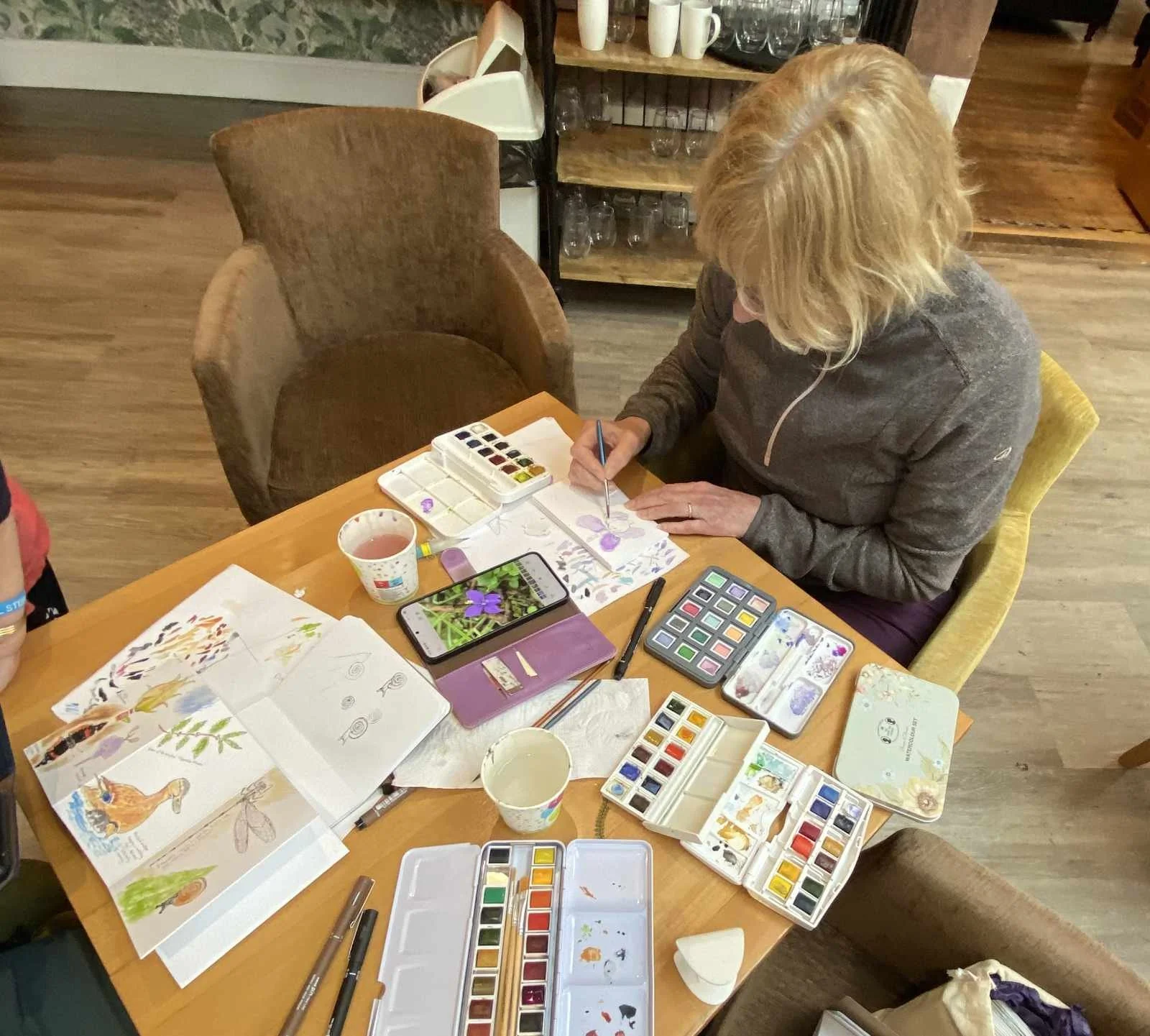
Nature journal in progress
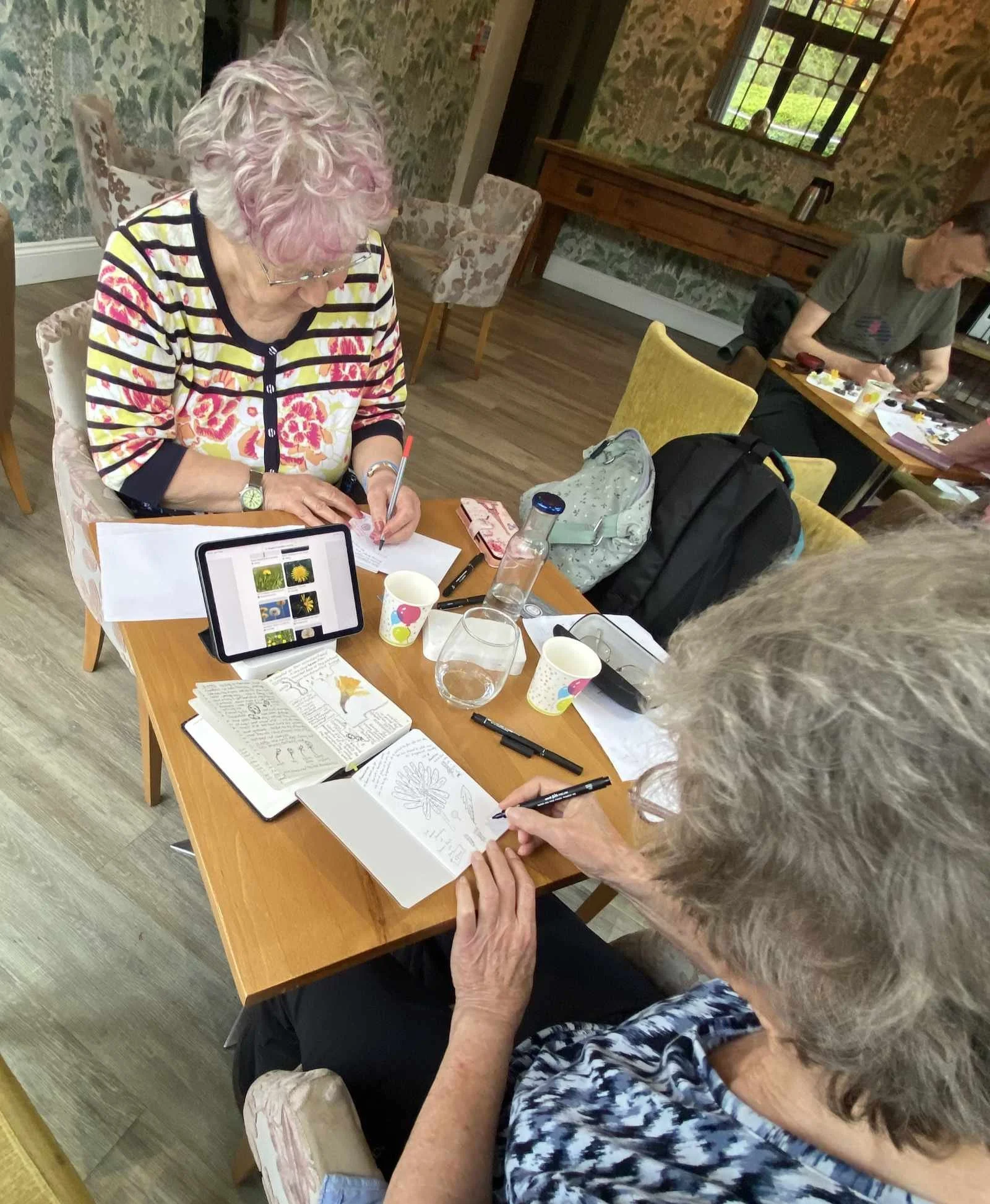
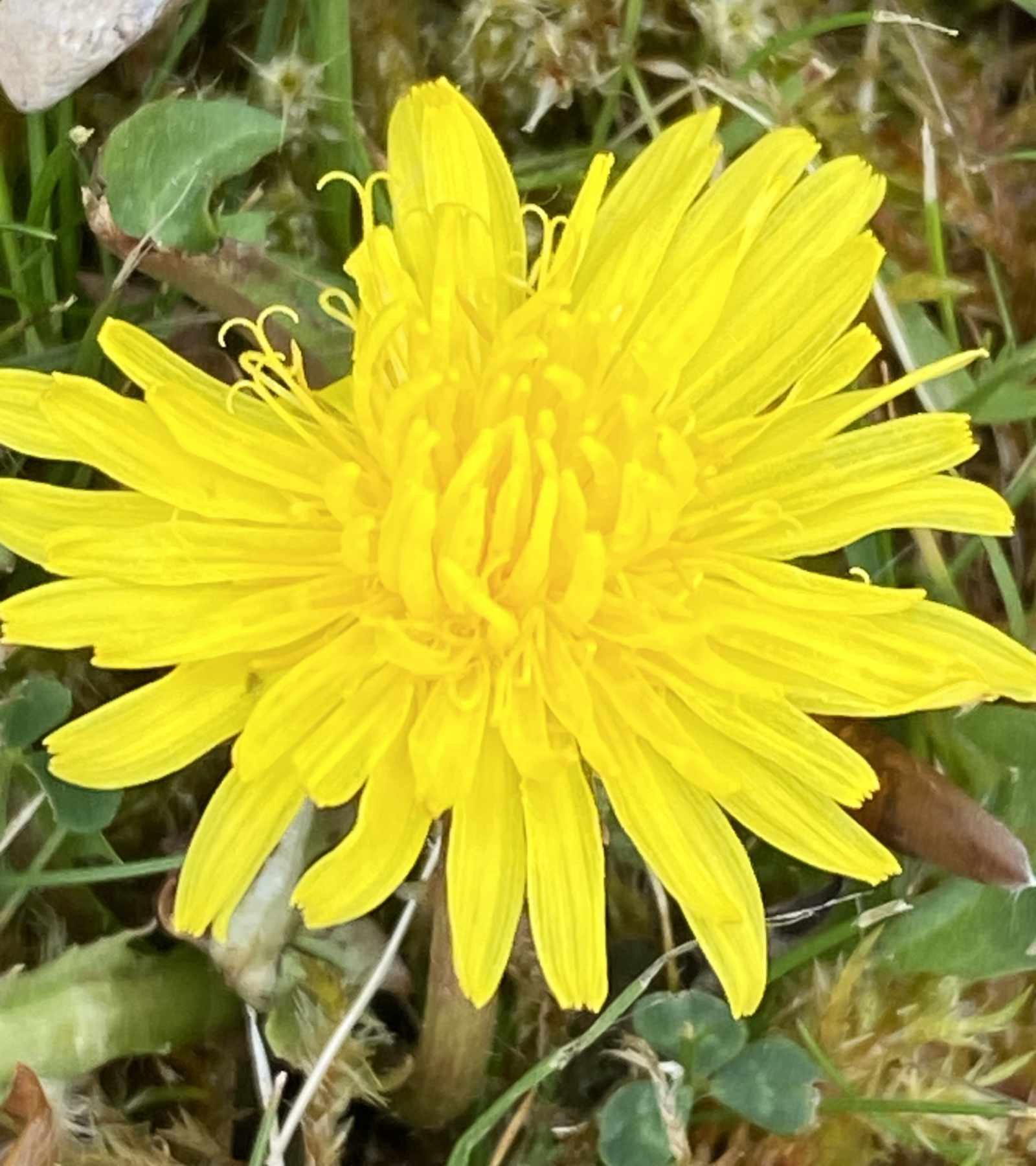
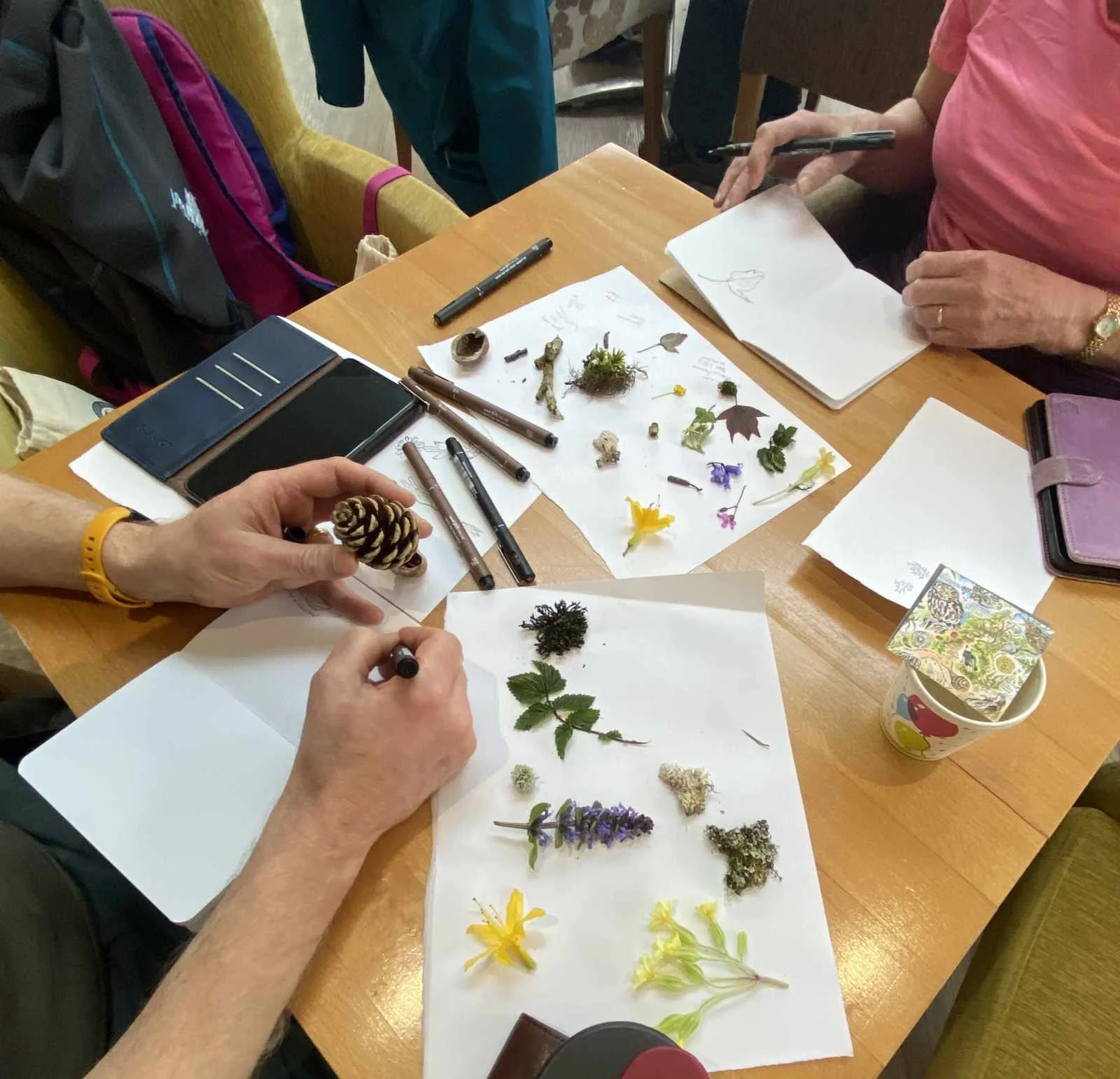
Back indoors we began the slow drawing exercise. For this we all used one of the pens provided in the packs and drew a dandelion very, very slowly. The slowing down is the key, here, as it allows for a mindful approach to drawing, without it feeling like a mindfulness exercise. Sort of like meditation without realising it.
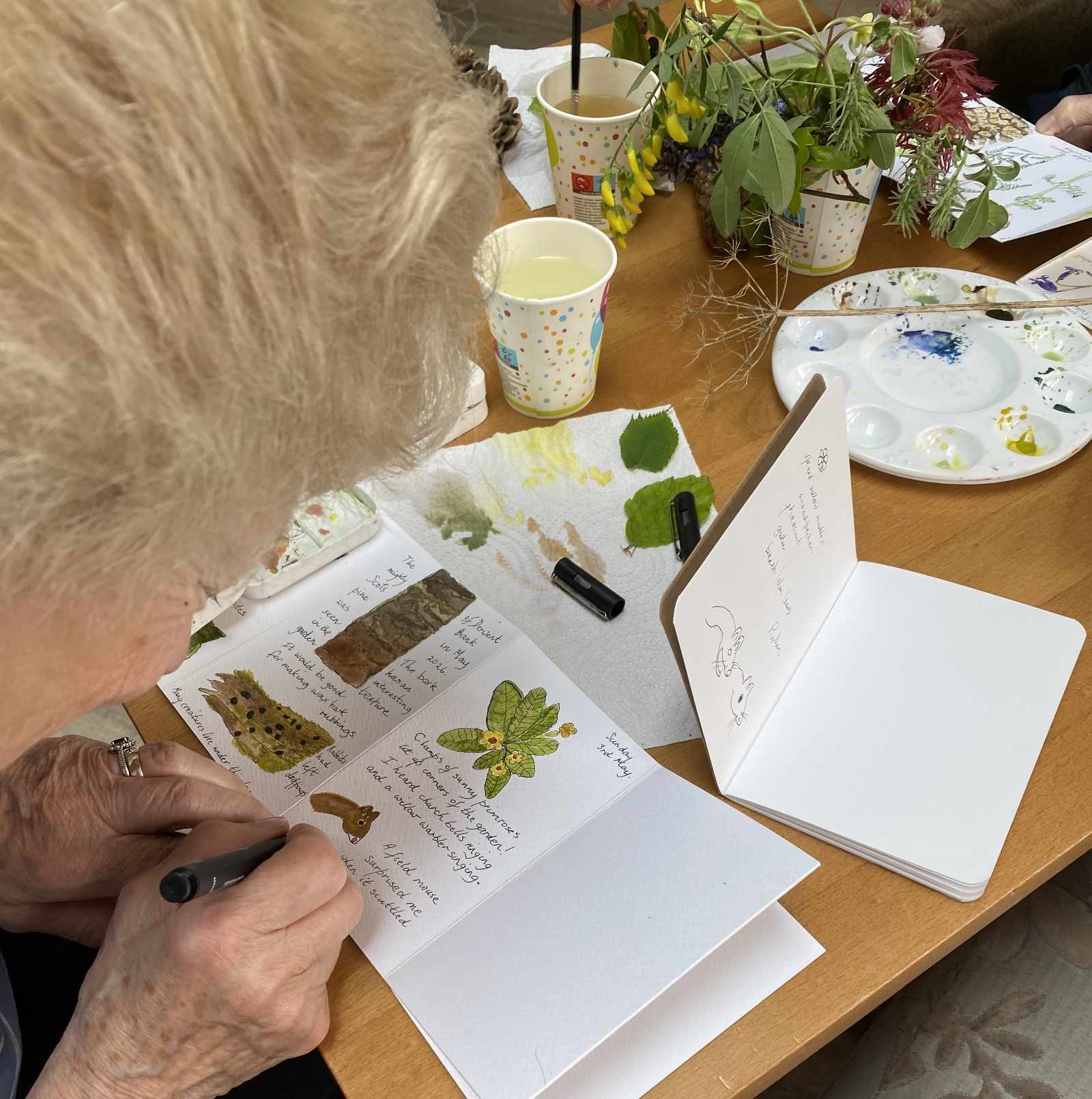
After that it was straight into creating the notes of our walk in the provided notebooks. And these notes are not just observations but feelings and personal impressions of how we felt when discovering new things. One lady commented that she is going to curse me as she will no longer be able to go for a walk without stopping at every step to explore the tiny “new” plants she was discovering. Plants that she probably, as we all do, pass everyday without paying attention.
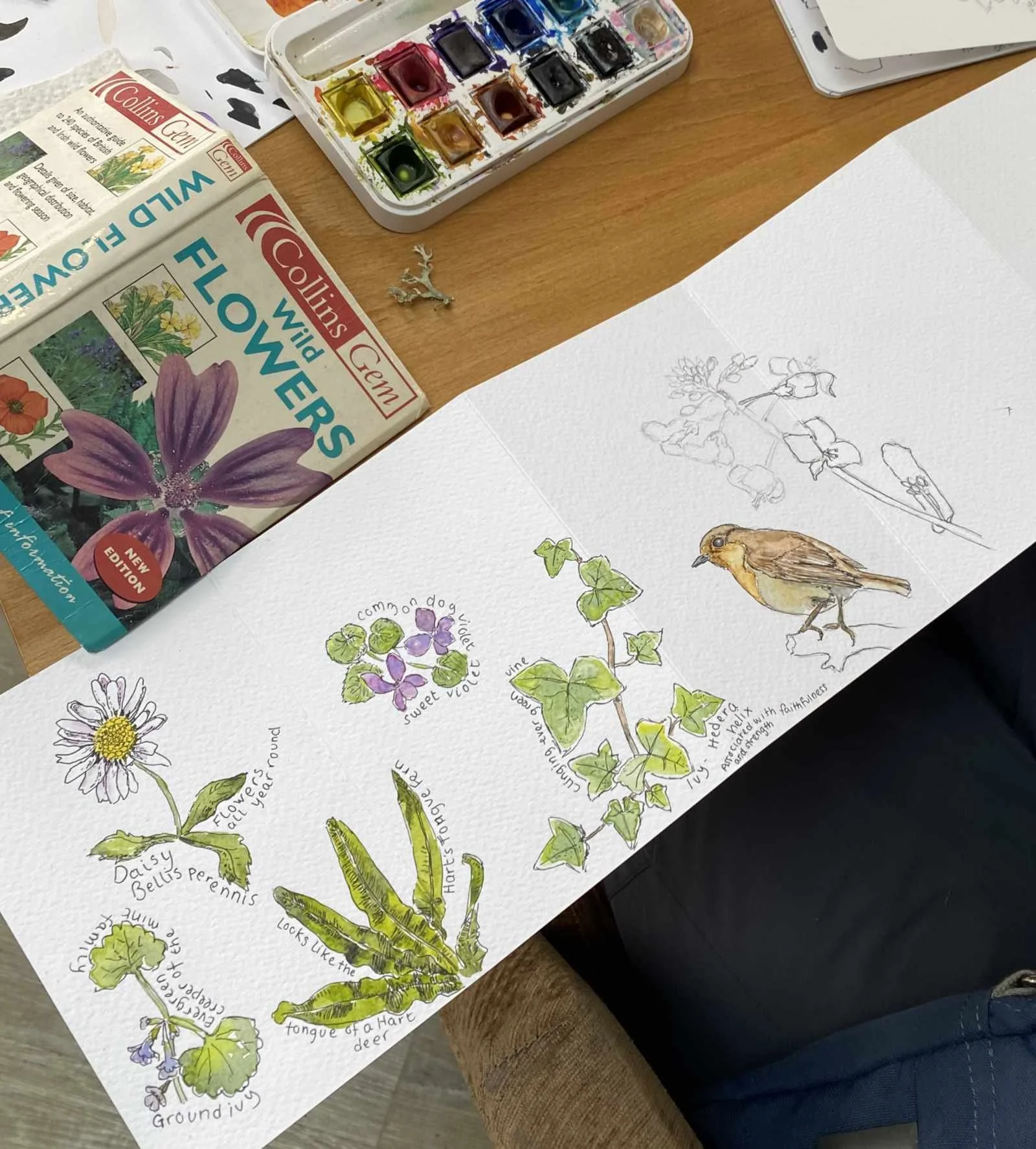
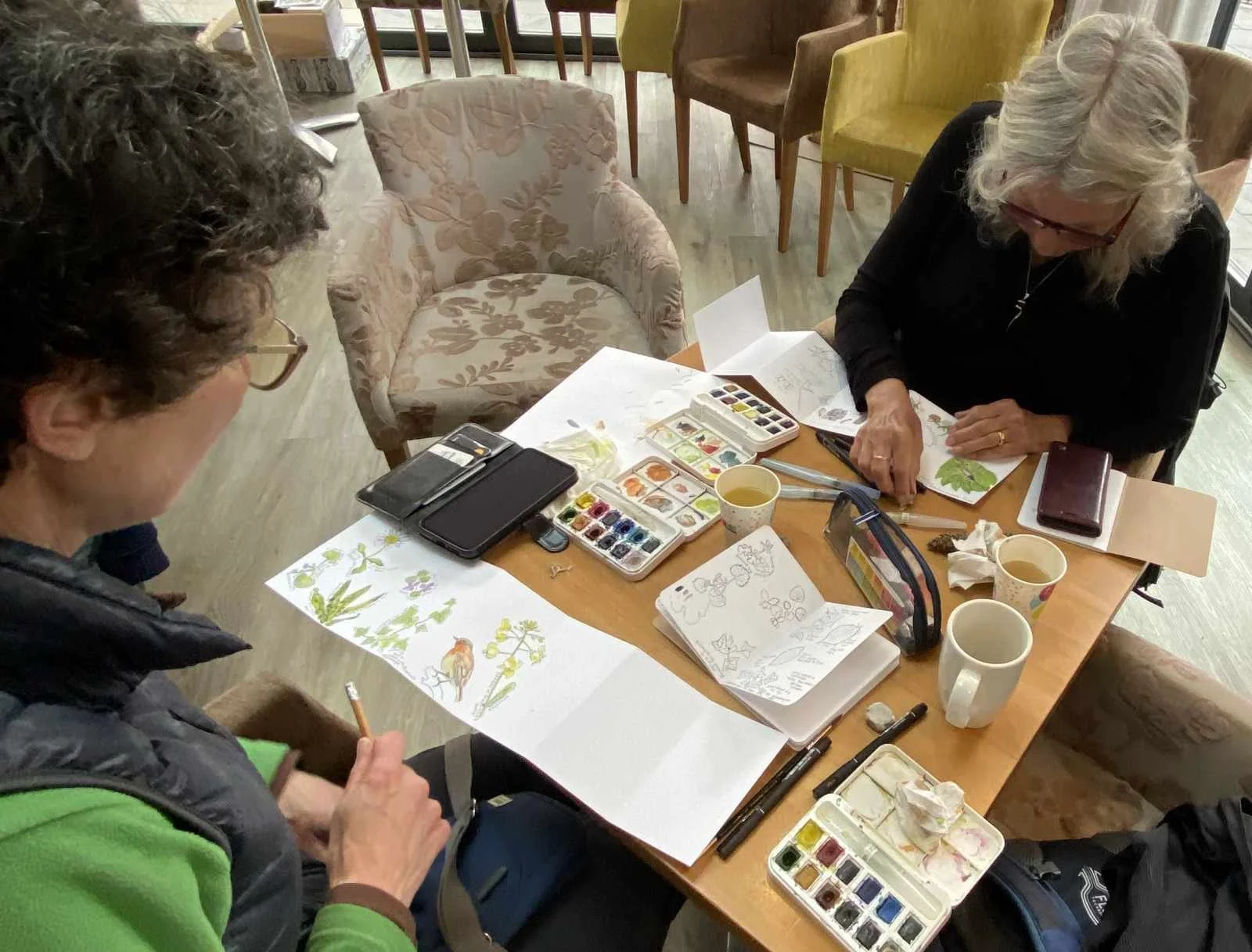
Making notes from observation
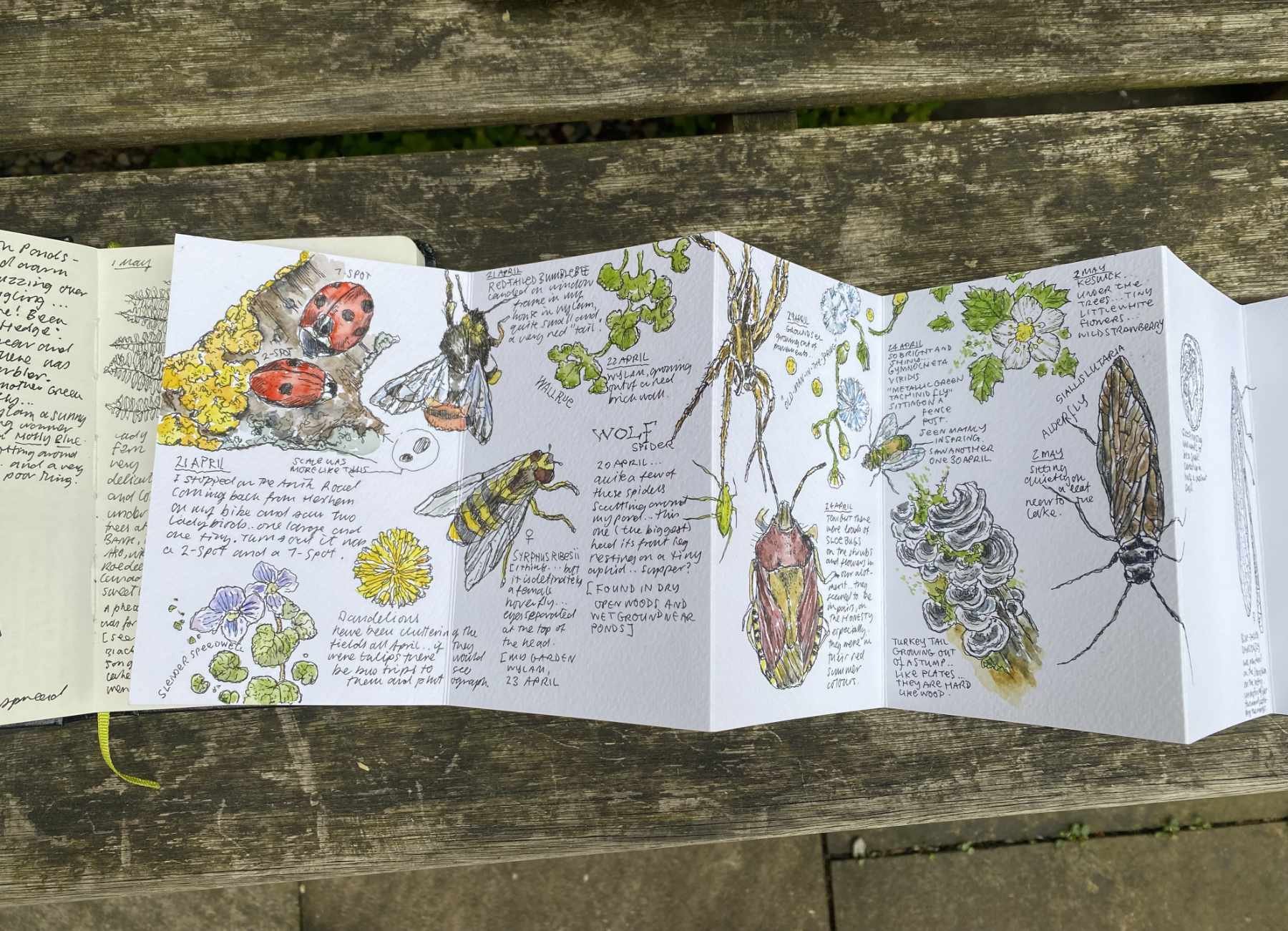
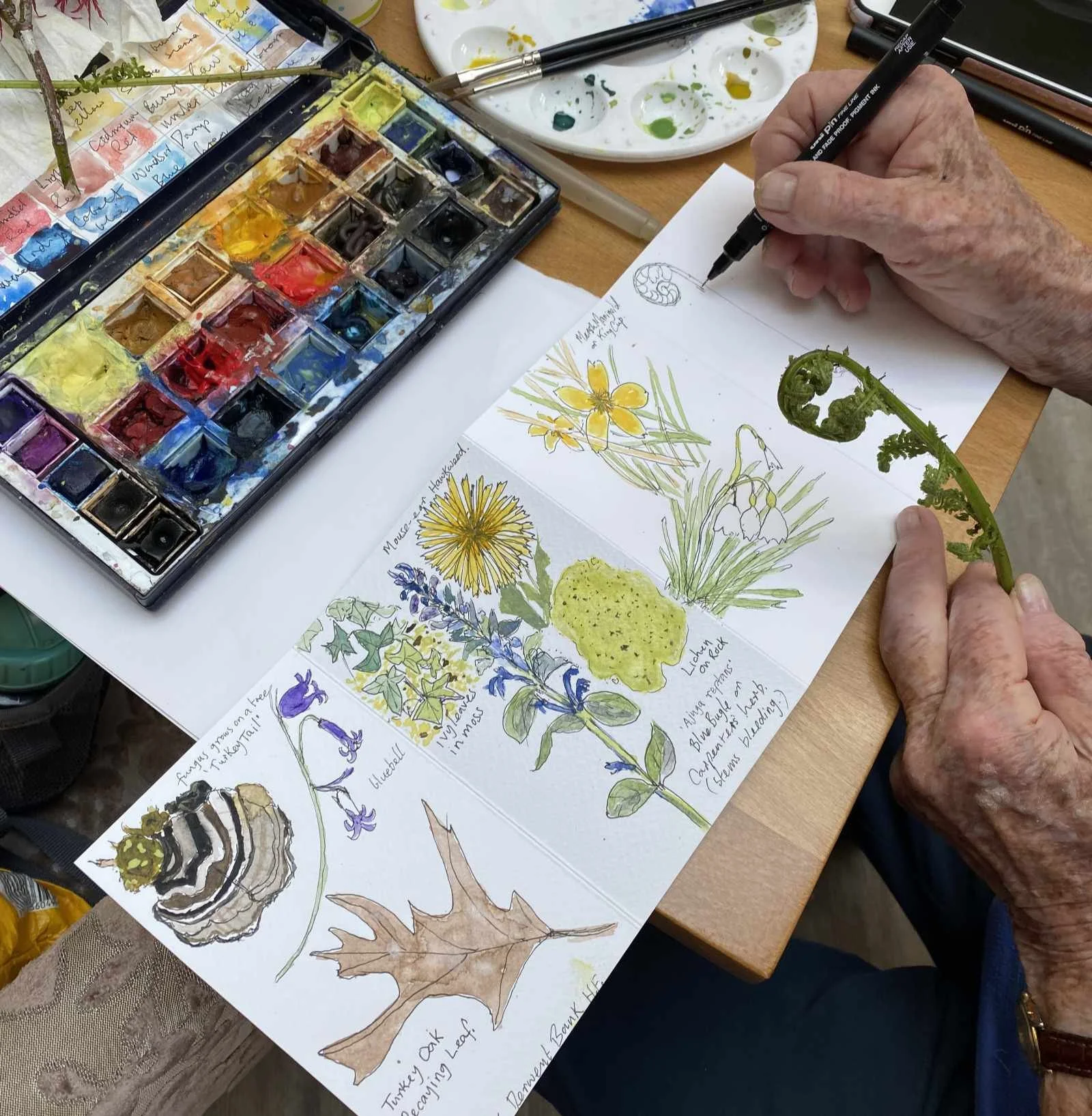
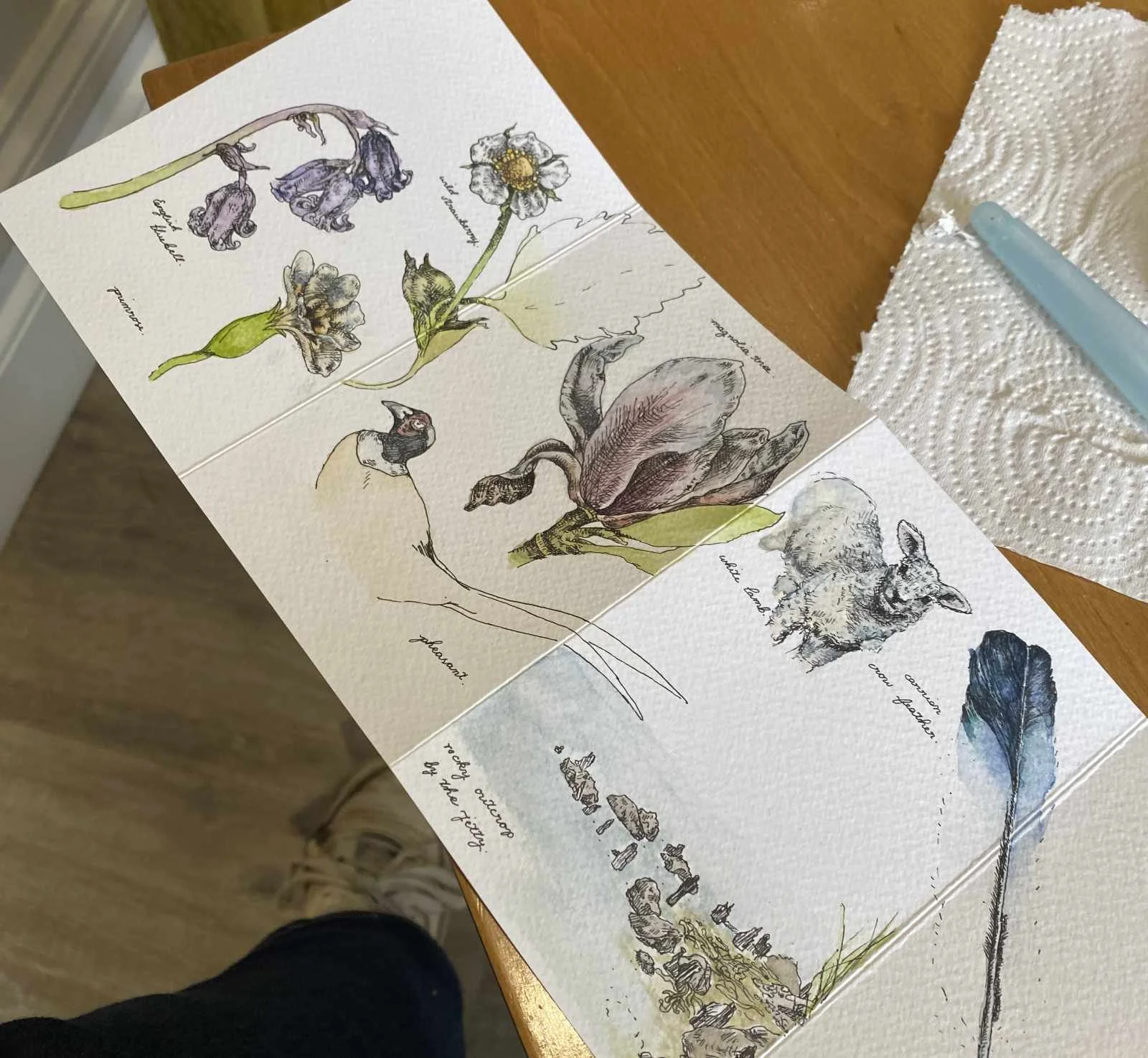
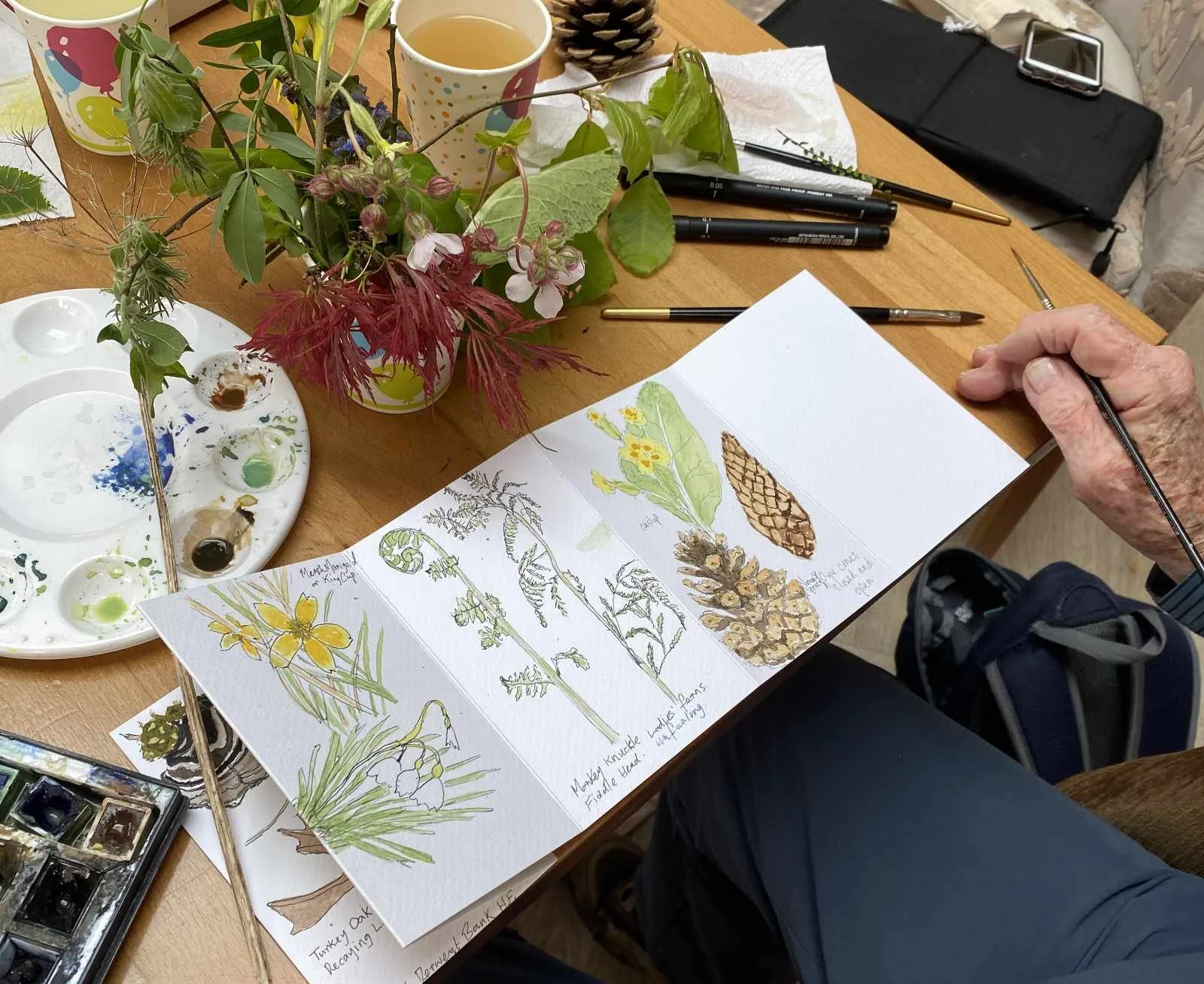
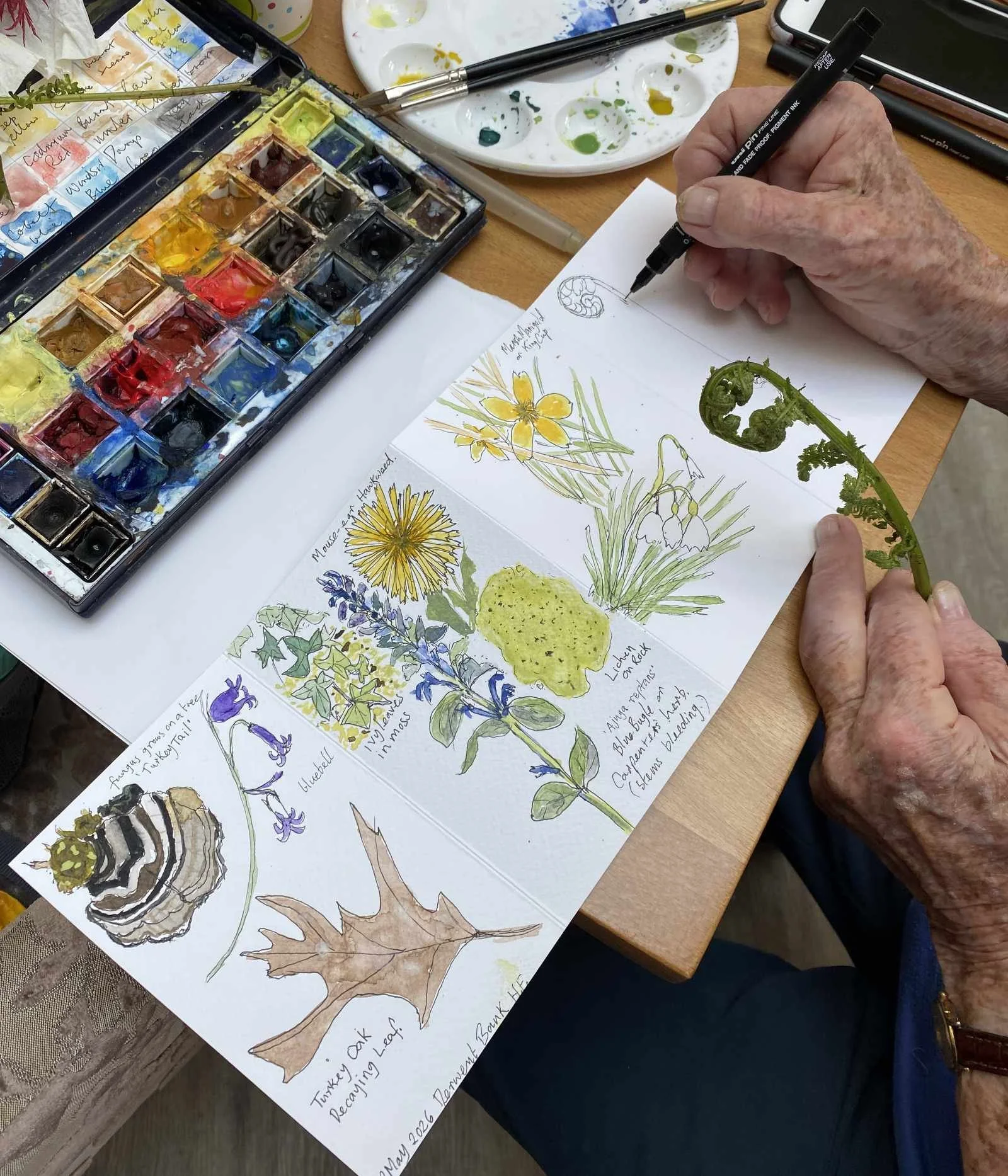
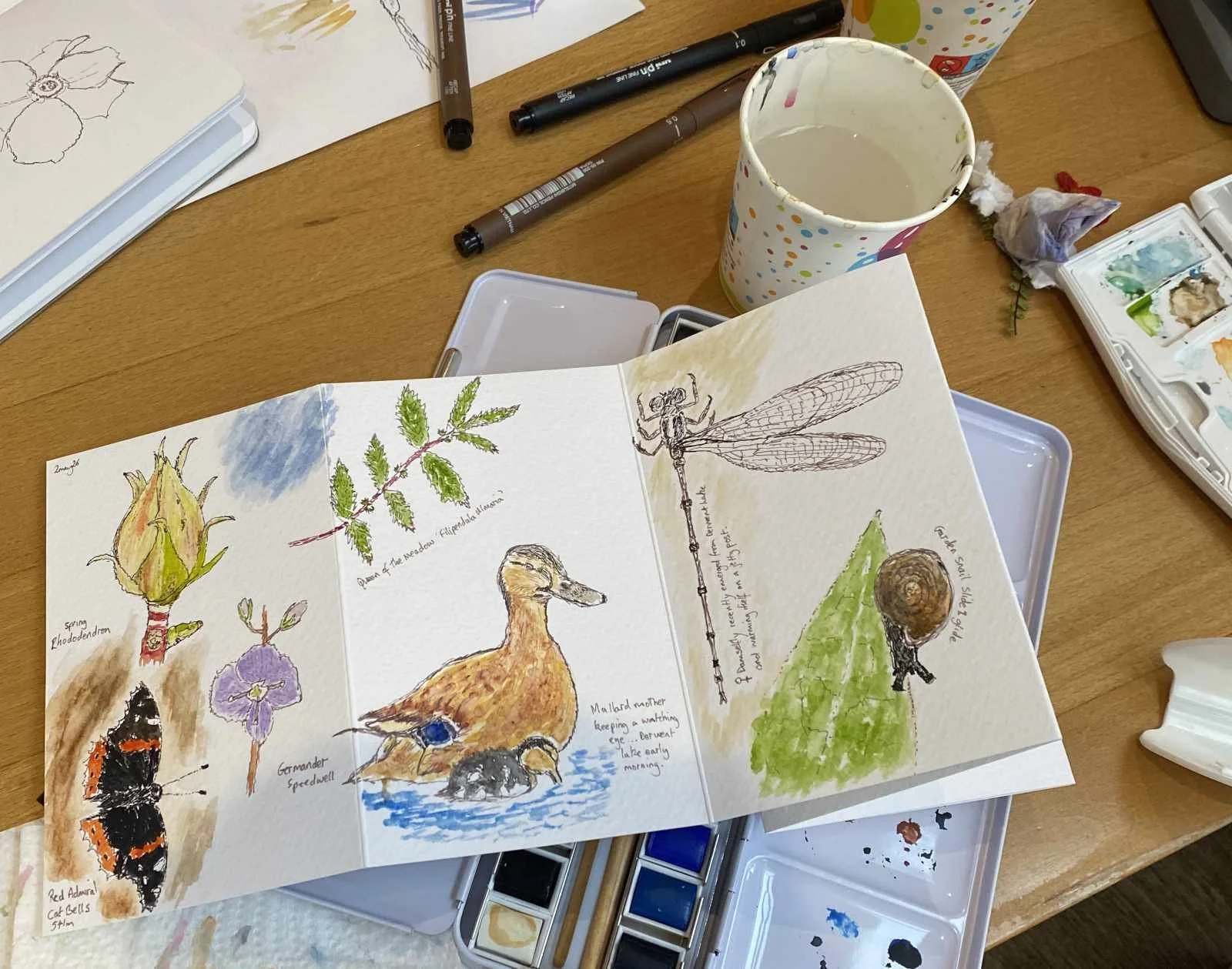
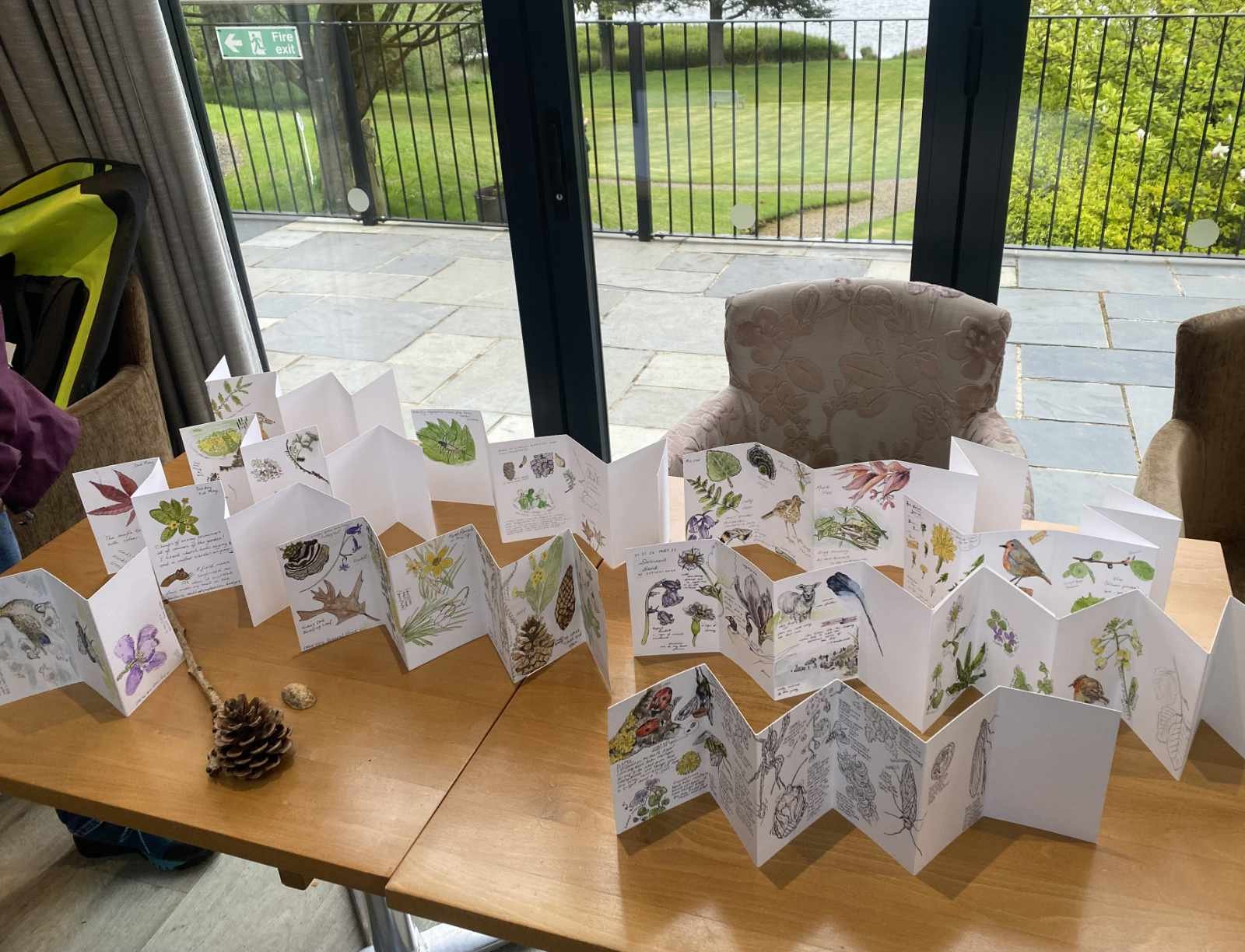
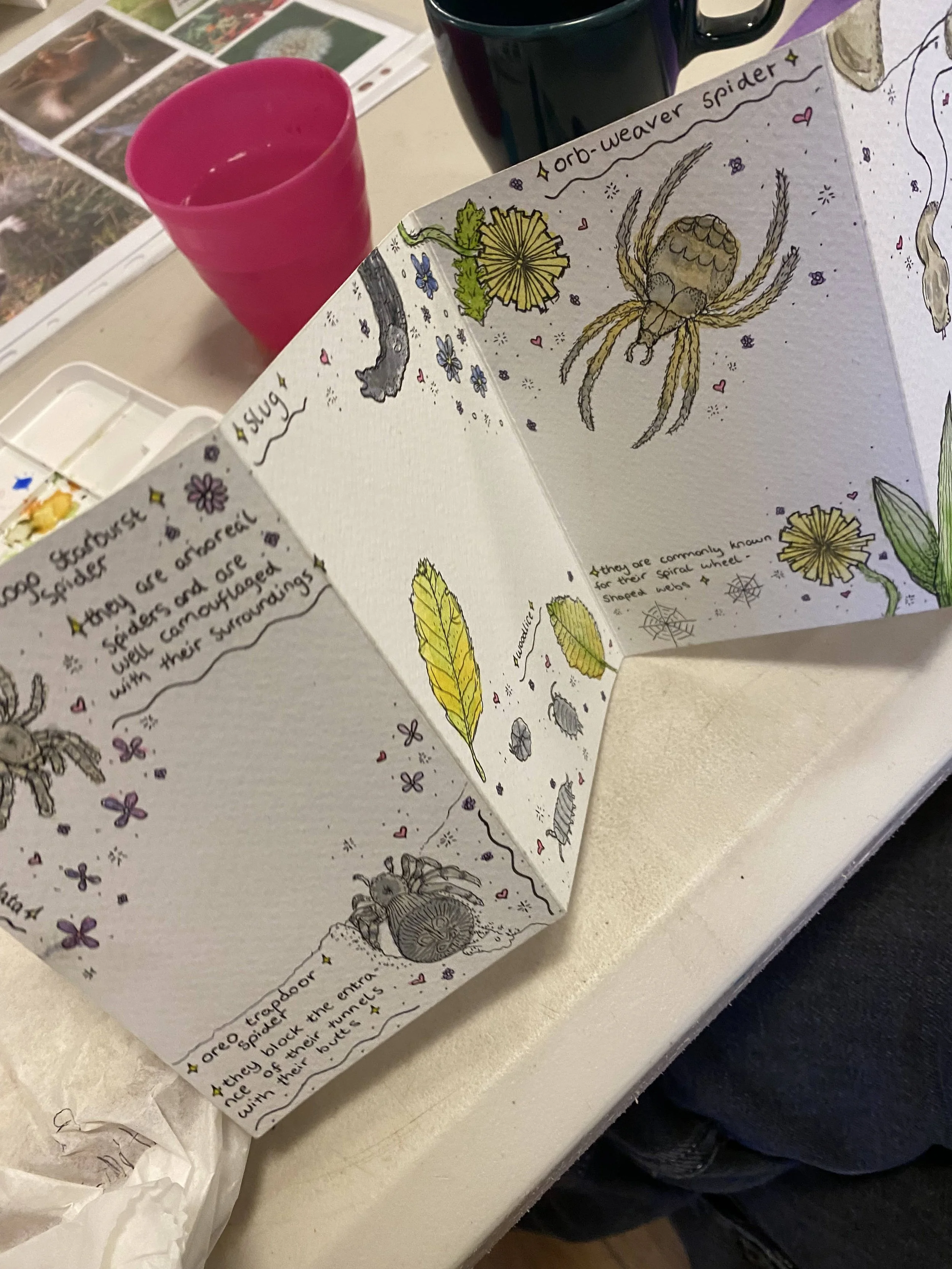
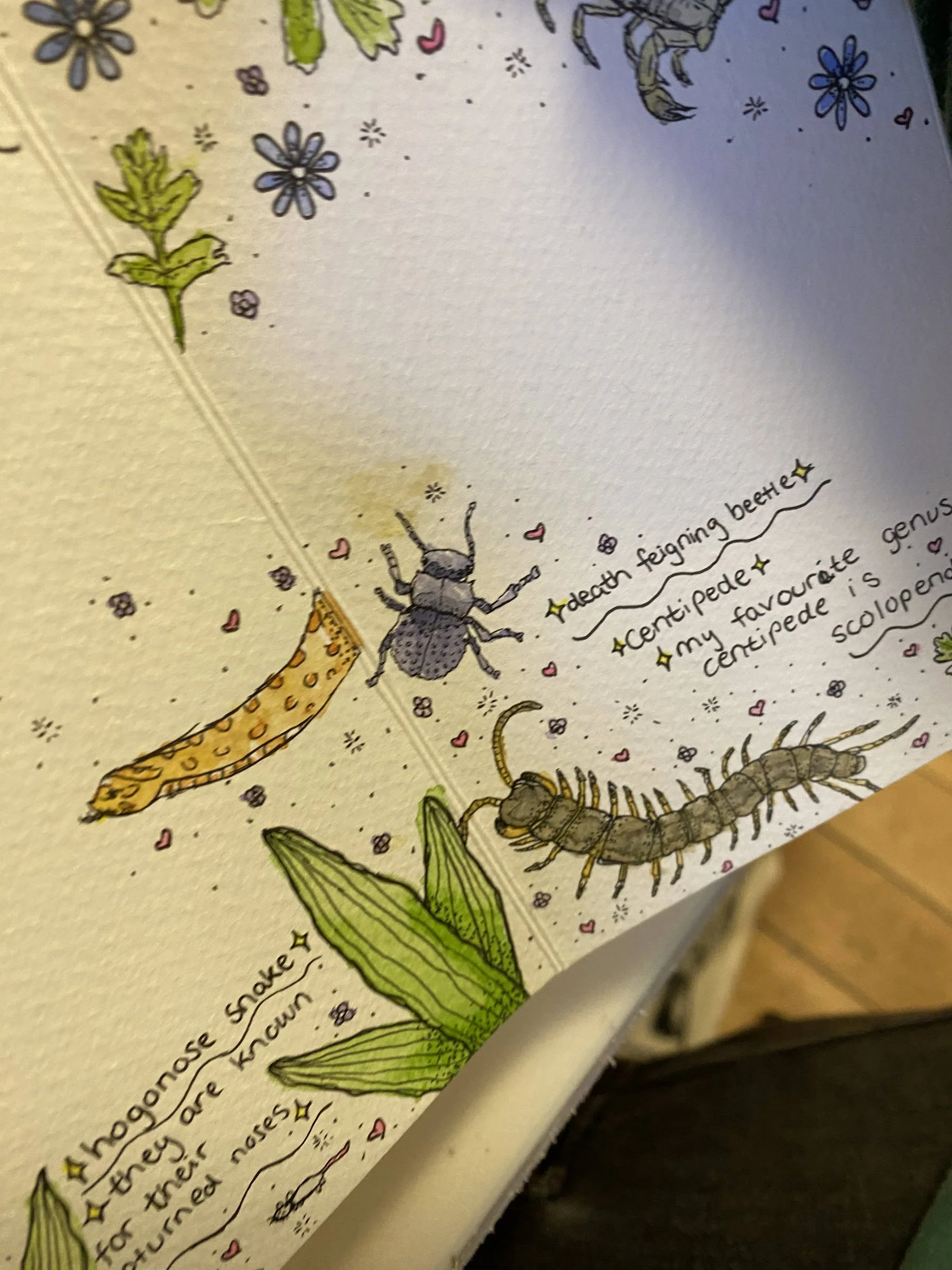
The drawing session continued adding the notes and finds into the concertina journals provided. This format allows for such freedom as they are not confined to a single page with a rectangle shape, but rather they have a more cinematic feel as they open and reveal - as if you are recreating the walk you had just been on.
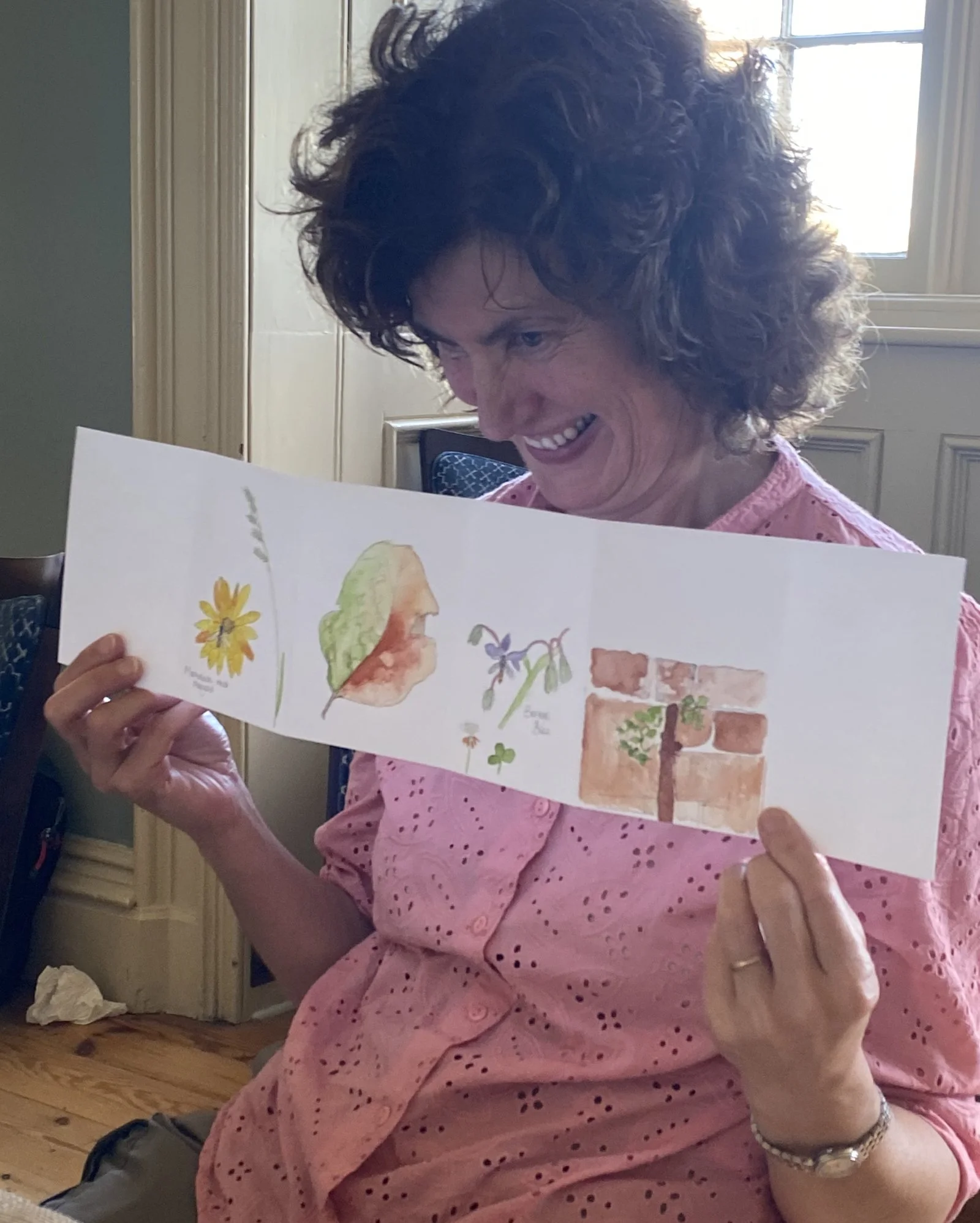
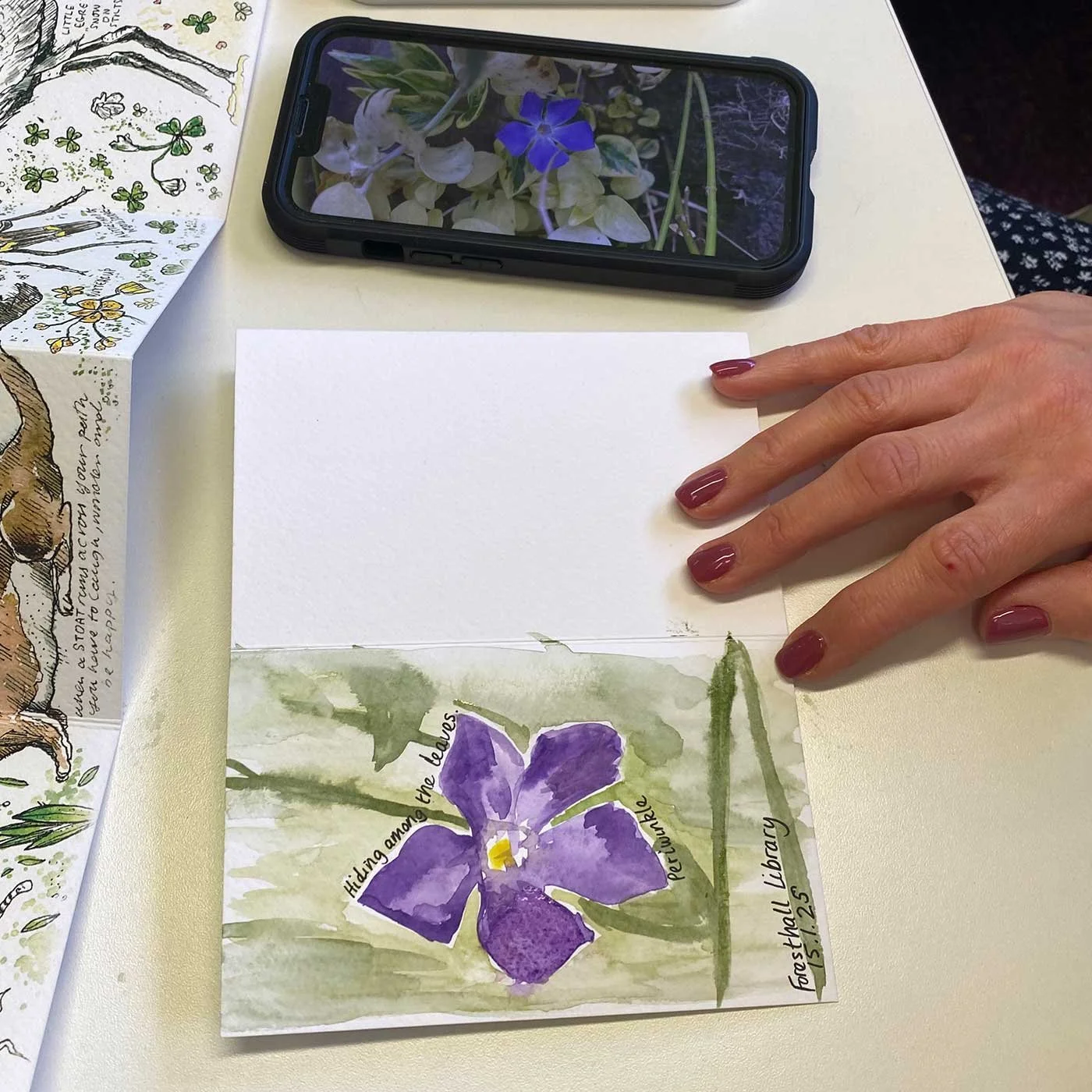
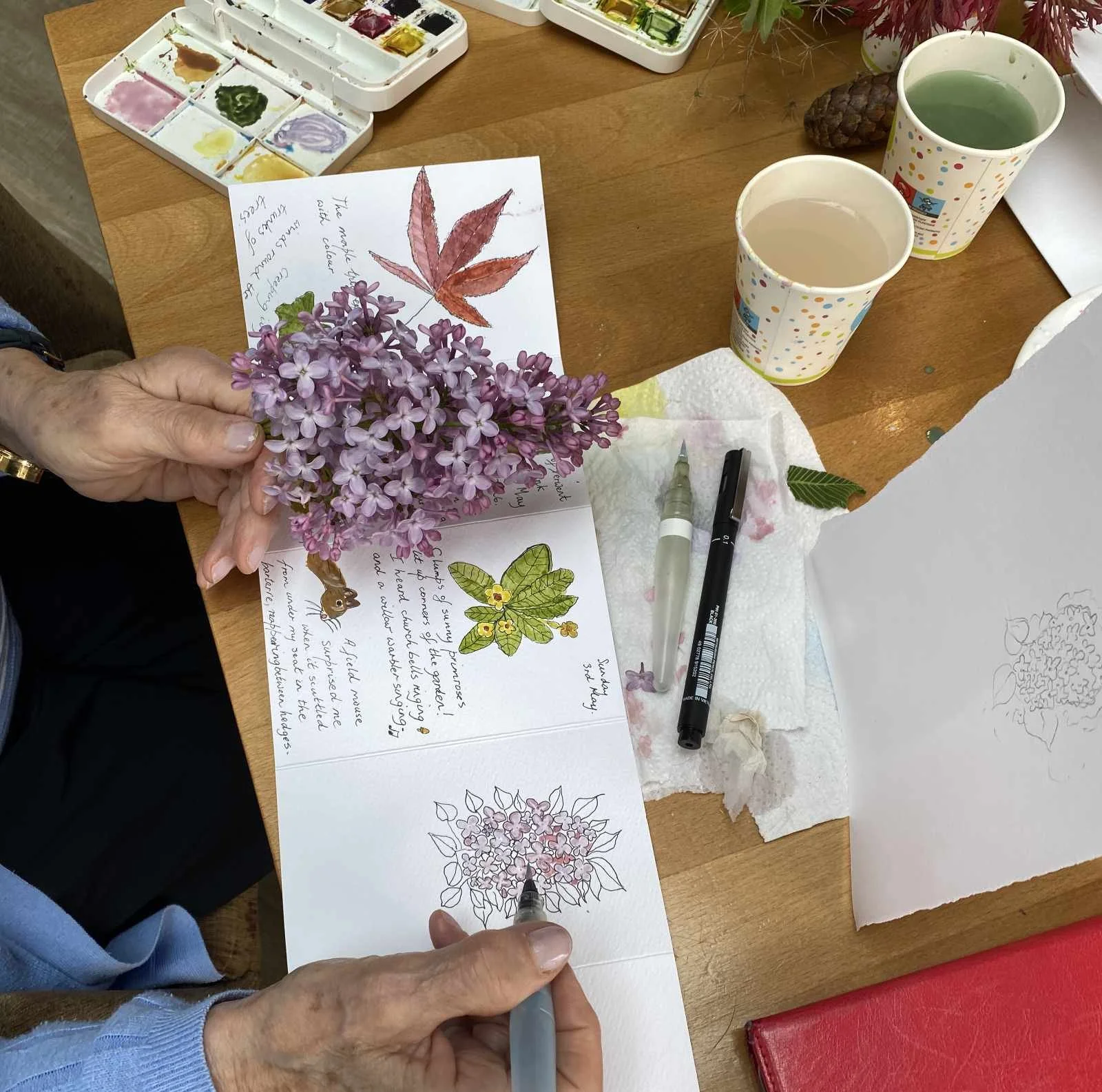
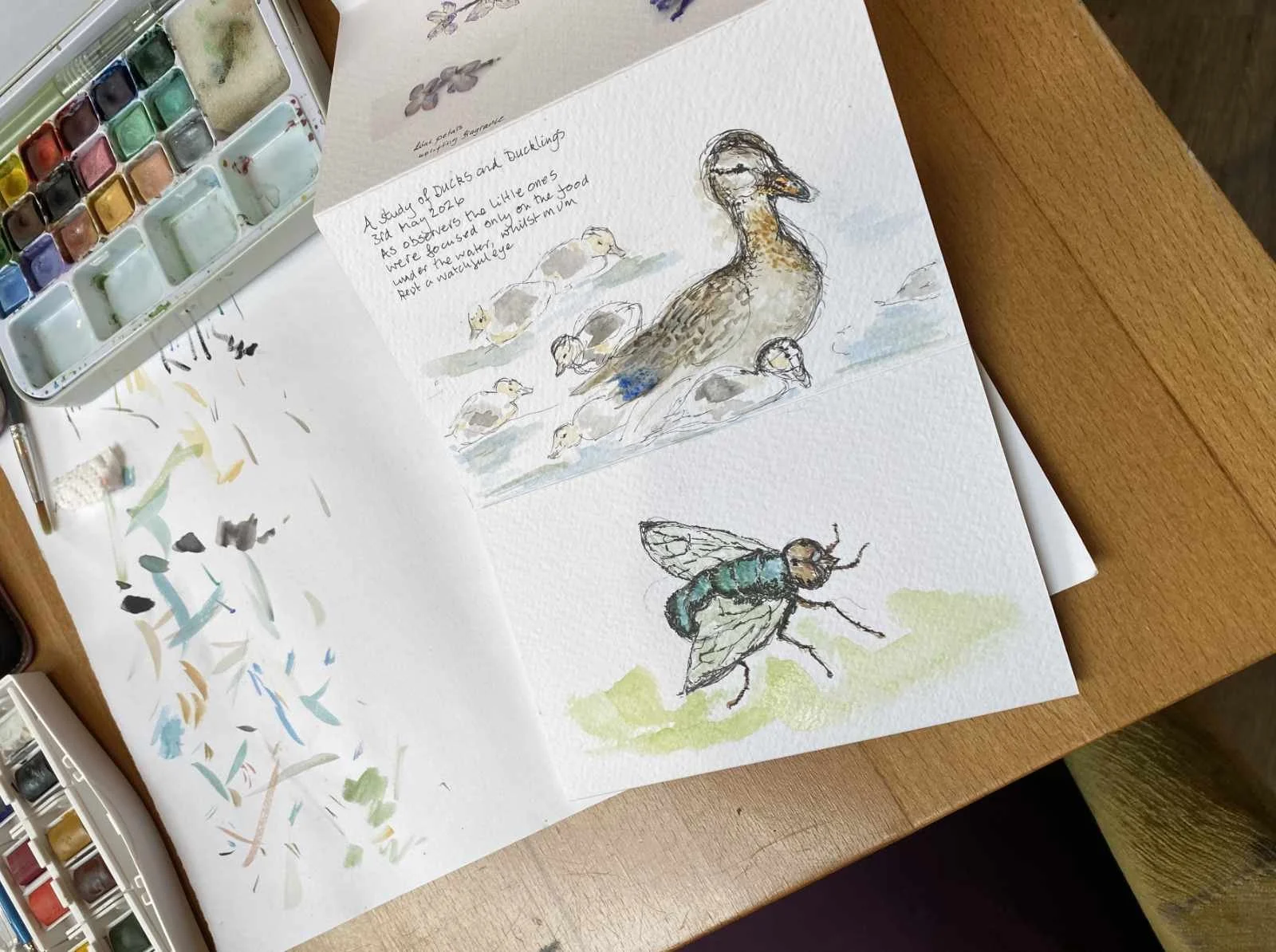
The afternoon session brought into play the really fun stuff - watercolour. Some of the group hadn’t painted before and so were feeling a little daunted by the prospect of painting. But this soon dissapated as I explain the simple process I use. The resulting work was so charming and beautifully done. One lady told me that she had been trying to paint for years and had been put off but found the accessibility of the course really helpful and encouraging and so thanked me personally.
Notes, observations and a pheasant feather
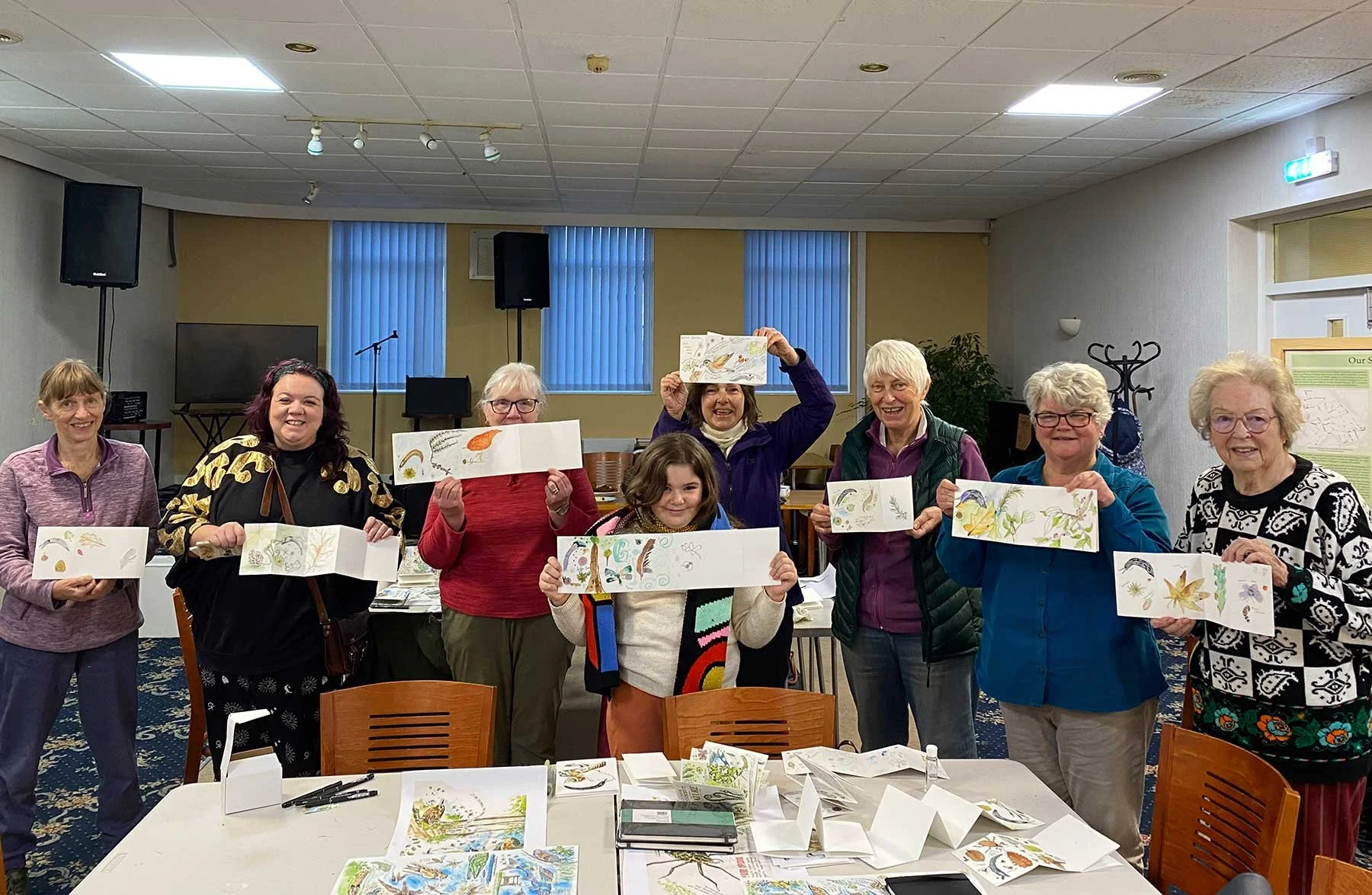
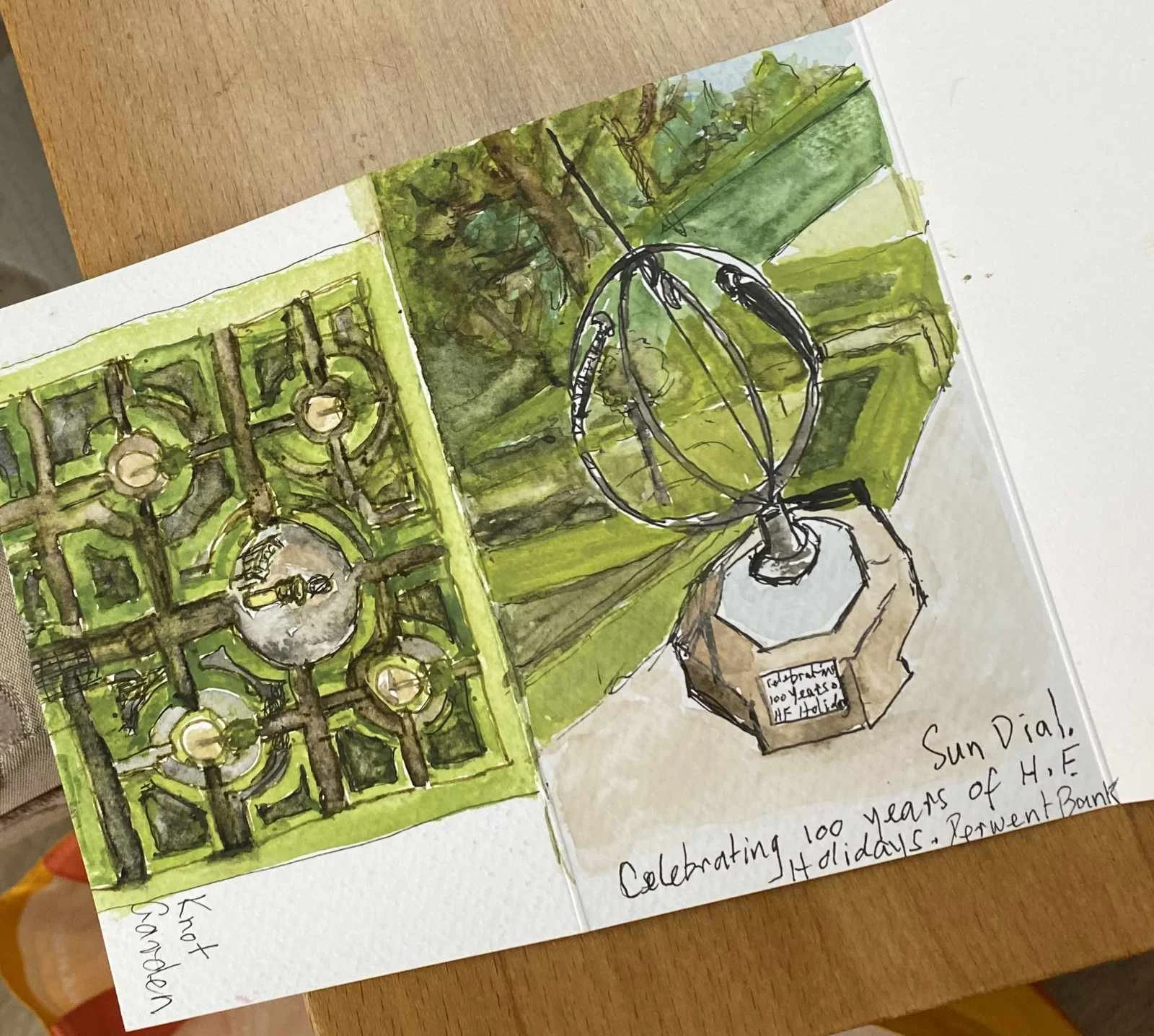
Day two was a continuation of the nature journalling and of course by now everyone is flying and expert observers! The journals are developing nicely with some lovely note taking, beautiful watercolours and creations. The simplicity of this nature journalling process allows for a great deal of freedom of expression and everybody has made their own journal distinctive and different and unique to them.
The next workshop at HF Holidays - at Alnmouth - can be found here. The next Derwent Bank workshop is in November and can be found here.

Alnmouth - mystery and discovery
Welcome to Alnmouth - I am soon to be teaching here for HF Holidays - see this link for the HF Holidays website. I will be showing artists how to create a themed nature journal and will offer some tips and tricks on how to draw what you see.
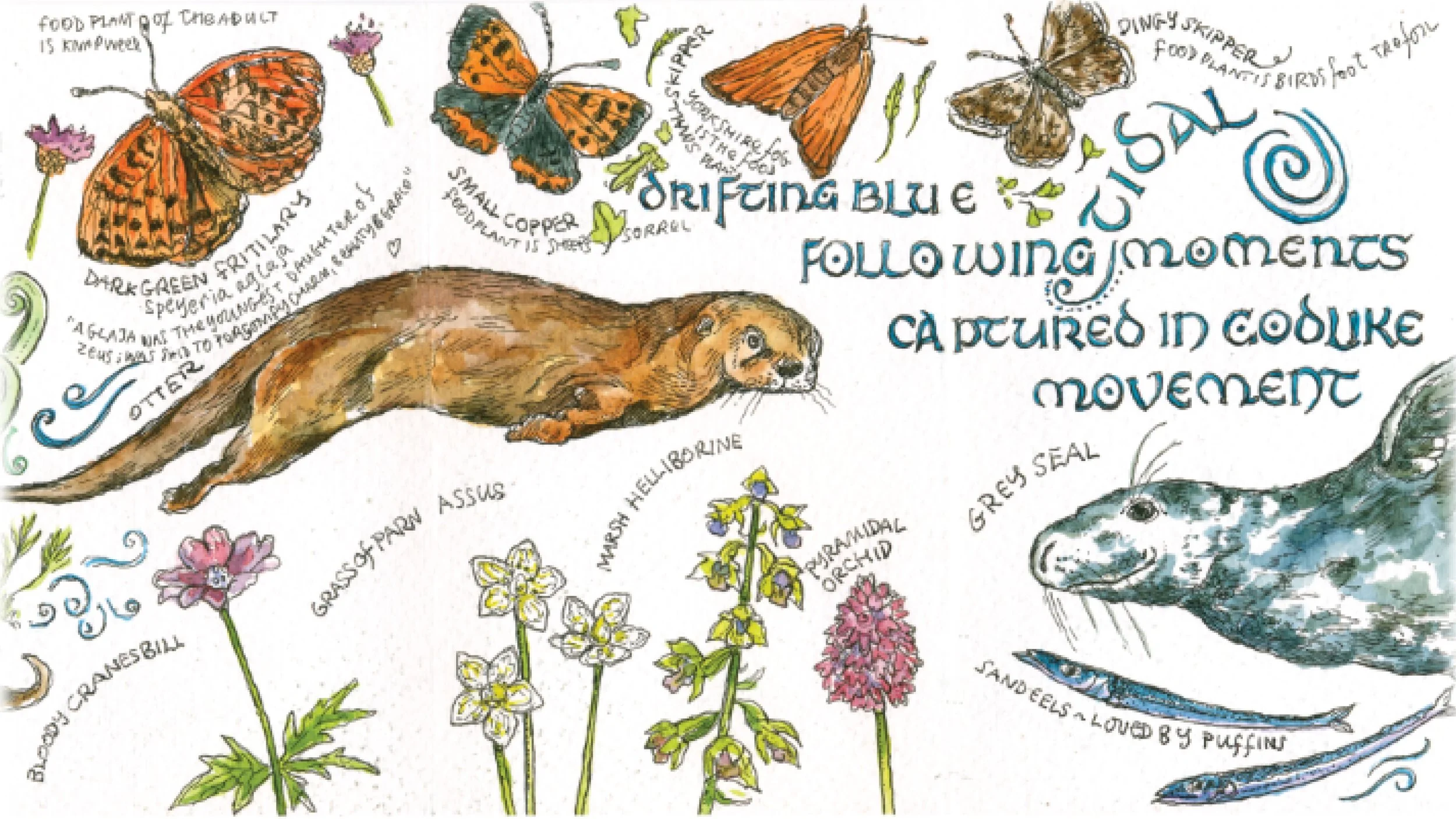
A full spread of the Alnmouth Chapbook outer.
The Northumberland coastline is one of mystery and discovery. And it starts before you get near the sea. That transition space between the land and the sea - the “Strand”. Which is why the Strand in London is so named as the river extended hear before the “Embankment” was built.
At Alnmouth you may look at the sea and sand and discover wonderful wildlife along the windswept and often stretches of beaches. But before you even get to the beach the dunes offer some secrets of their own. Bloody cranesbill shine out from the marram grass and equally burning red are the six spot burnet moths.
Detail of owls and curlew
This chapbook shows the subjects that can be included. I have taken a bit of artistic license (of course!) by adding some nature encounters that I have had over the years. The short-eared owl couples two experiences I have had - one along the Northumberland coast near Holy Island and the other near Allendale. The six owls sitting on the posts were just before the causeway to Holy Island and had just arrived as migrants - perhaps they were resting. The other was near Allendale where the owl seemed to see me from far off and then flew closer and closer and then veered off at the last moment - it was like a scene from a “Bird of Prey Show”.
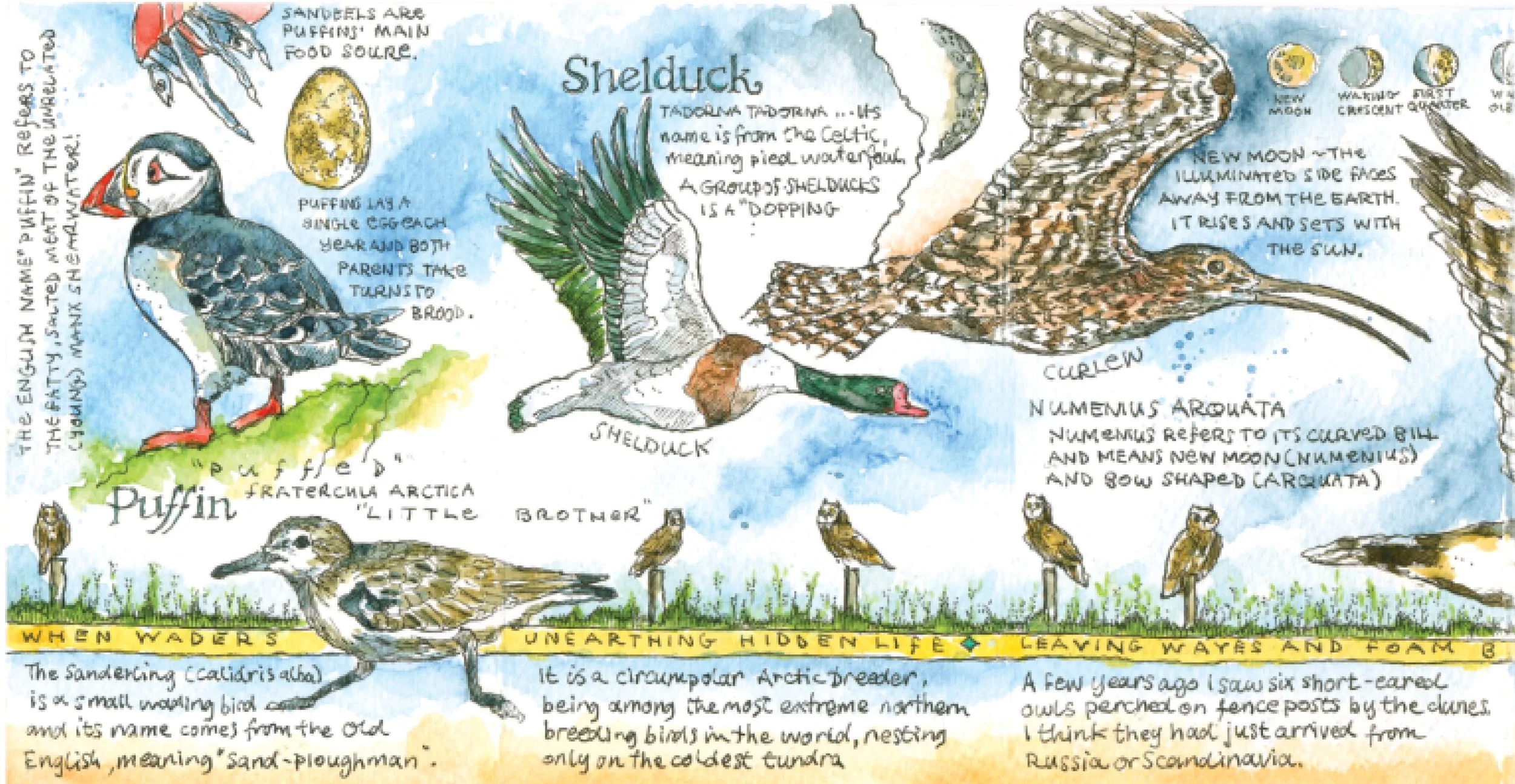
Running sanderling
Also look for the little sanderlings scuttling along the strand line and the lumbering shelduck flying low over the sands. You may not see puffins but to be honest I couldn't leave this little gem out of the picture. And of course Cuthbert’s relationship with otters has to be included.
A full spread of the Alnmouth Chapbook inside.
The notion of adding historical context to a nature journal is valid using the Chapbook Process which I have developed over the years. This gives you permission to have fun and develop a narrative around the place you visit. For me this allows me to have so much fun and allows for some creative expression along with the noticing of nature.
A detail of Cuthbert and his otters.

Celtic Rainforest
Small, precious, almost invisible, vital and fragile and more threatened than tropical rainforests. This is the description of the Celtic Rainforests of Britain. But at least there is still some left and this nature journal chapbook explains something of this fully formed world.
Celtic Rainforest Cover
This is a nature journal in the Chapbook style that was inspired by my upcoming workshop at Derwentbank, in Keswick for HF Holidays - see the details here.
I remember a walk around the far side of Derwentwater many years ago where I saw Pied Flycatchers for the first time. So it was this memory that came to the fore when I started drawing a nature journal based on the temperate rainforests of the UK.
Polypody - lover of wet places.
But what is a temperate rainforest? These woodlands are also known as Atlantic rainforest, Upland Oakwoods, Atlantic Oakwoods or Western Oakwoods. Today, the Celtic rainforests exist as small fragments of the temperate rainforest that once covered much of Ireland and the west coast of Great Britain. The majority of these fragments occur on steep-sided slopes above rivers and lakes which have avoided clearance and intensive grazing pressure. They can also be seen as really wet places where plants grow on other plants!
Maidenhair Spleenwort.
The types of plants would include lichens of all kinds and with some beautiful and often hard to pronounce names! But I am fond of Elegant Sunburst and Yellow Map. Coupled with these delicate and fragile plants are the small things of the forest floor. Fungi, beetles, slugs and snails all keeping the forest floor healthy.
Fragile and precious forest floor wildlife.
But how was this captured and how created. It is not always easy to draw stuff you can’t see - or is too small - or too far away! Well I am the ultimate cheat and I like to make things easy for myself. For this journal I had an idea as to what I wanted to achieve and that was to demonstrate to people coming on the workshop weekend what was possible and what you might hope to see. So in a way this was a demonstration piece. But I followed the same principles that I always follow and that is to make things easy for myself.
NOEL - Notice - Observe - Empathise - Learn. And remember what Noel means - “to be born”. So I look at things as if for the first time and enjoy the wonder of things as I draw them.
The inside of the journal.
Of course not everything is small and there are some spectacular things to see in this area too. Big and small. And understanding the lives of the things we draw is important and enriching.
Finished nature journal
I have used my mini nature journals which fold to a small pocket size sketch book but concertina out into a lovely spread when completed. These are the same templates I use for my workshops.
Inside spread of the concertina nature journal
for bookings and more information see HF Holidays website here.

Rose Castle
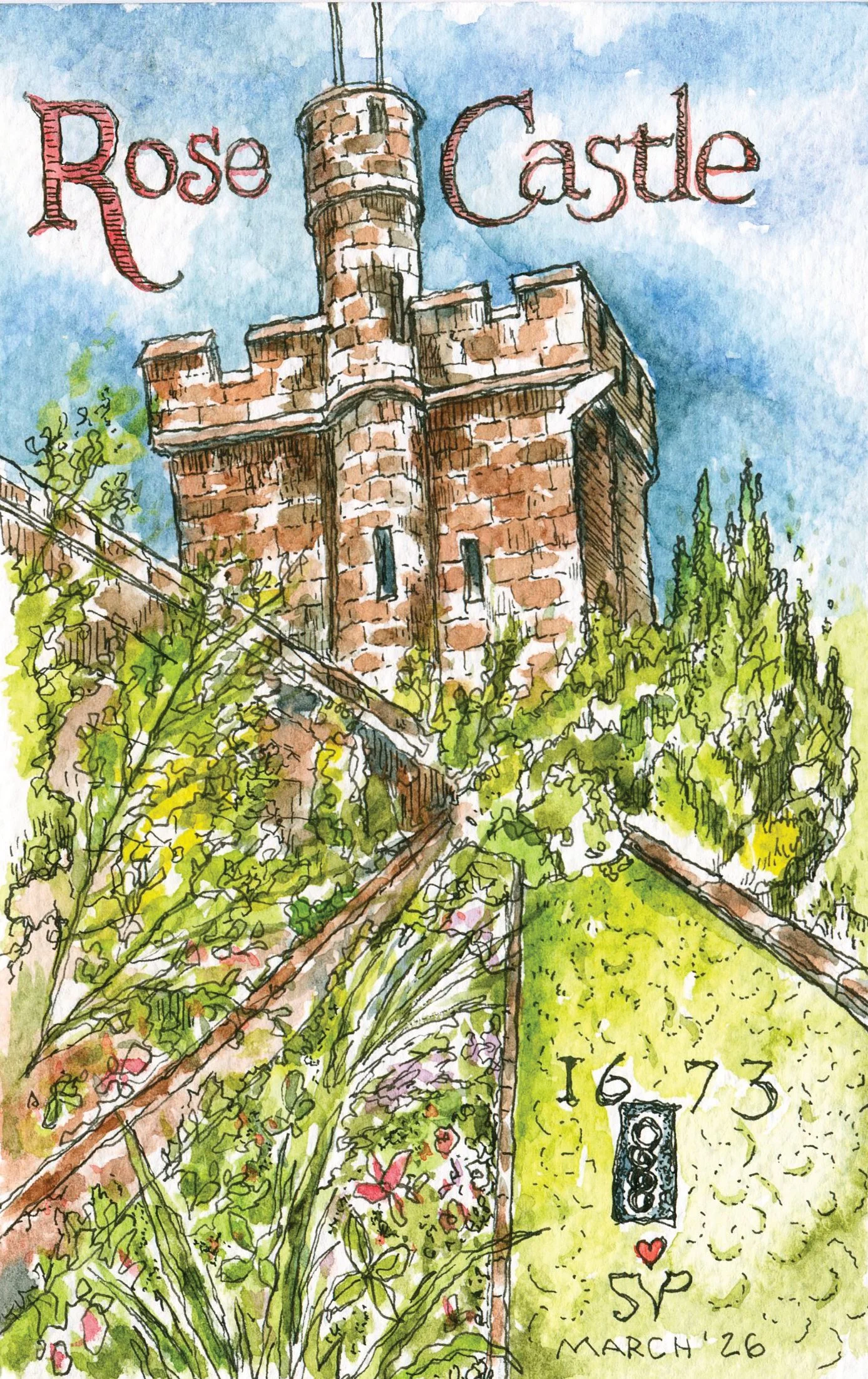
Rose Castle Nature Journal weekend. An exploration of built and natural heritage of this historic location surrounded by beautiful countryside.
A completed Chapbook journal showing a mix of nature and historic subjects.
I am heading over to rose Castle near Carlisle in June - see a little bit about the retreat here.
This is going to be a fascinating and really fun weeknd. The Castle itself is surrounded by wonderful countryside and gardens. And of course the historic location in itself is inspiring. In advance of this trip I have created an example of what you might hope to achieve with me on this weekend.
The inner side of the chapbook journal showing something of what you might expect to see.
My chapbook is based on a brief visit so some of what I have represented on the chapbook I did see but there is a bit of artistic licence involved too! But I reckon there will be a whole lot more to see than I have drawn.
Process
So how did I create this little journal? Well it is a simple process of starting with one thing - the easiest thing - and that was the seed head of last years rose which I was fascinated with. Such lovely colours and shape. There was also still come flowers edna gorgeous crab apple tree full of tiny apples.
Some of the nature to be encountered at Rose Castle.
Once I started drawing the story seemed to take shape itself. I can’t stress enough the importance of starting with the easiest thing - this gives you confidence to continue and sets you up for success. After that the drawing sort of does itself.
Some nature that has crossed my path.
On my next visit I will be doing some more exploring and I really want to get under the skin of the building itself. There are a lot of interesting features to draw and I like to weave these in and out of the natural history subjects.
Rose Castle with a flourish of native daffodils.
I wished I had seen a weasel - I wonder if by me drawing one will magically bring one to me when I go in June? But at all times of year there is something to see - look at the wild carrot - who know that there was tiny red flower right in the middle of the umbrella.
Completing a Chapbook journal is very satisfying as it allows you to create something that is worth keeping and will become a record of your visit to Rose Castle. This format is both a nature journal and an opportunity to include some personal thoughts and feelings about your visit and your encounters with nature too.
A full spread of the Rose Castle Chapbook journal
But how is to done?
Well it is really simple - I use a fountain pen with waterproof, fountain pen ink. You can use fineliners too and in fact I will be providing you with fineliners along with a blank journal. I will help you through the process of drawing your ideas. I aim to guide you in finding your own style of drawing - everyone has their own style which is as unique as their own signature.
The reverse spread of the Rose Castle Chapbook journal
Workshop Season
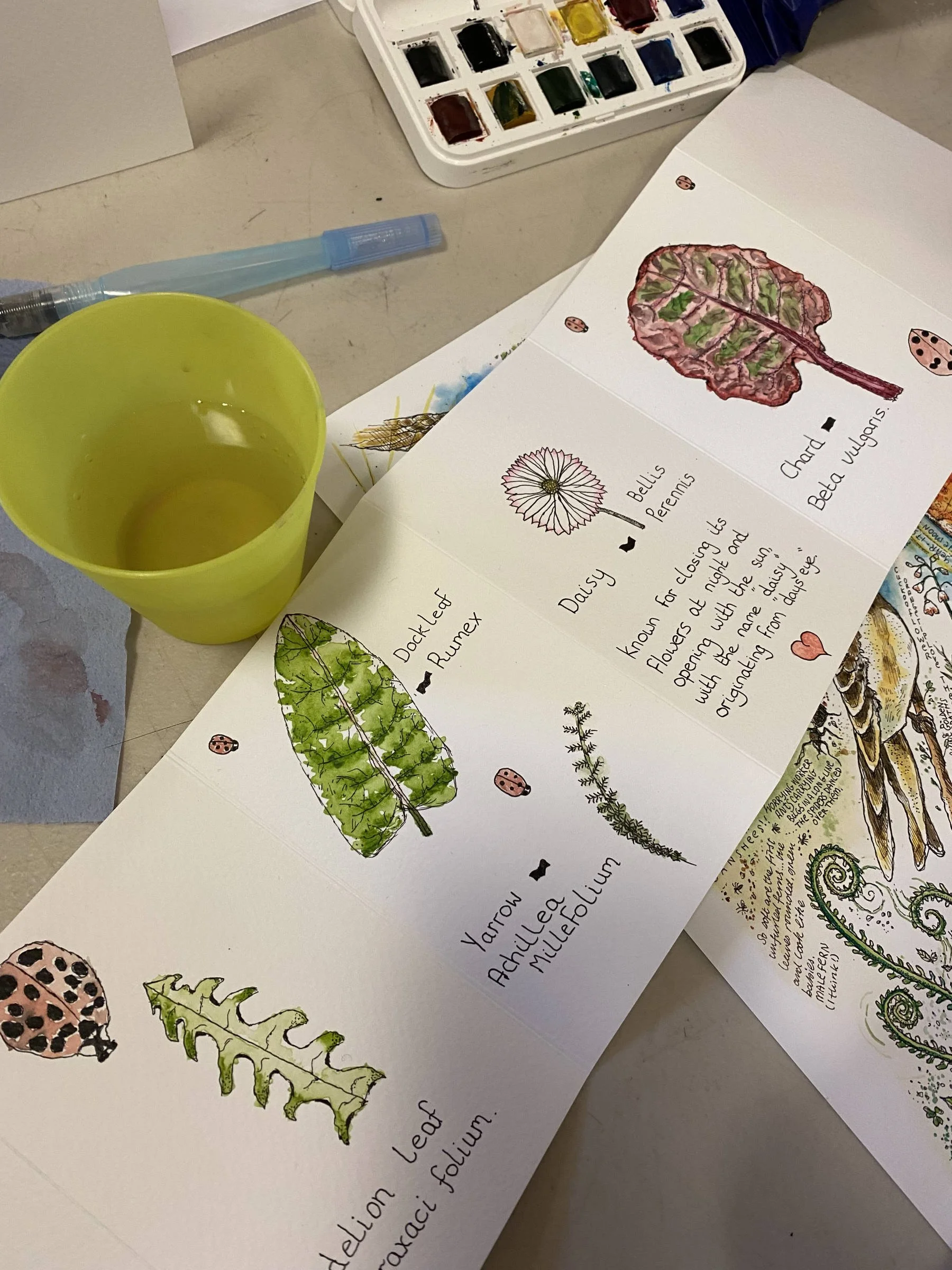
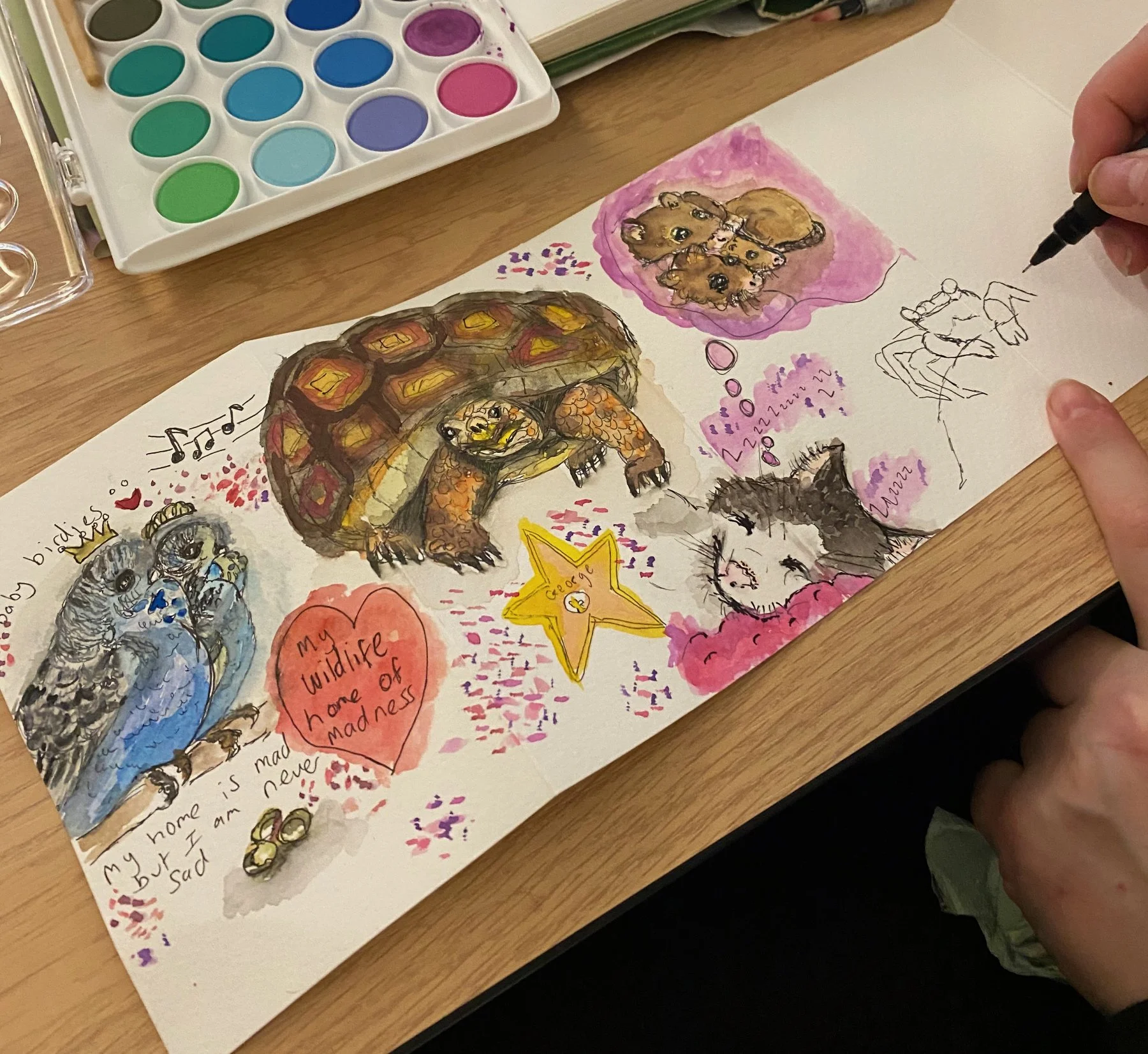
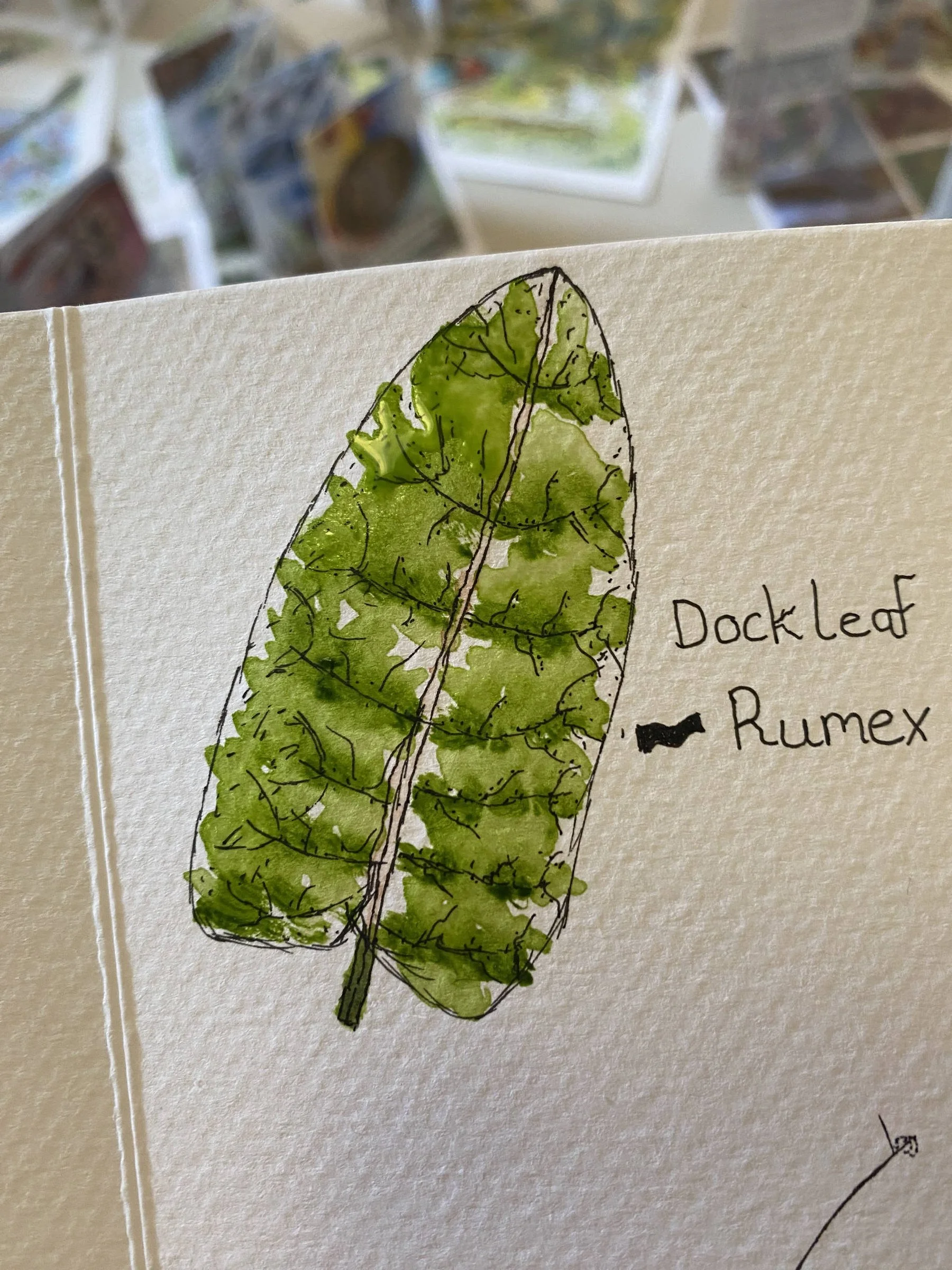
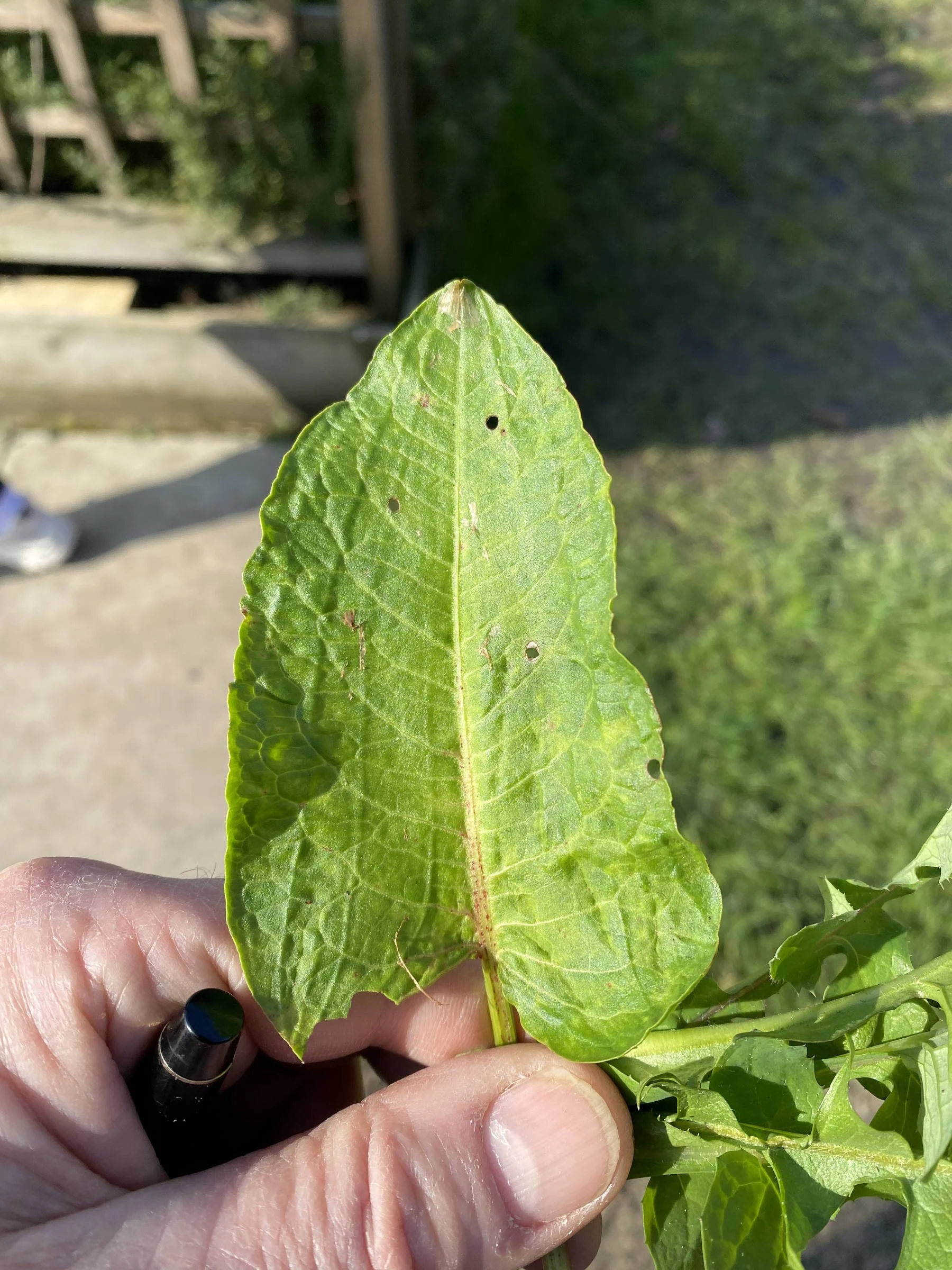
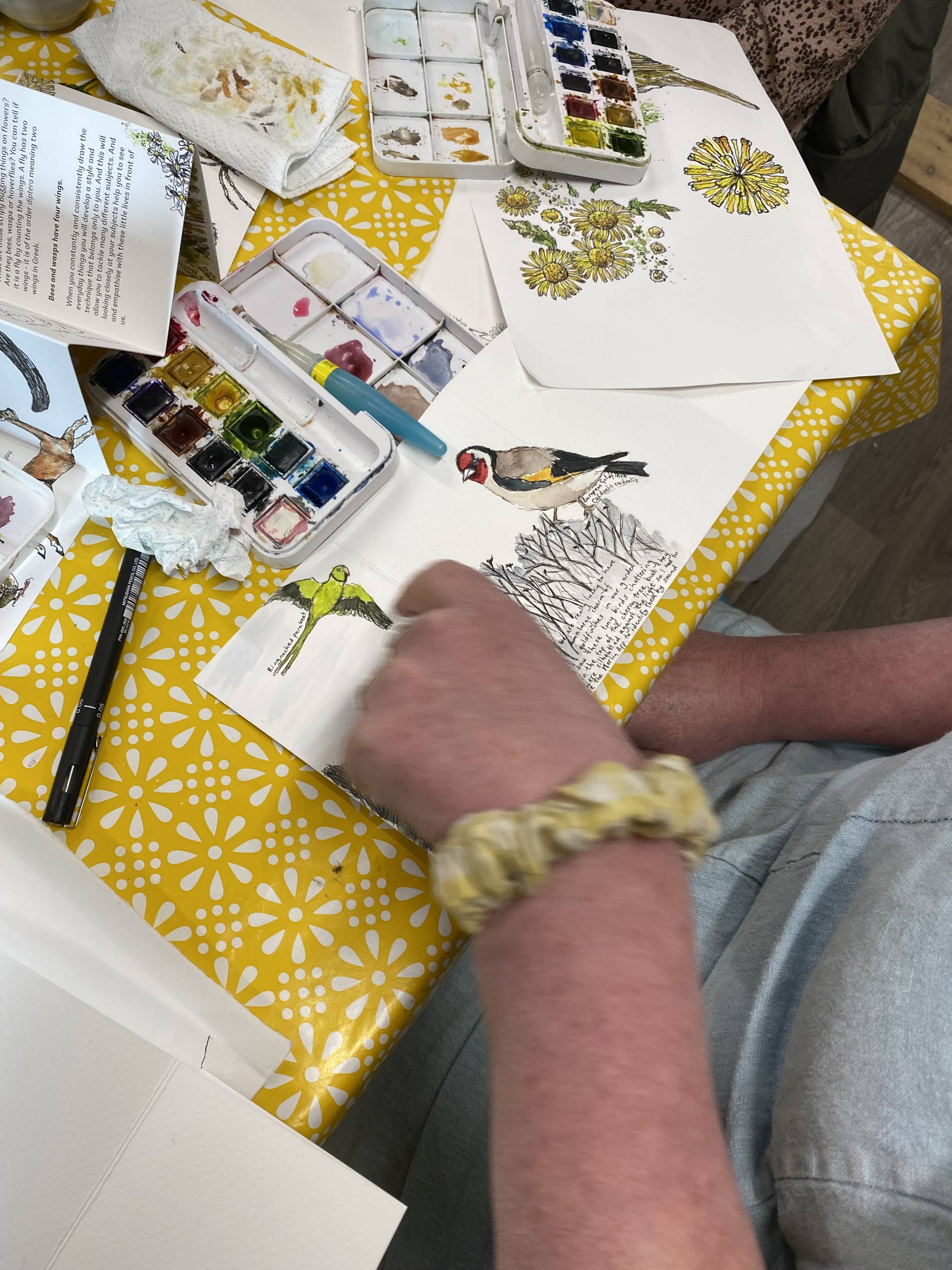
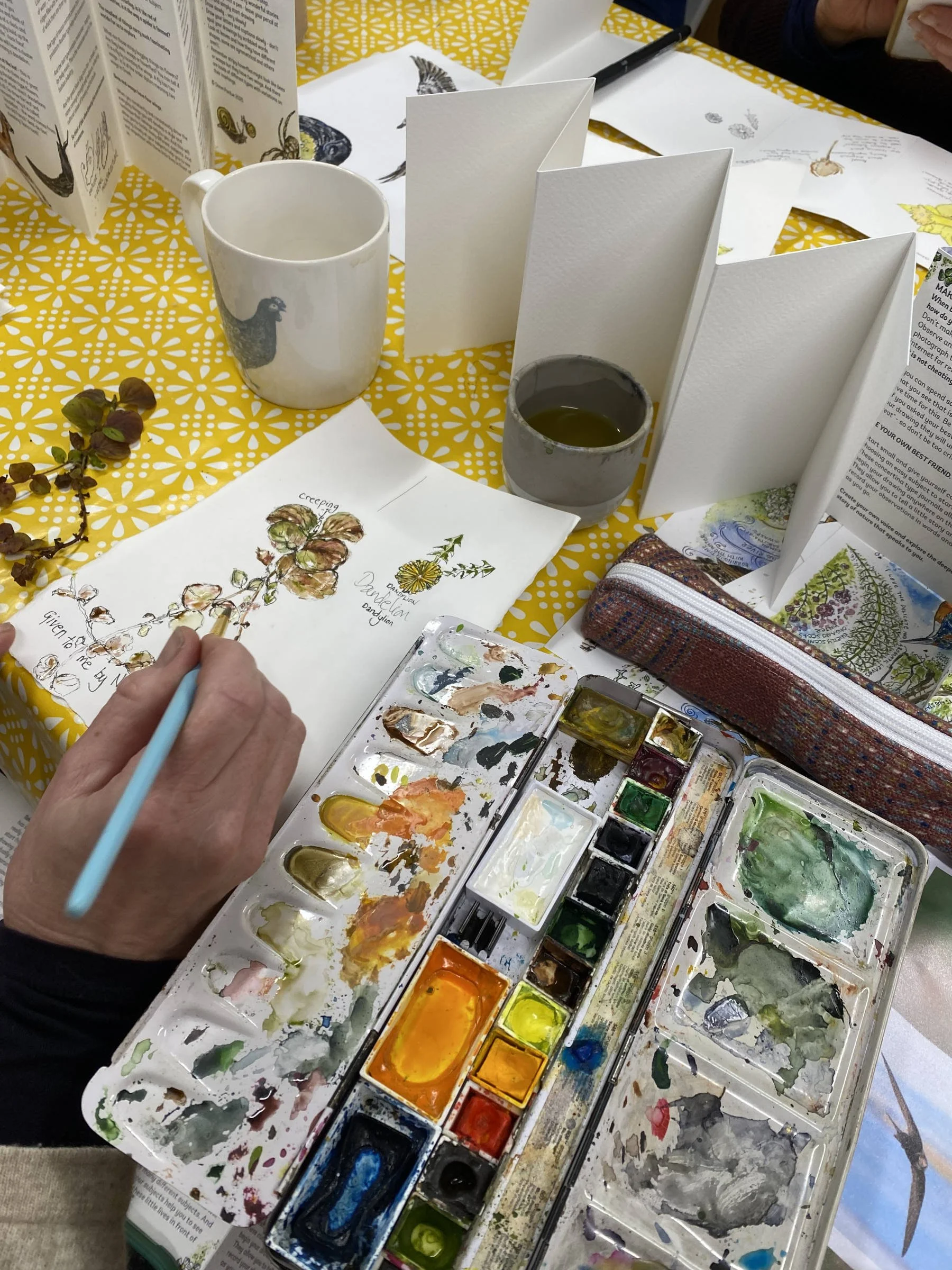
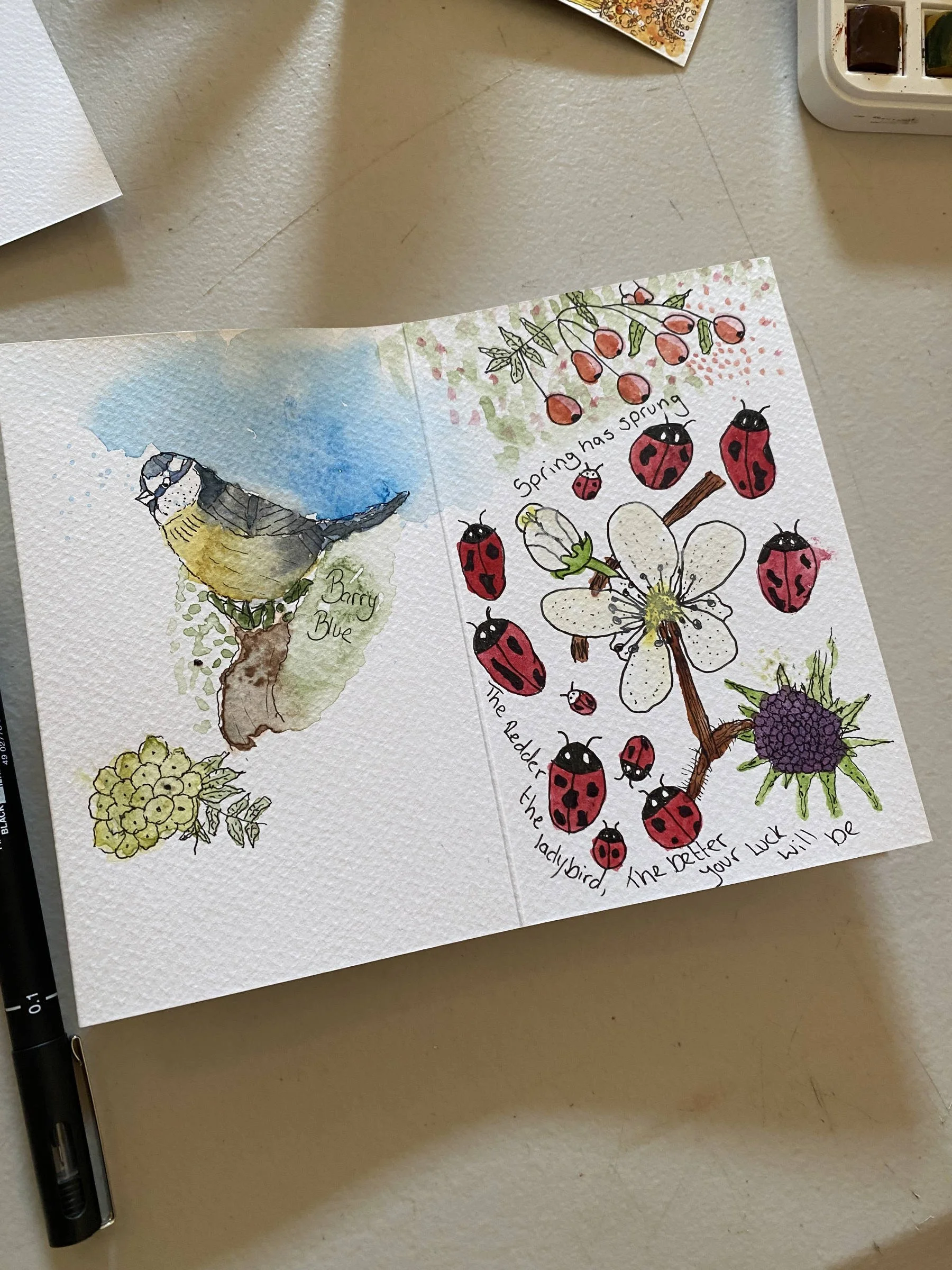
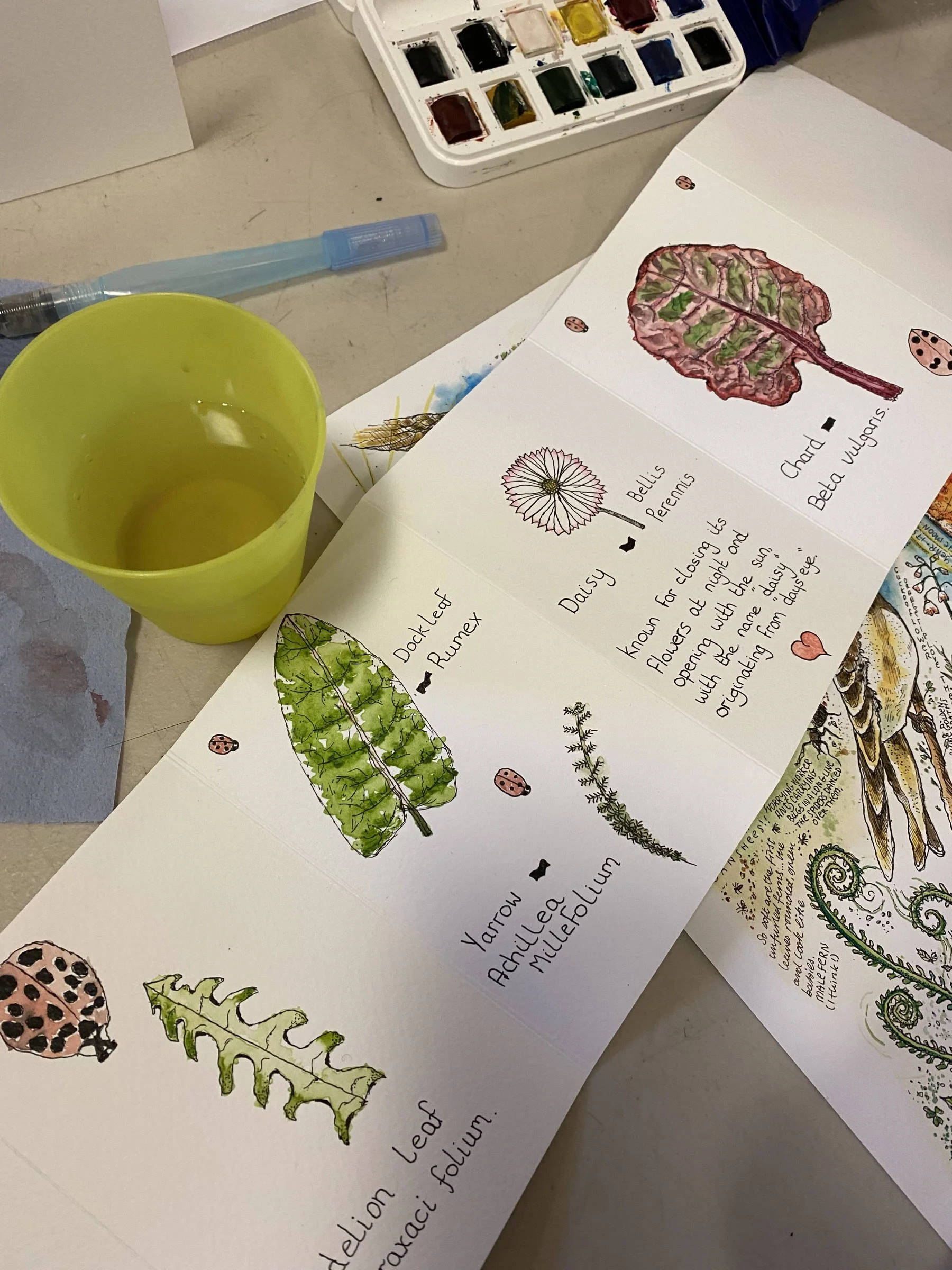
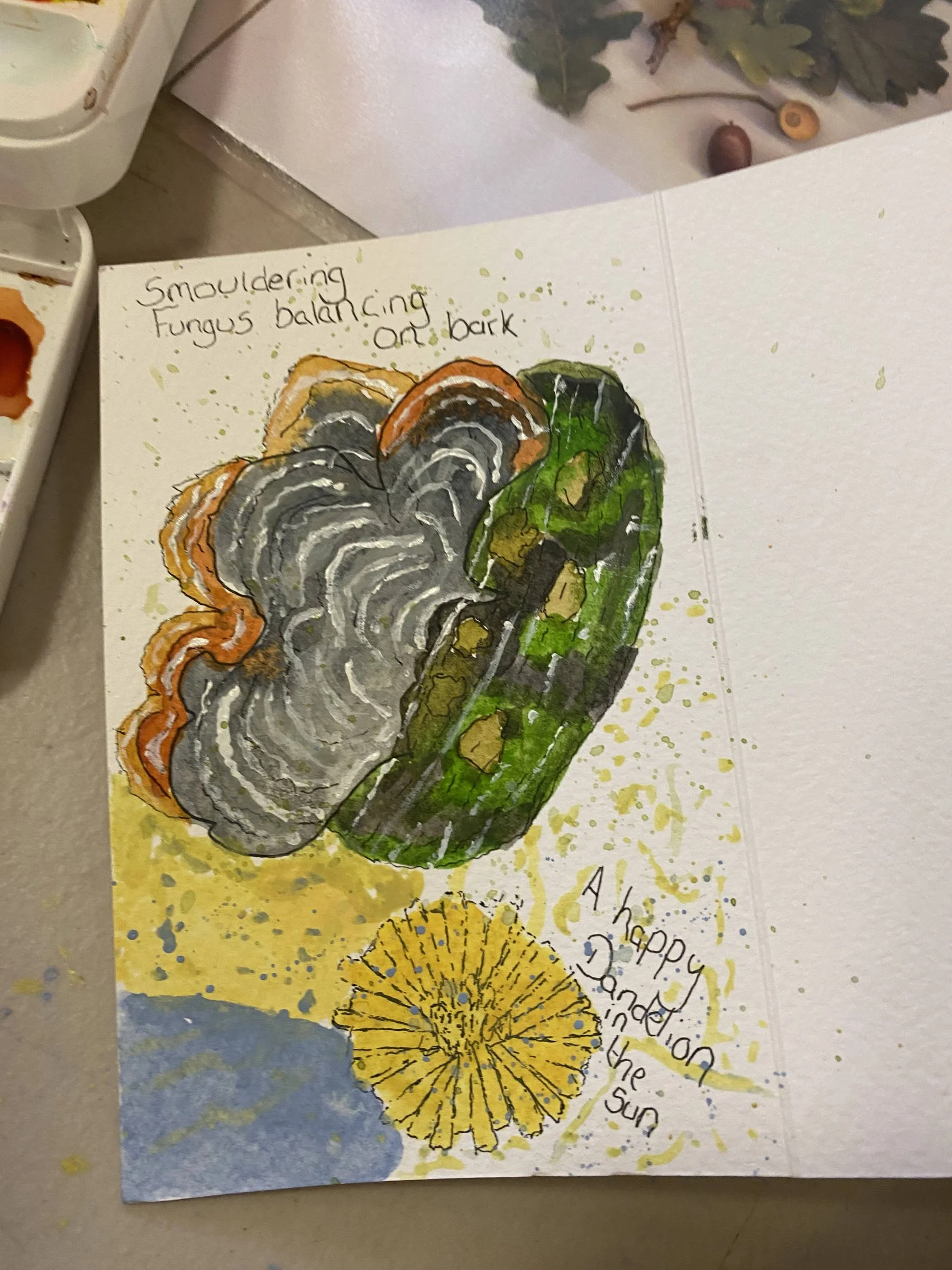
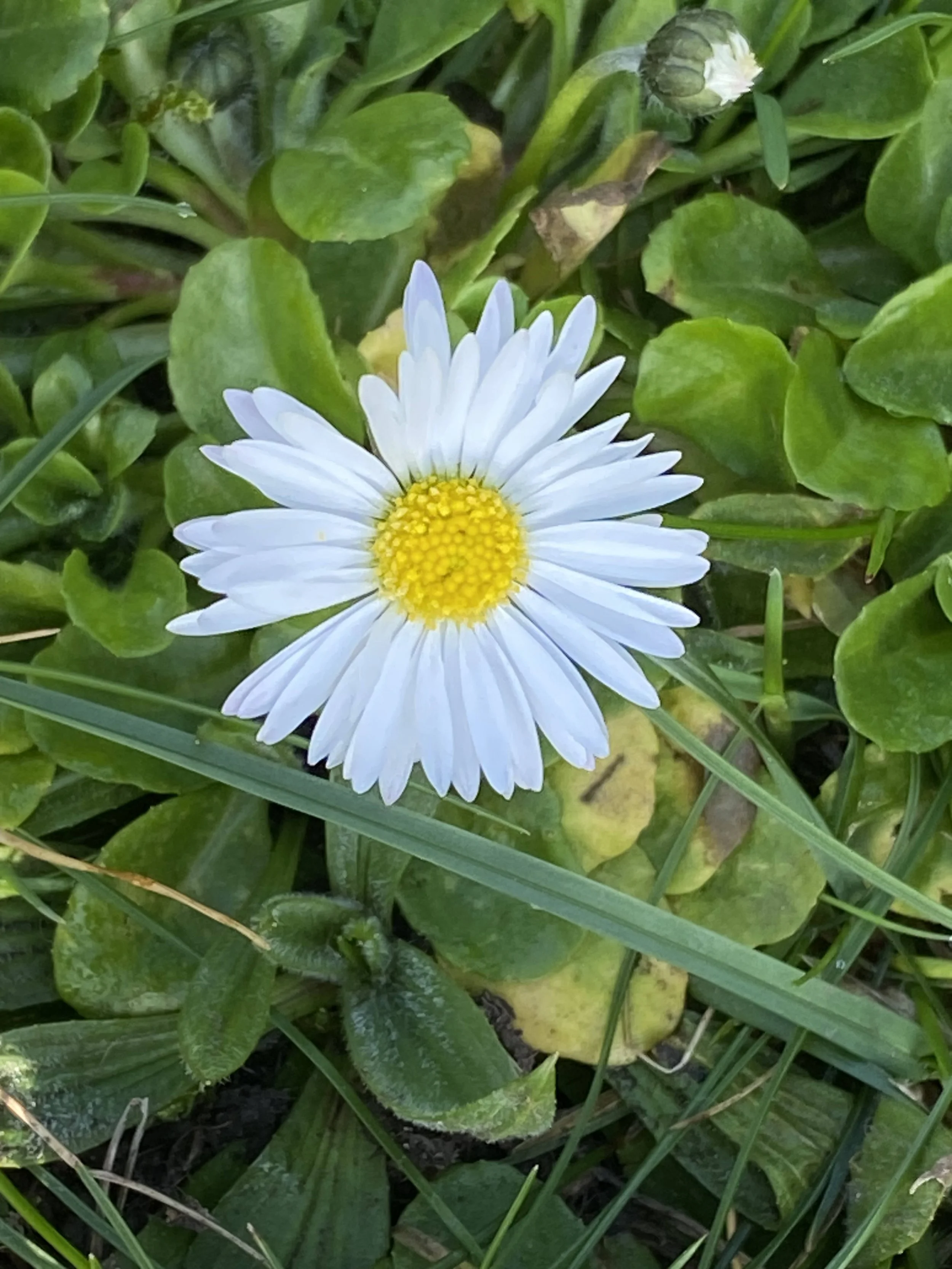
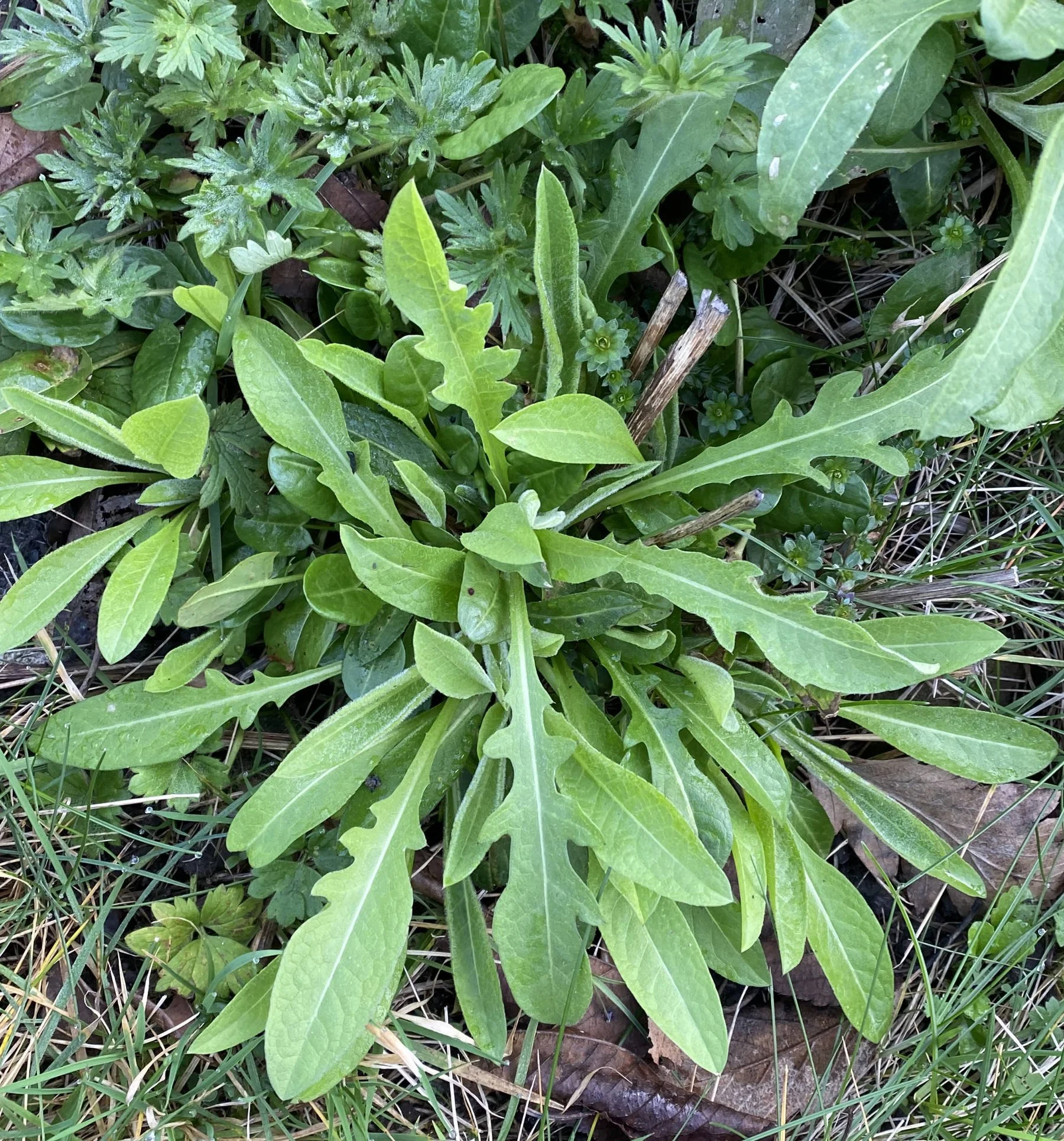
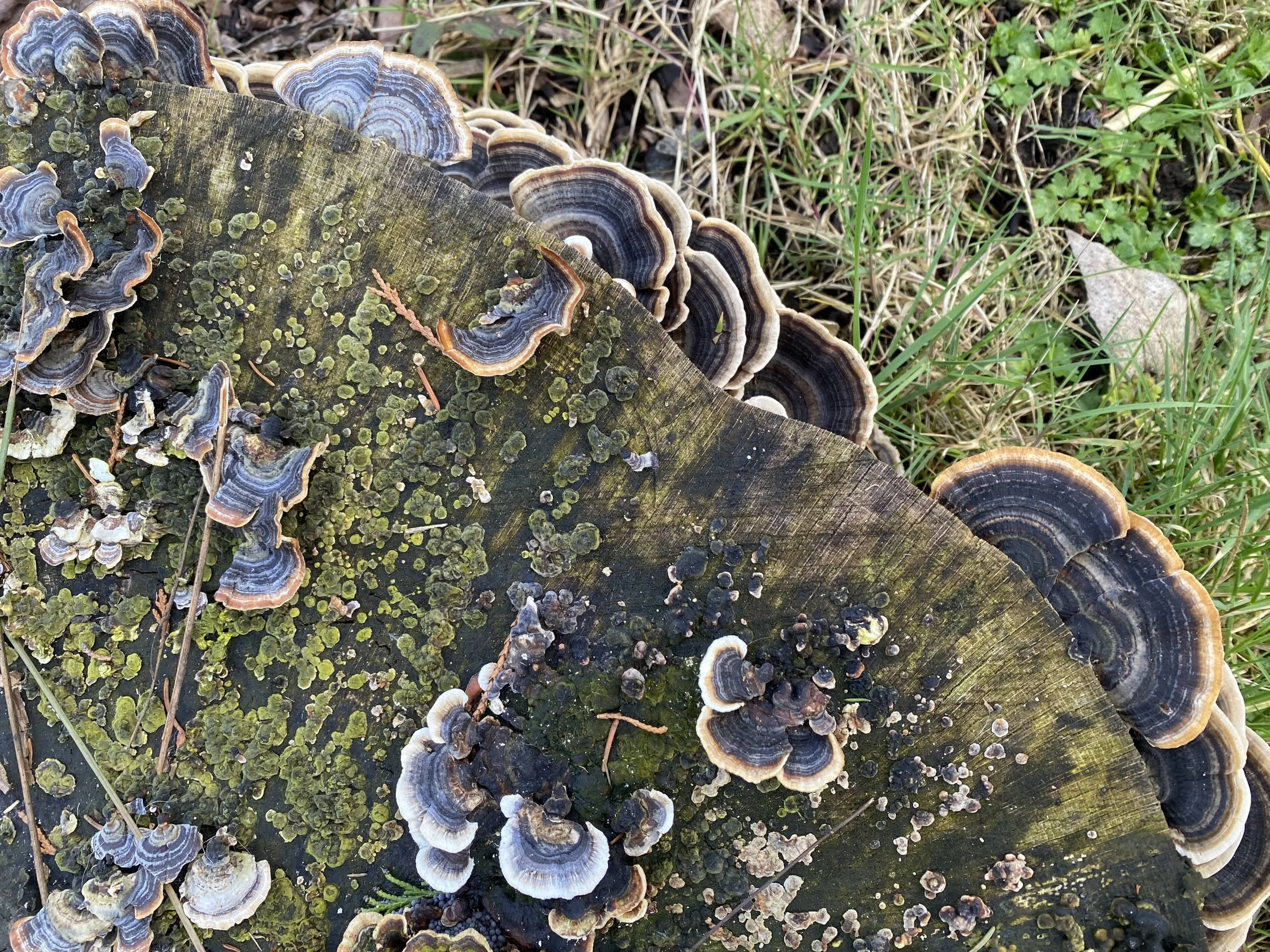
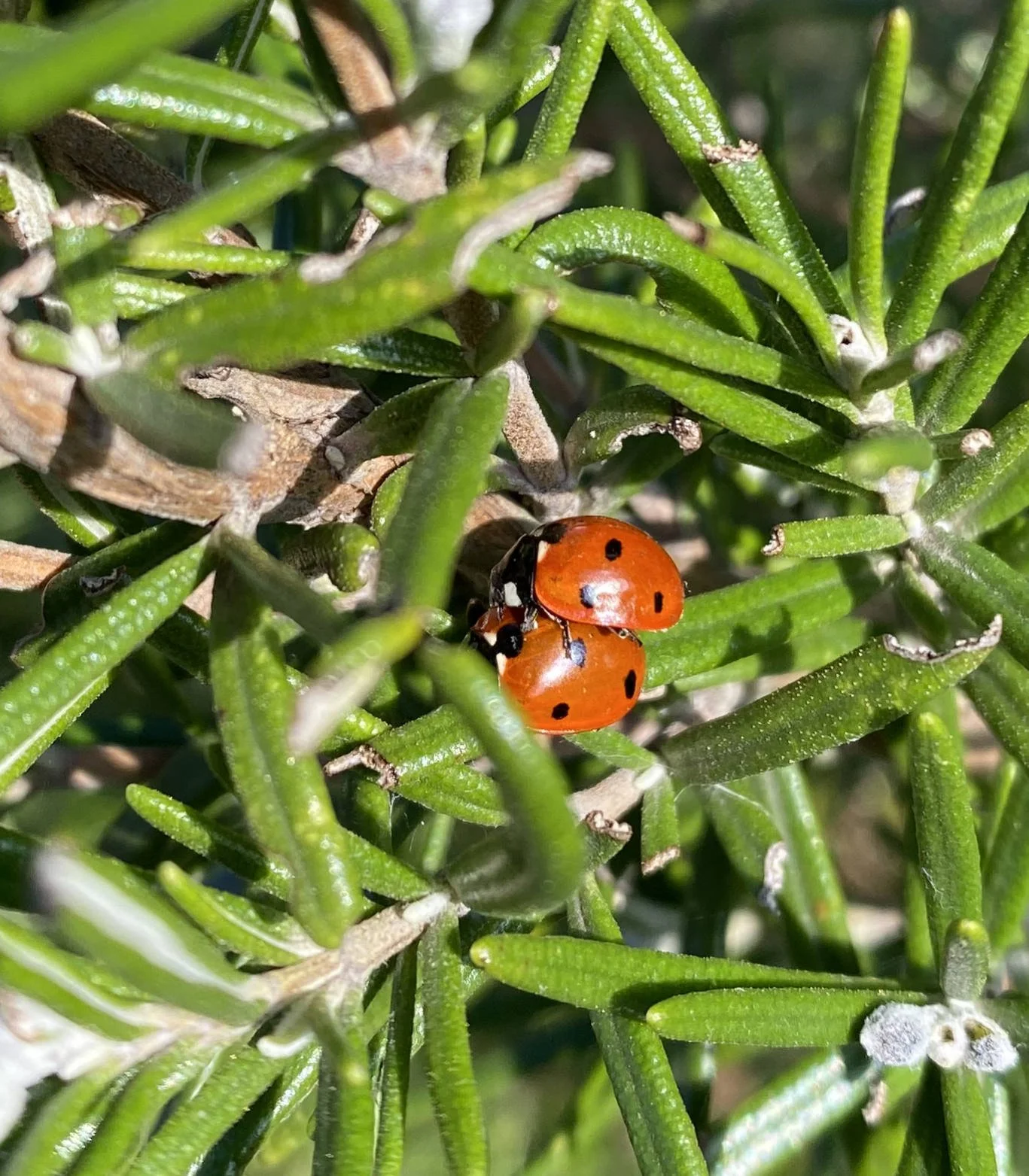
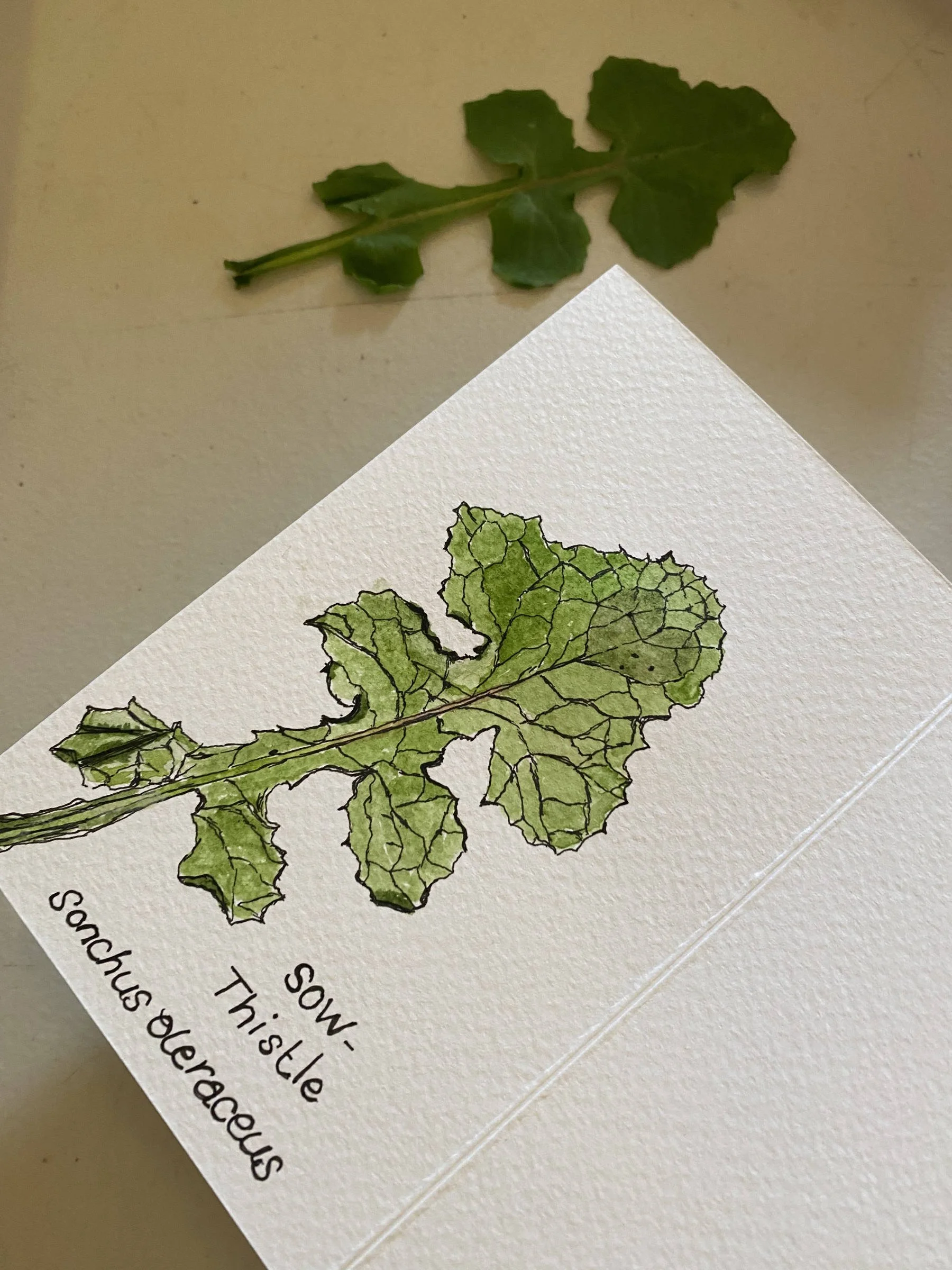
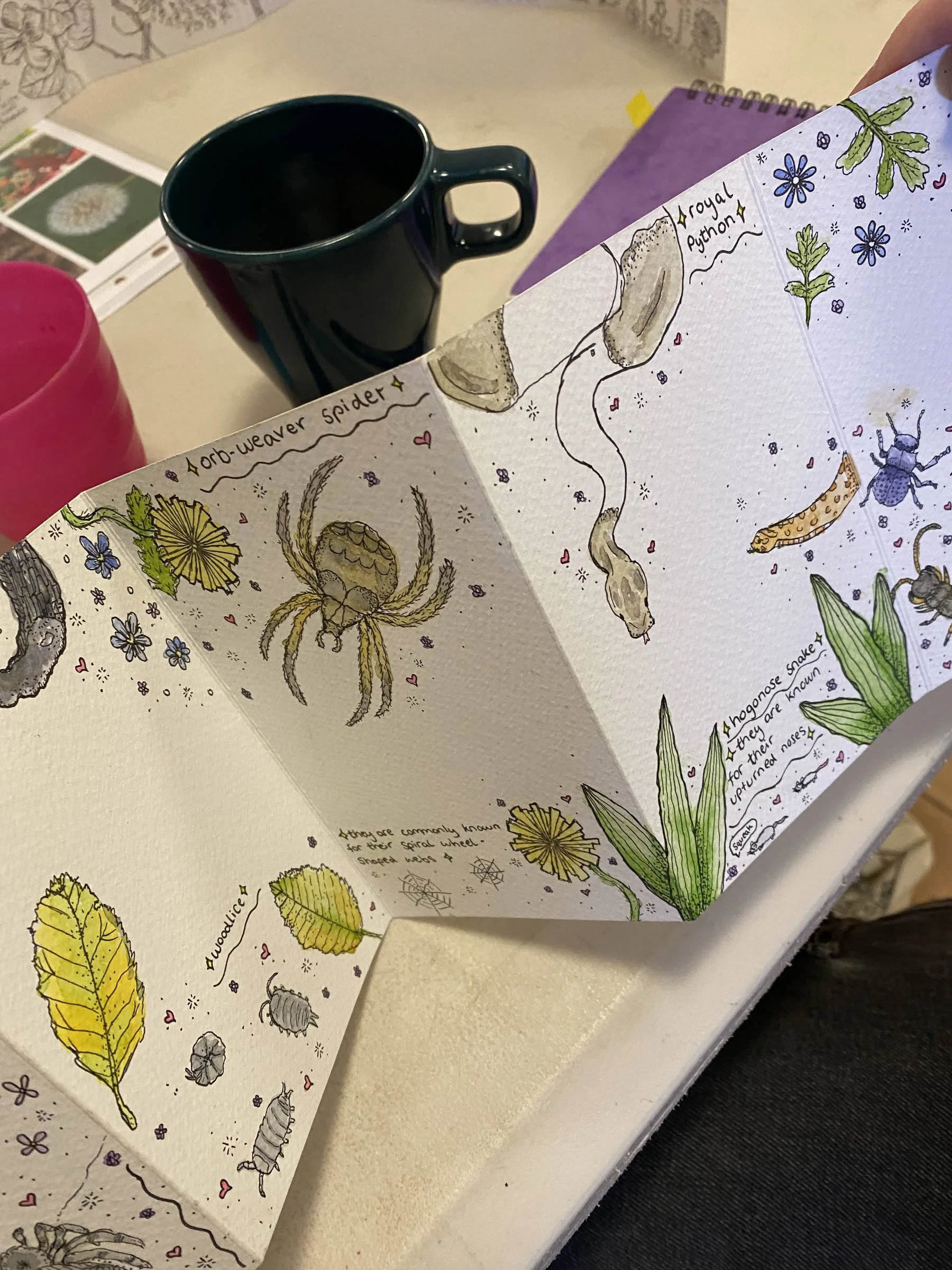
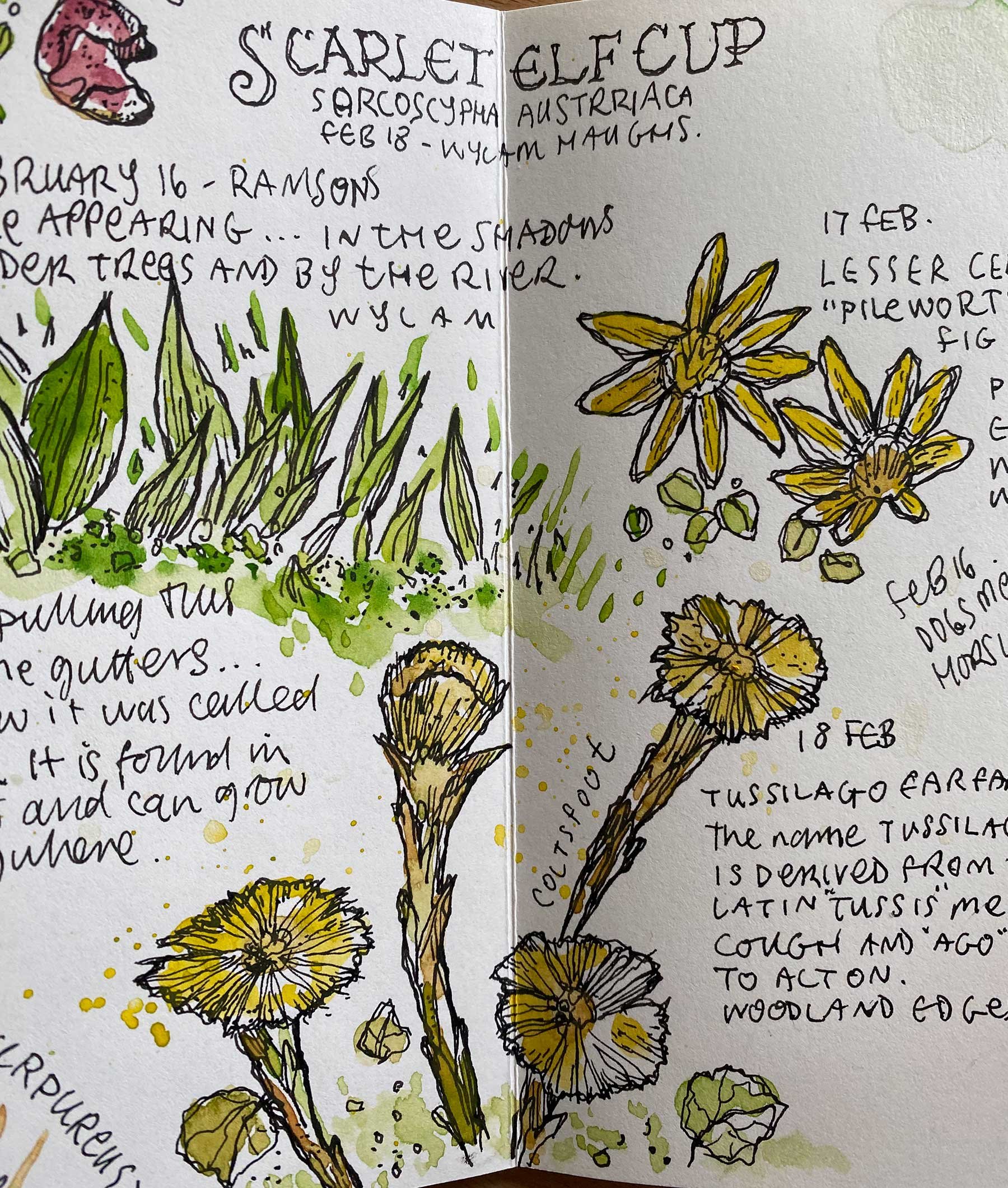
Okay it is always workshop season to be honest. And whilst you may think you need access to a garden or nature reserve to experience nature …. well who knew - you don’t! Nature is all around. Just look into the gutters, cracks in the pavements, walls, drain pipes, the clouds. There is always something to find and draw. The above sketch was done by one of the attendees in a workshop recently - and we found loads of stuff in a small urban community garden - packed full of interesting nature - from coltsfoot - one of the earliest of the dandelions to flower to bitter dock growing like salad leaves all over the place.

Highlights Tour - Gilsland
The last of the workshops for the Highlights Tour took place on the Threshing Barn in Greencroft this week and was a wonderful way to finish off this season. the artworks created were so lovely and offered such variety too.

The final workshop for the Highlights Tour took place in Gilsland. The venue was provided by the amazing Threshing Barn at Greencroft - see here.
We had an amazing group of artists both new and established who for different reasons had wanted to begin creating nature journals but just need a little helping hand. And, really it didn’t require too much of a helping hand as they were so talented.


Highlights tour - Newbrough
Exploring the nature of Newbrough and creating beautiful nature journals. The town hall was the perfect venue for us to base ourselves and with the nearby woodland providing inspiration and resources we were all able to create wonderful little journals.

Nature Journaling taking place in Newbrough Town Hall
The Highlights tour continues and this time I wasn't in the lovely and historic Town Hall at Newbrough. We had access to the nearby woodland which was full of wildlife garlic. The artists including two horse riders who were really keen to carry with them a journal that could record their rides and the wildlife they see along the way. Interestingly they both agreed that riding a horse is a great way to see nature as the smell of the horse mask the human scent so they could get really close to wildlife.


How do these workshops work and what can you expect from them?
It is really simple and I aim to be really inclusive in my teaching - my firm belief is that everyone can draw! It is all about the process and observing and understanding is part of this. The “Chapbook Process” is something I have developed - I am going to write about this more - and it is a way of giving permission to “do your thing”!

Isle of Wight revisited
This May I spent two days Nature Journalling on the Isle of Wight centred around Newtown Nature reserve with the National Trust and some lovely artists who created wonderful pieces of art and are now on their way creating their own nature journals.

Nature Journal in the ancient Town Hall of Newtown
What a privilege for me to be invited to the wonderful Newtown Town Hall to deliver a nature journal workshop centred around the nature of the nearby Newtown Nature Reserve. Many thanks to the National Trust for providing the venue and support. The Town Hall itself is such an interesting building and carries with it a depth of history. Imagine - we were working on a table that was used for meetings since the 1700s.
Newtown developed as a commercial centre and a borough in the 14th century, however, it failed to recover after a French raid in 1377 but Queen Elizabeth I awarded the town two parliamentary seats to try to stimulate economic development in 1584.
In the late 17th century, the mayor and burgesses decided to commission a town hall in order to be able to exercise the privileges afforded to them of holding dinners at which they would confirm the names of the candidates for the two seats.

Newtown Town Hall
I ran three workshops with the attendees being taken through my introduction about the “History of Monkeys” (don’t ask?), the love story that is the Sexton Beetle lifecycle and of course the three types of mucus that slugs are blessed with - Oh noble slug!.
After that it is the creation of the Chapbook form that I have made a specialism - this is a concertina journal allowing people who perhaps have that fear of paper to simply make a mark without fear!

A beautiful chapbook creation
Everyone who attends my workshops go away (I hope) with a new found confidence in their own ability as artists. My main aim is to bring this out so that the attendees can continue their journaling using their own unique style and voice. They are certainly not copying my work.

I love the different interpretations and charm that each artist brings to the workshops.
Some people are aware of their ability but some are not - my job is to tease and nurture this ability - I am not imposing my style on them but simply nudging a little bit. After that each person seems to flourish and their own joy of nature comes out.


Barningham Workshop Day
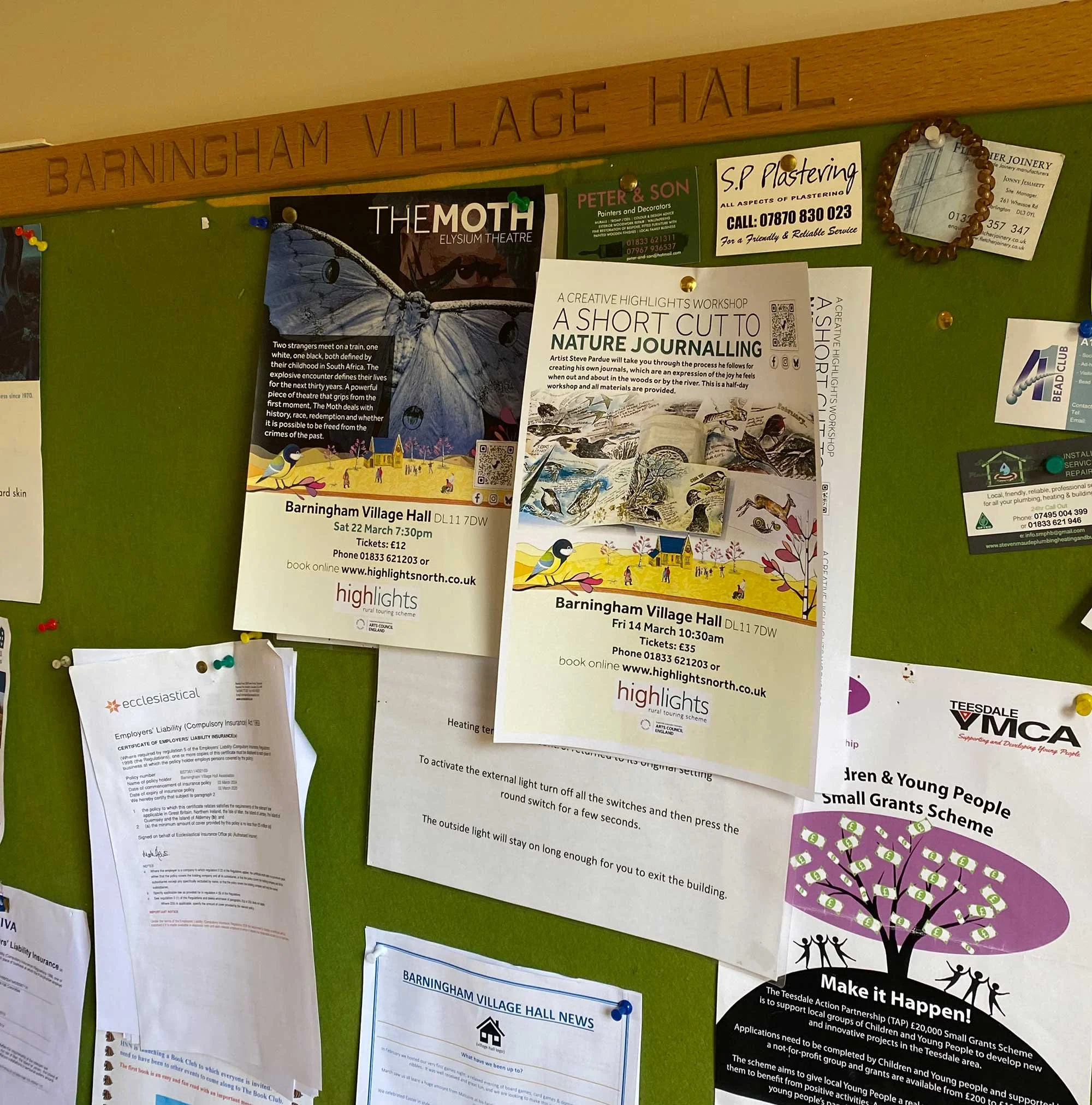
The first of our Highlights Tour workshops saw us in the lovely village of Barningham for a Shortcut to Nature Journalling. We had a wonderful group of artists who created some lovely nature journals full of colour and joy.

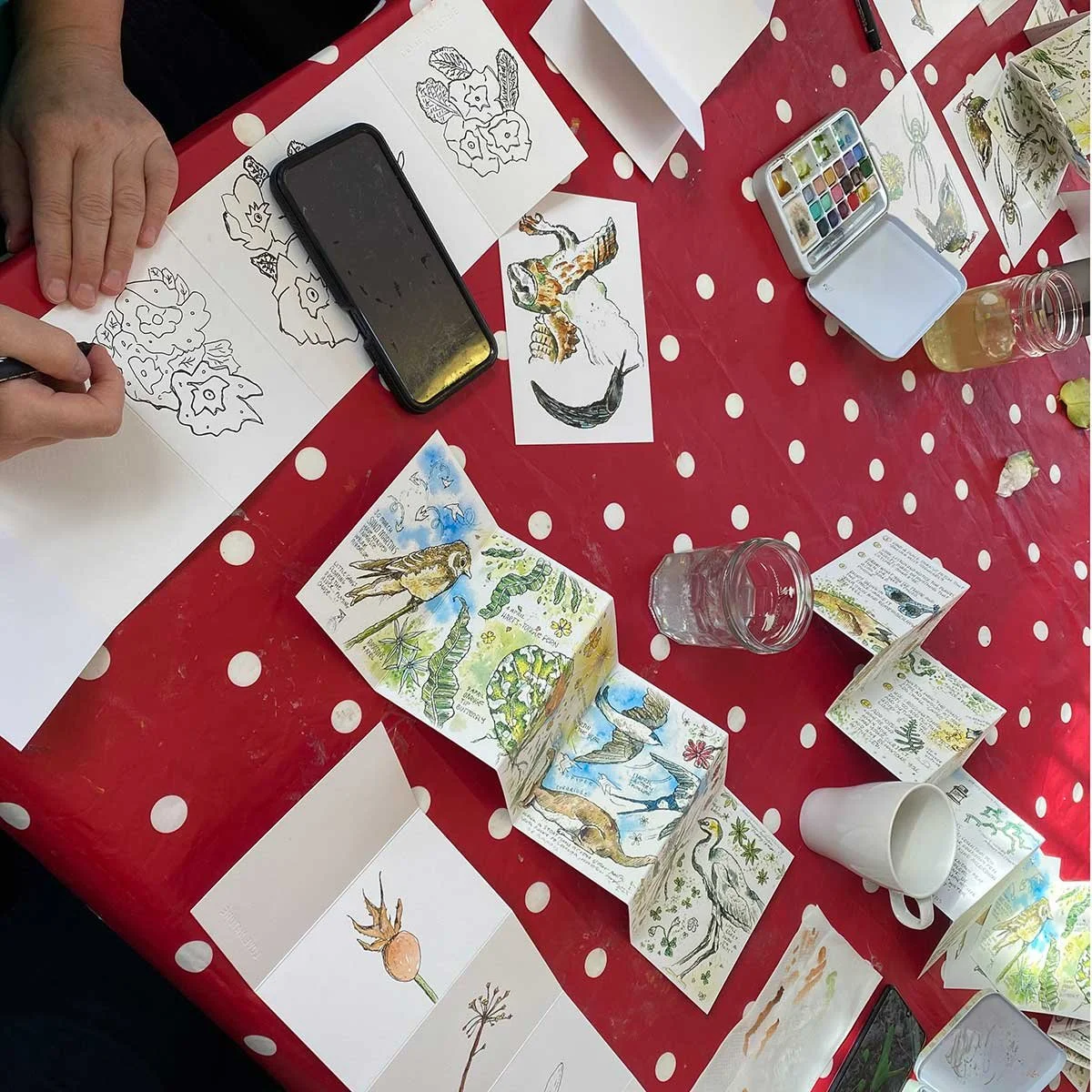
Everything in place for a day of nature journalling
Last week was the first of the Highlights Tour Workshops. This was in the lovely village of Barningham. The weather was kind allowing us to do a bit of exploring the on the village green.


The session involved us in discussing nature at its smallest - there is always an opportunity to see the everyday nature around us such as slugs, dandelions, last years leaves and new growth coming through such as Celandine leaves.


Everyone was able to begin their nature journal using my specially designed and created journal concertina nature blanks, and this, coupled with my short guide to creating your own nature journal we were up and running.
It is somewhat of a challenge, initially, to draw using pen rather than pencil - no rubbing out here! But after a while everyone found it liberating to get straight into the drawing. The final hour was all about adding colour to our nature journals.


Forest Hall Family Day
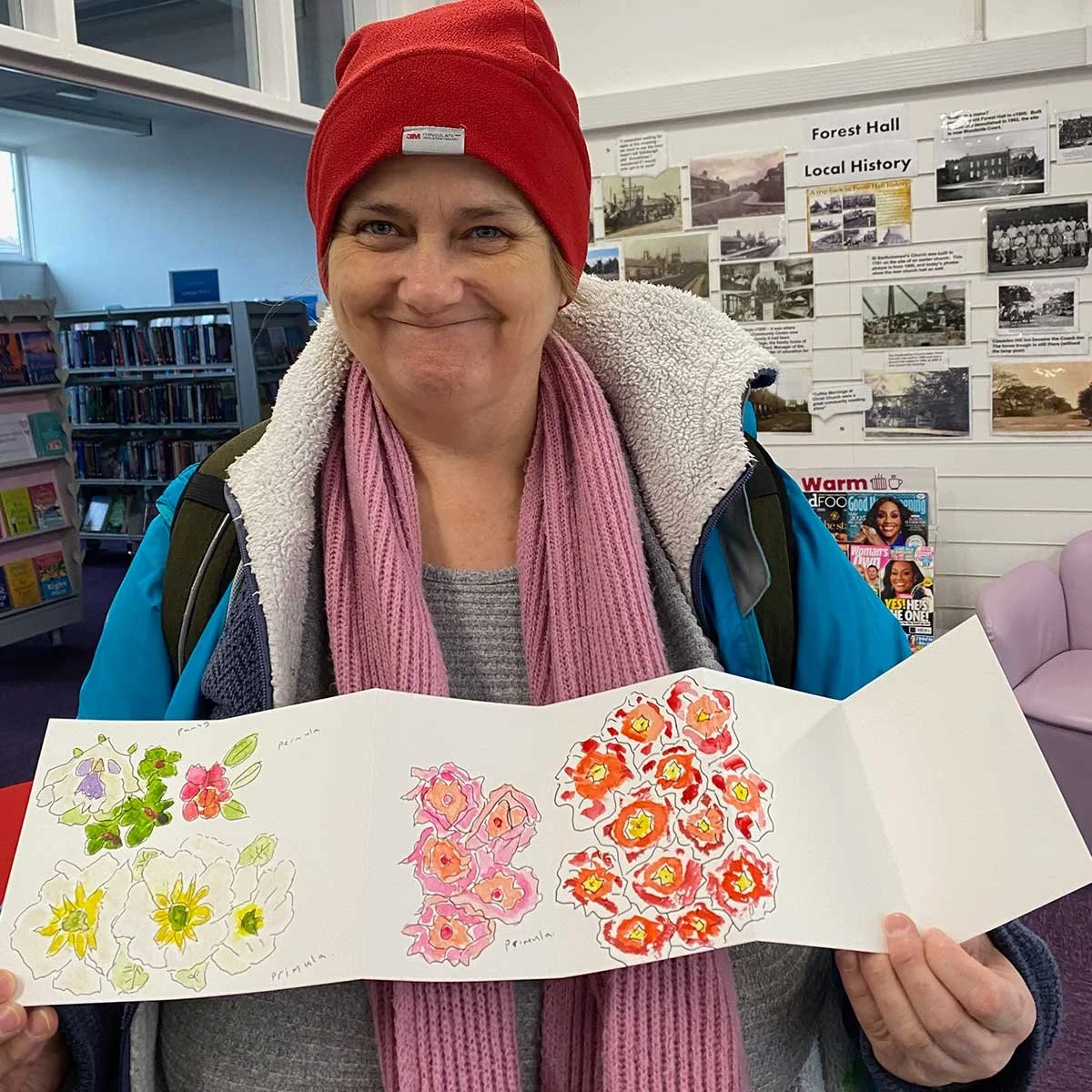
It was Family Day at Forest Hall Library today and we all had a lovely time drawing the simplest of things. I provided my unique little concertina nature journals which I have made just for this purpose. These little journals are a great way to get started in nature journalling.
Today’s workshop was for families in the half term break. Again Forest Hall library provided fantastic hosts for this Free workshop. A great one for mums, dads, carers and children to take part in a restful morning simply drawing nature. I do insist on a few rules and as usual rule one is when drawing slugs, which you must, include a lovely red heart alongside him/her.
Second rule it drawing with a pen and not a pencil - why? This is to ensure that people draw with some freedom and not get bogged down with trying to make that “perfect” drawing - nothing in nature is perfect after all. It is so liberating working straight onto paper with a pen and living with your mistakes and after a short while you forget you are not using a pencil!


Nature Journal Overview
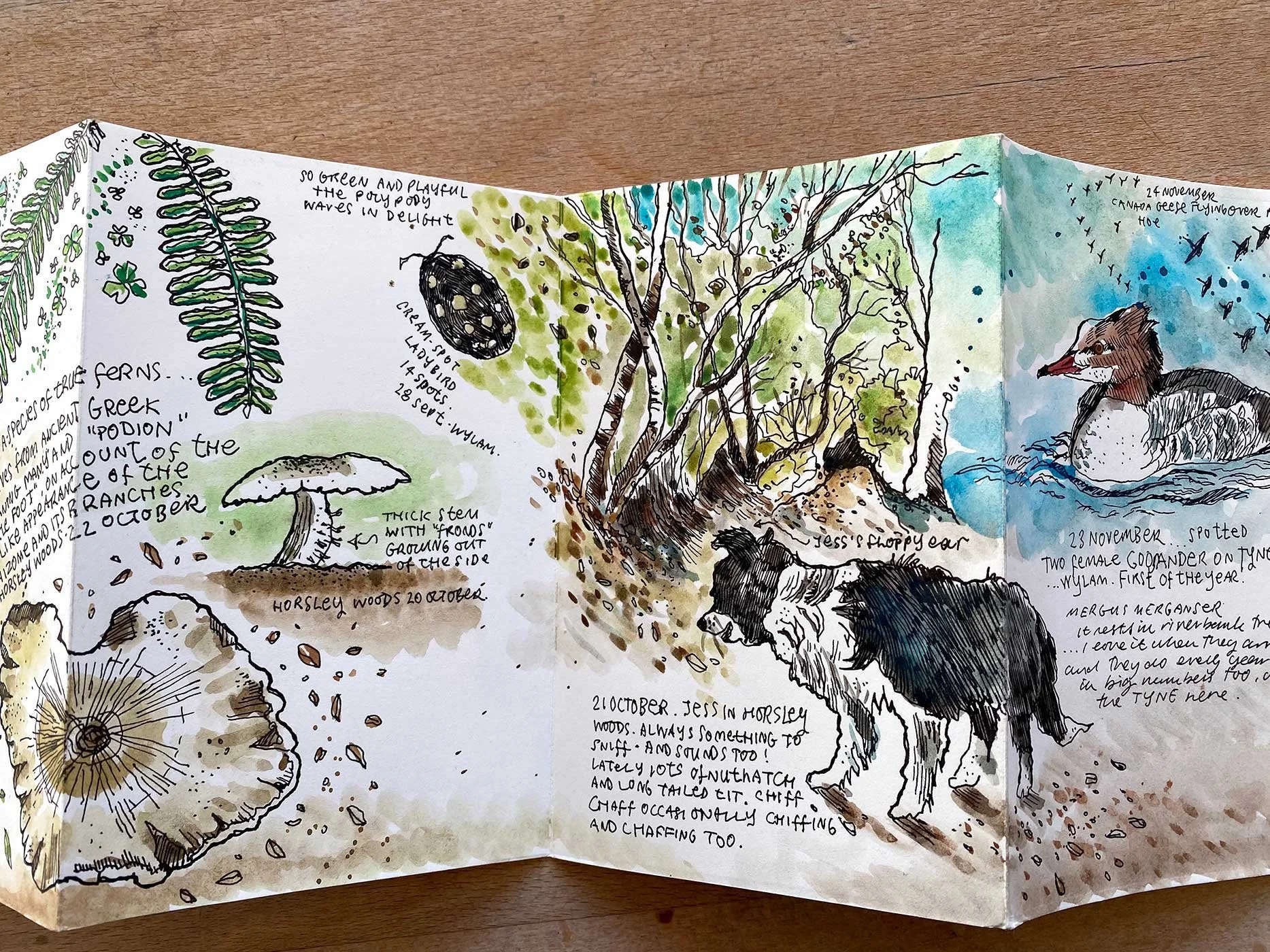
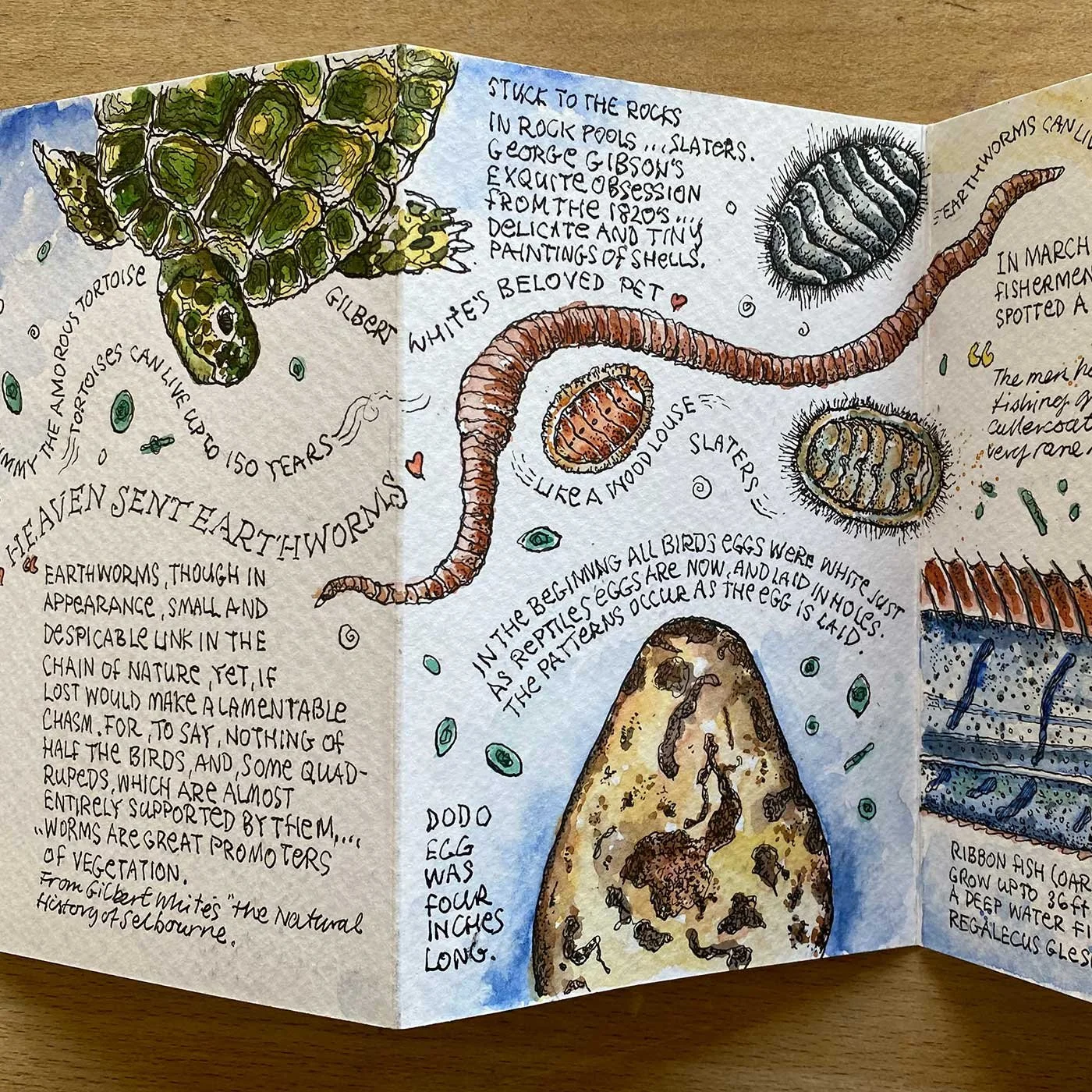
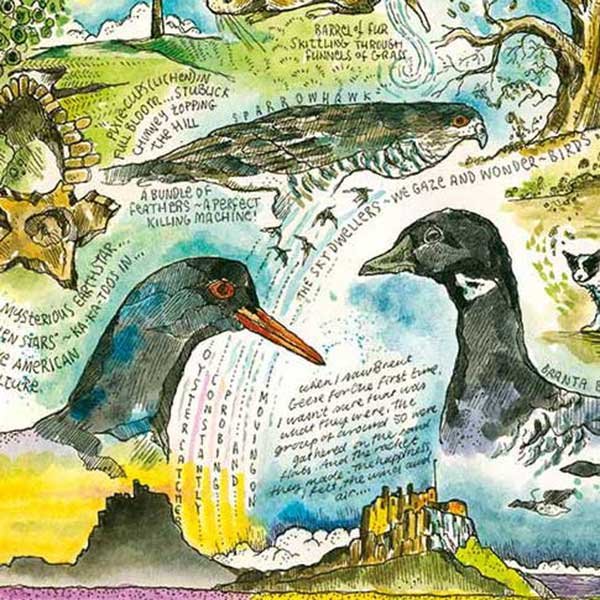
There are many ways to create a nature journal and I do have a few different ways to create observations of nature. My main focus is by the use of Moleskine Japanese Accordion Sketchbooks. They are such lovely little books that you can fill and when opened up they re-create the walks I take when observing nature.

It all begins with a walk, usually with my dog, Jess.
My work begins with a walk. Usually with Jess. It is all about seeing and listening. The words are quiet places until you start to listen - you can even hear the trees breathe …. sometimes. And if you are really lucky you will have an encounter. A hare runs into you. A deer crouches before you. A woodpecker drums above you. My job is to observe and record these wild things. From these observations I record my thoughts and feelings into my Moleskine Sketchbook and am on a mission to make composites of these sketches as complete paintings.
Each journal I make carries a journey - usually a journey through a three month period - sort of seasonal but not quite. I have decided there is much I cannot change so I am a witness instead. I witness the moving seasons and the changing landscape. There are no rules - the rules are mine to make and break - and the sketches are done for me only.
It takes a little time after a complete journal for me to take it in and it is only then that I make paintings from the journals. I work using fountain pen and Noodler’s ink - which I love! Watercolour paints and brush pens add colour. I am not very purest when it comes to adding colour and often end up splashing paint onto the spreads - a bit like dappled light through the trees.
This is an ongoing process for me as everyday is a journey.




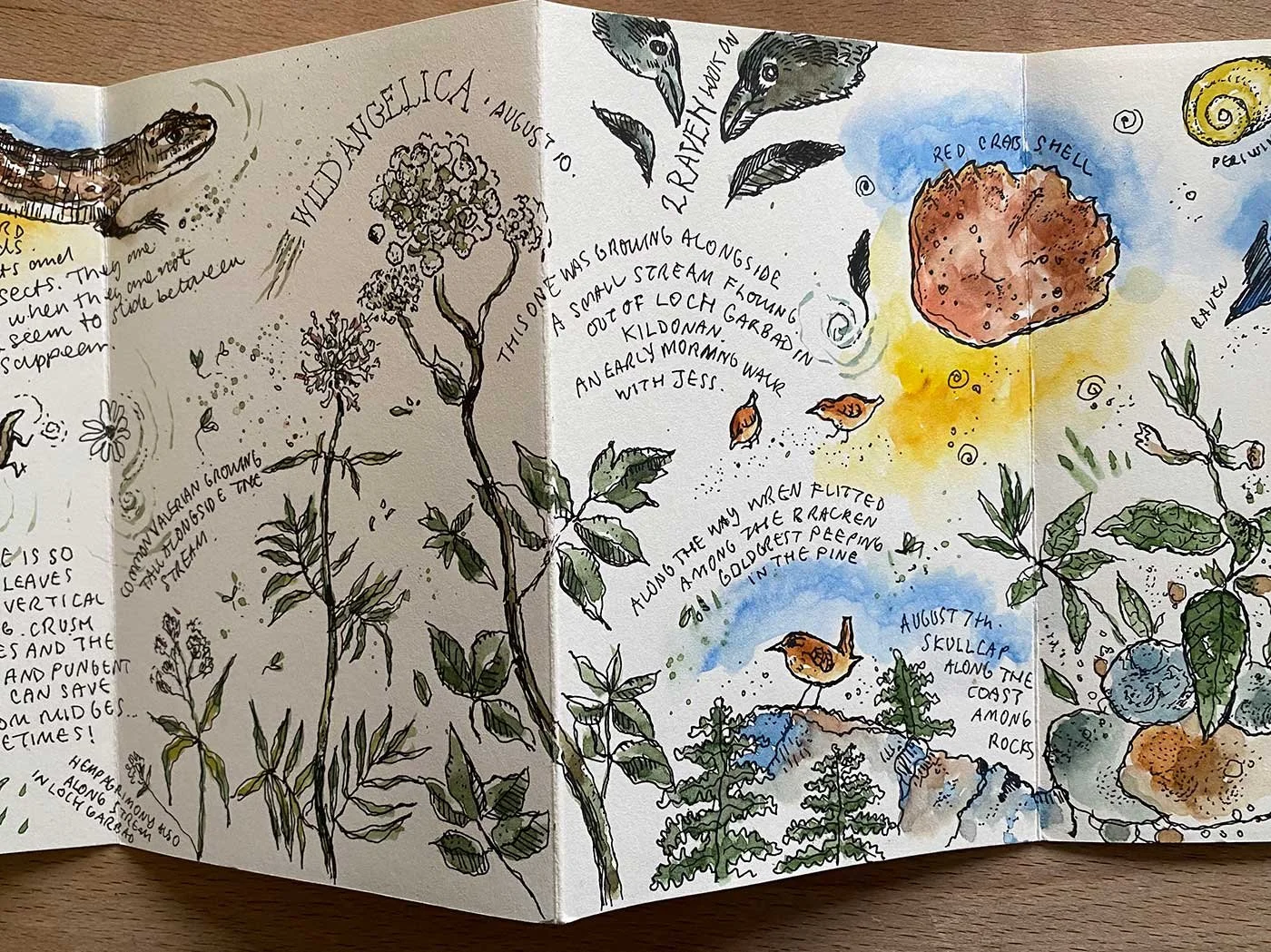
Book 2 - May to August 2017
The second of my nature journals created in 2017. Includes a wonderful week on Arran which seemed to be bursting with wildlife, from the boggy areas to the sea, from grey seals singing and lizards sunning themselves on rocks.

When an osprey flies over you have to stop what you are doing and gawk.
And into May the walks take on even more meaning as nature unfolds around me. So many things to notice and breathe in - their presence a joy.
Some highlights:
11 May - tasting water dropwort hemlock
May 11 - osprey flying over my allotment
May 16 - cockchafer flying into my bedroom
Early June - grey seal singing
June 19 - newts arriving in our pond
August - manx shearwater
Coffee in a fancy cup
sedge warbler
red squirrel
lizards
raven

Wow indeed!
Sitting amongst leaf litter - becoming invisible to living things - merging into the scents and sounds and becoming still.
Ramsons in full flower. What is the celery-like plant - it has a celery like taste and texture. I shouldn't have - but I did taste it! Turns out it is water hemlock dropwort the most poisonous plant in Britain.
11 May - An osprey flew over my allotment - following the Tyne up to Kielder Water.
16 May - Small and very beautiful dingy skipper on the Spetchells.
21 May A wonderful, burring, buzzing beetle came into my bedroom - bouncing off the ceiling - it was a May bug or cockchafer.

Cockchafer are so big!
29 May - Diaponis damselfly emerging from my pond.
Mouse-ear hawkweed on Lindisfarne ... and the dunes were carpetted with northern marsh orchids.
1 June - This morning, salmon were leaping vertically out of the Tyne at Wylam.
Be aware, lone fly, butterwort awaits.
A wooley bear caterpillar of the garden tiger moth - I used to see so many of these in the garden of my council house when growing up - I never see them now!
Grey seals were singingfrom the rocks ... ghostly murmurrings as if from mermaids.
Under the greenery amongst the hemlock grow the wonderful aniseed smell of sweet cicelly ... and chiff chaff, bullfinch and chaffinch. And Jess finds a patch of sunlight to sleep.

Singing seals.
There are clusters of this green plant on the river edges ... and when the wind blows, the leaves flash white underside ... they smell of herby-lemon ... and have celery like stems ... mugort - once known as poor-mans tobacco.
Sand martin, dodging and disappearing and so hard to follow.
The deadly power and grace of giant hogweed.

A brain and a moon.
What are these strange things in the woods? A brain and a moon!
Turns out to be a common earthball and anm oak gall.
Common earthball - scier oderma citrinum is the common species of earthballs in the UK and occurs widely in woods, heathland and in short grass from Autumn winter - and yet
I saw it in June!
Oak apple gall wasp - female gall wasps insert eggs into the tree and on hatching the legless wasp grubs begin secreting chemicals that recognise the oak's normal growth processes. Instead of producing normal oak tissues, the gall structures are created by the plant around the developing grubs.
Amazingly, this morning - 20 June - there were 10 dragonfly sitting on branched bur-reed in our pond ... waiting for their wings to dry out ... some of them clinging to their nymph cases still.
July - Combe jelly at Druridge Bay, a big dusky slug, white moth - ermine moth? Could have been a bird-cherry ermine. The host plant is brid cherry and the caterpillars make extensive web-like nests. They eat a whole tree bare. the tree is covered by a mass of webs containing the caterpillars. Wylam Haughs Nature Reserve.
Red bartsia - Garstang. Vanessa atalanta - lots of red admiral in July - feeding on nettles - turns out this is the food plant of the caterpillar.

Manx shearwater drifting over the waves.
August
Manx shearwater drifting over moving seas ... sea and sky meet in clouds of spray. Drinking coffee out of a fancy cup watching red squirrel in the garden on Arran. Teasel and linnets - wind and lots of rain. Oystercatchers, noisily keeps watch on rock - winds surrounds - loud strident calls. A sea of grass hides a hare - stillness and watching.
Willow warblers darting amongst the willow. The shingle is full of scentless mayweed ... but why should their lack of scent define them ... it is as if they are somehow less because they don't smell.

A silent hare among the grass.
Grass of parnassus - a most beautiful flower.
At Kildonan there is a wee coastal walk that is full of lizards ... some of them as small as insects and others as large as ... well, big insects. They are so delicate and precious and when they are not sunbathing on rocks, they seem to slide between blades of grass and disappear.
Bog myrtle is so lush - green leaves thrusting vertical through bog. Crush the leaves and the fragrant and pungent aroma can save you from midges ... sometimes!
Wild angelica - common valerian growing tall alongside the stream - along the way wren flitted among the bracken asnd goldcrest peeping in the pine.
Skullcap along the coast among the rocks.
What an amazing week on Arran.

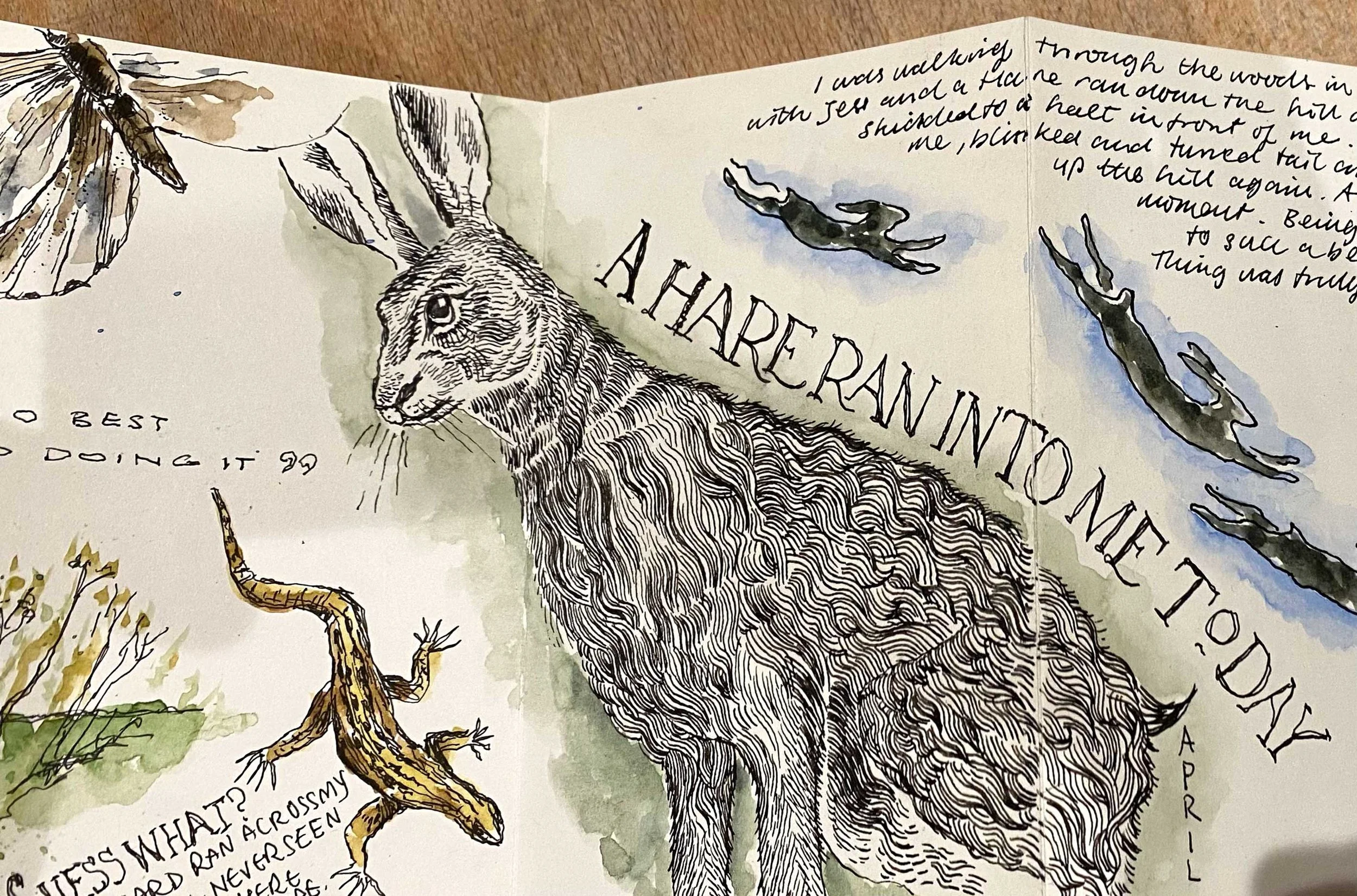
BOOK 1 - 1 APRIL TO MAY 2017
The first of my Nature Journeys captured in a Moleskine Concertina sketchbook. A journey that began 1 April 2017. The highlight was a hare running into me.

A hare ran into me today and I held my breath.
A hare ran into me
The first of my Nature Journeys captured in a Moleskine Concertina sketchbook. A journey that began 1 April 2017. The highlight was a hare running into me.
The very first journal I created was deep in the bottom of Horsely Woods. Among the Dogs Mercury … Jess sat … a perfect picture and a perfect start to what became a constant project.
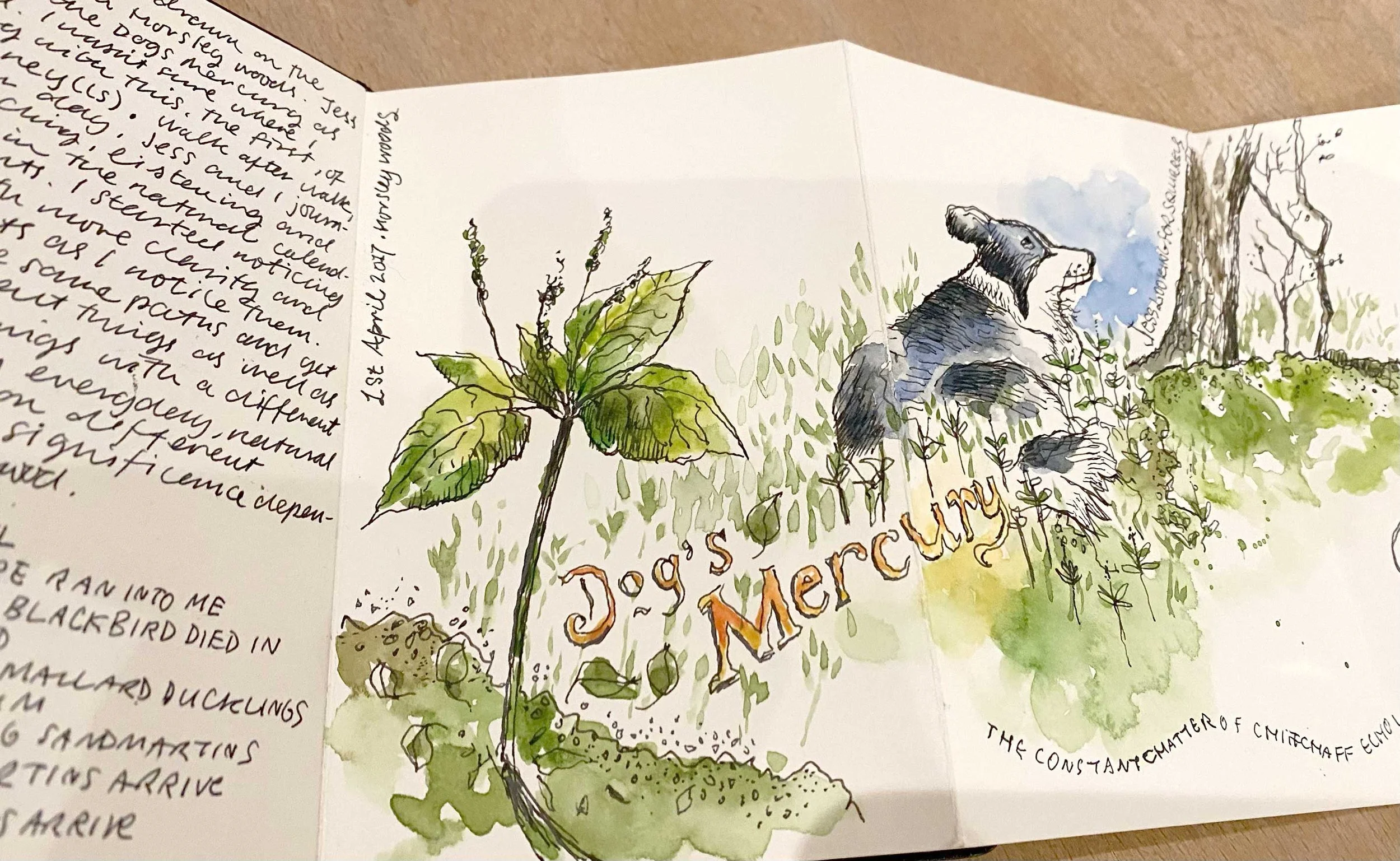
My first page of my first nature journal - a rather sketchy beginning.
In truth she was looking up the tree for squirrels and she sat very still as Collies do when concentrating. My had my first Moleskine Concertina journal with me along with fineliners. The first few shaky lines lacked direction and confidence and I nearly discarded the sketch later. However, I decided to add colour and more sketches until a narrative starts to emerge.

I noted that the last year the sandmartins nested in the holes in mortar on the retaining wall along the railway line. Over the winter these holes were filled in and I wondered if that would deter the birds form nesting.
It didn’t - they seemed to find new cracks and crevices and formed joyous and playful groups flying over and above my head as I watched.
A kingfisher flashed by. Blue streak for a moment.
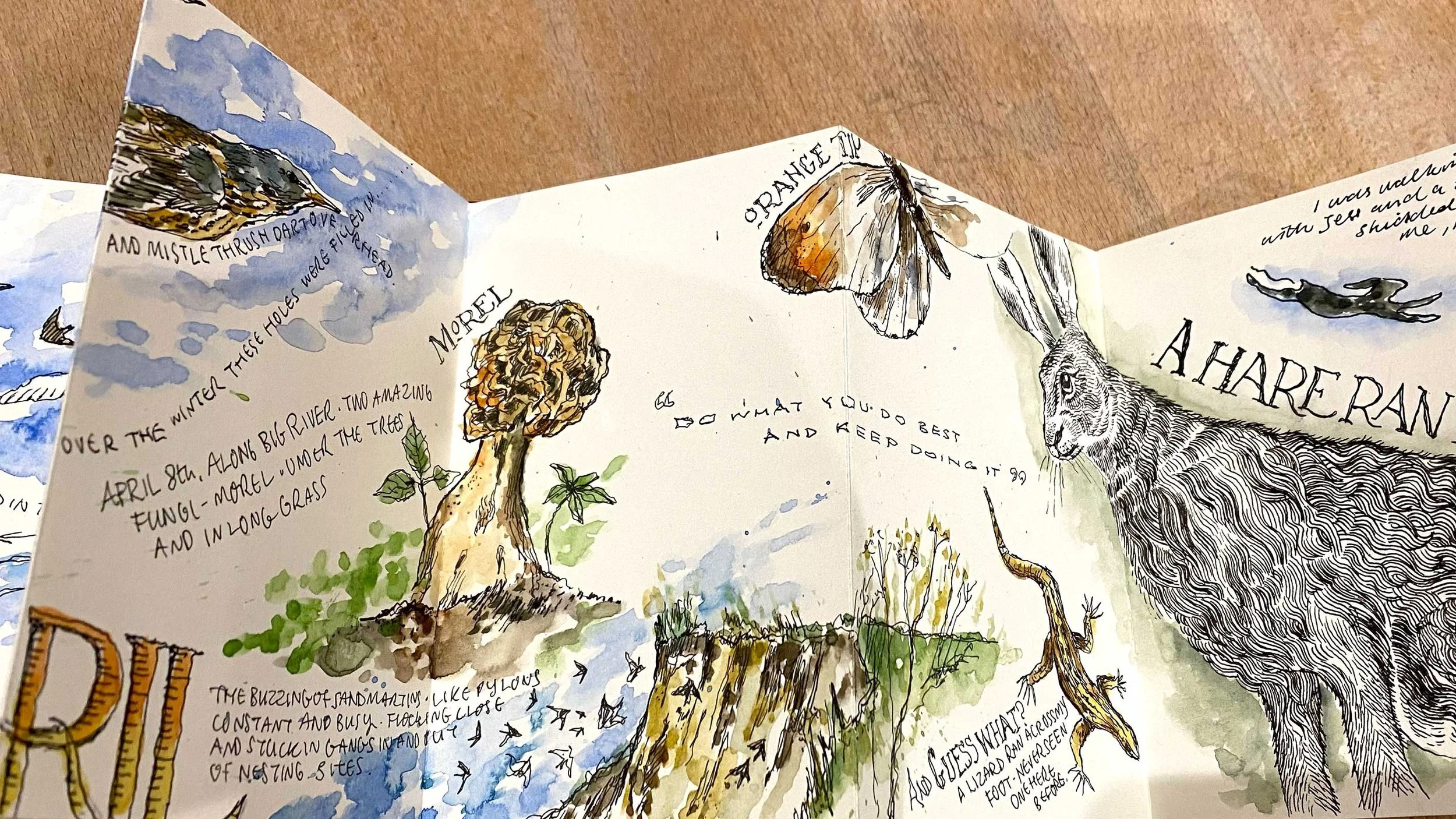
Morel fungi looking like a brain on a stick!
Later on in April I spotted a strange fungi - looking like a brain on a stick - Morel - hadn’t seen one before and I haven’t seen in it since. And at this part of the river east of Wylam there is a river bank that is undermined by holes that the sandmartins have made. One day this bank is going to crash. And a lizard ran across my feet … I have never seen one here before and I haven’t seen one since - but I still look.
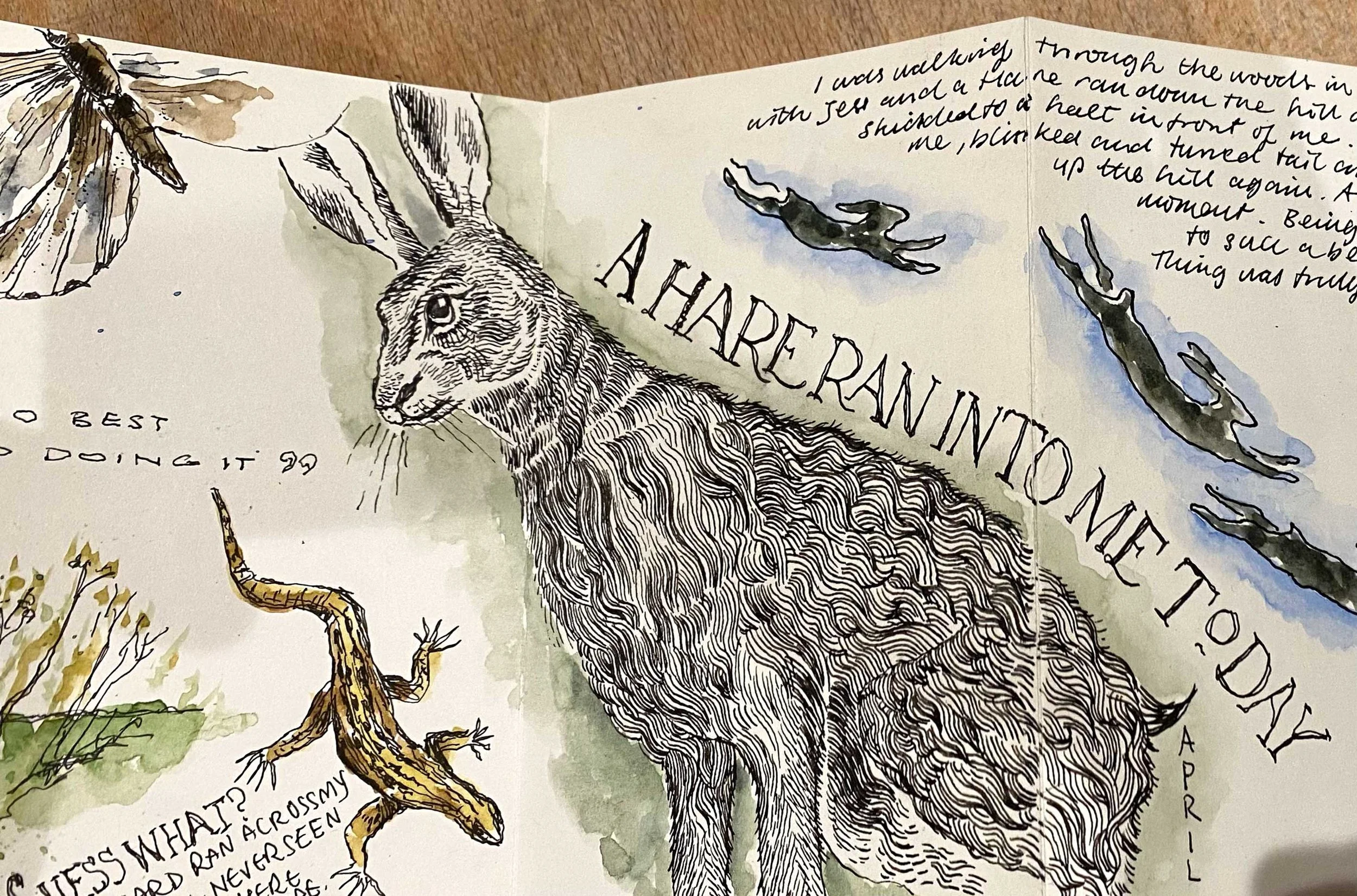
A hare ran into me.
I was walking with Jess and a hare ran down the hill and almost skidded to a halt in front of me. It looked up at me, blinked, turned tail and ran. heart stopping. Jess was too surprised to do anything but look at me as if to say wha … what?
In Garstang today there were little gangs … or I should say more accurately colonies of Tree Sparrows. They are so handsome - and so different from House Sparrows.

Tree sparrows are bonny and really quite different from house sparrows.
When journalling it can be really helpful to have a conversation with yourself. It allows you to let things percolate that would perhaps fester. Just by drawing and writing about experiences can help you through a situation. When I found a baby bird on the road, I couldn’t leave it there. I picked it up with the intention to move it into a hedge or garden. But it just closed its eyes and went to sleep … forever … in my hands.
Later that day I saw a duck with 12 chicks hanging onto her dress.

Look at all of those ducklings!
I love it when the sandpiper arrive down by the river. As this journal passes through to May and past half way in the book my style is starting to emerge. Still using fineliners and watercolour, I am starting to worry less about the drawing and concentrate more on the recording of what I see. I often do the drawings after the event - at home sometimes … sitting quiet at the kitchen table remembering what I have seen that day or that week.
The thing I like most about journalling is not necessary the drawing but the noticing. today I met a St Marks fly - a female - as she wasn’t flying in that showy way the males do. You know those lazy flies that float and drop with dangly legs? The females are just checking the males actions out to see what takes their fancy.
St Marks fly is so called because it emerges around St Mark's Day, April 25th. Also called the Hawthorn fly.
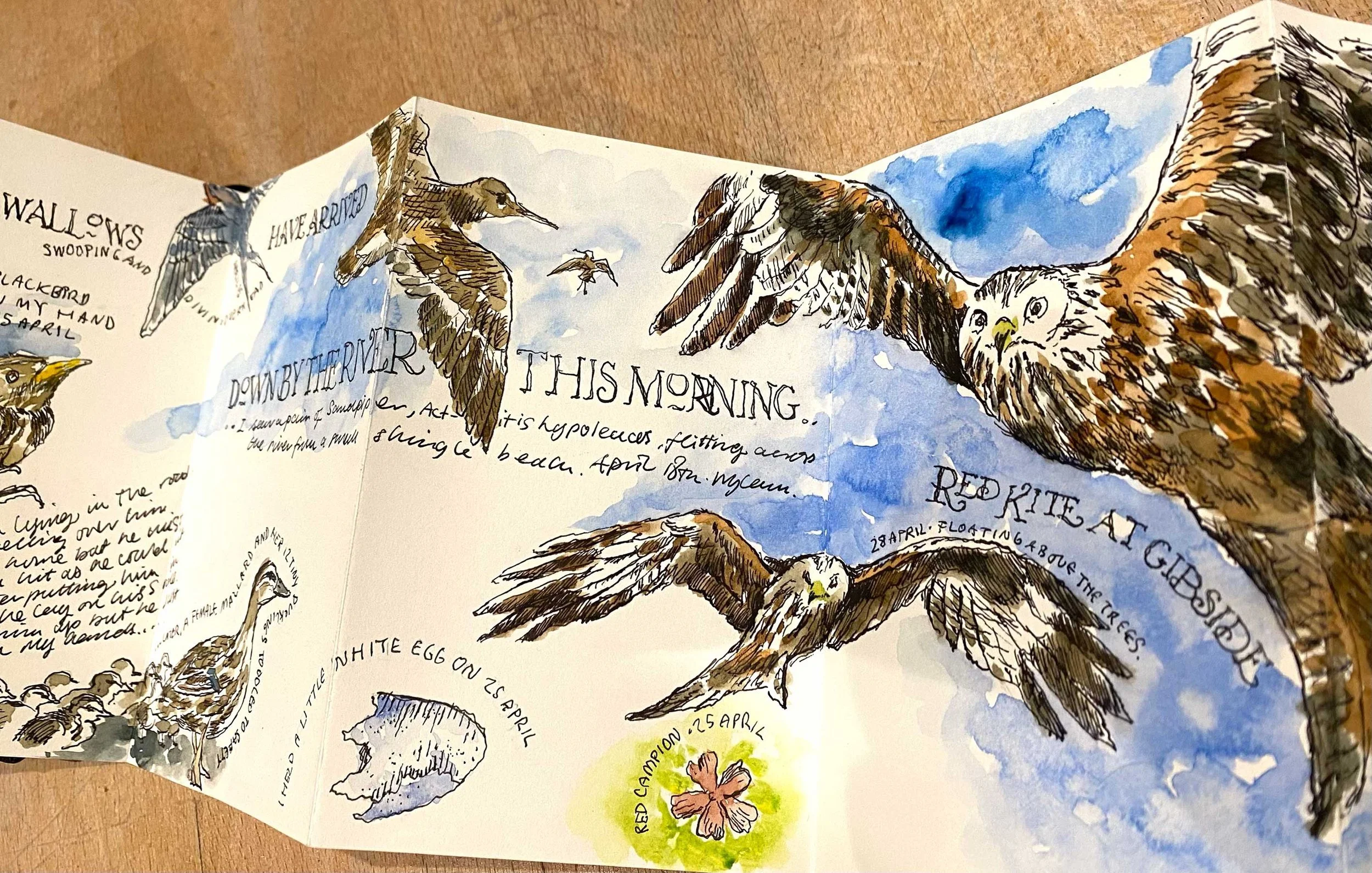
Red kite floating on angular wings.
I truly believe that my role is to be a witness, to notice and make notes of things I see, hear, experience and think. Only I can do this in my way … everyone does it in their own way … which is why journalling is so unique … it is unique to the person who creates it. Every day you can see things and treasure the experience. Henry David Thoreau said:
I omit the unusual, the hurricane and earthquakes - and describe the common.
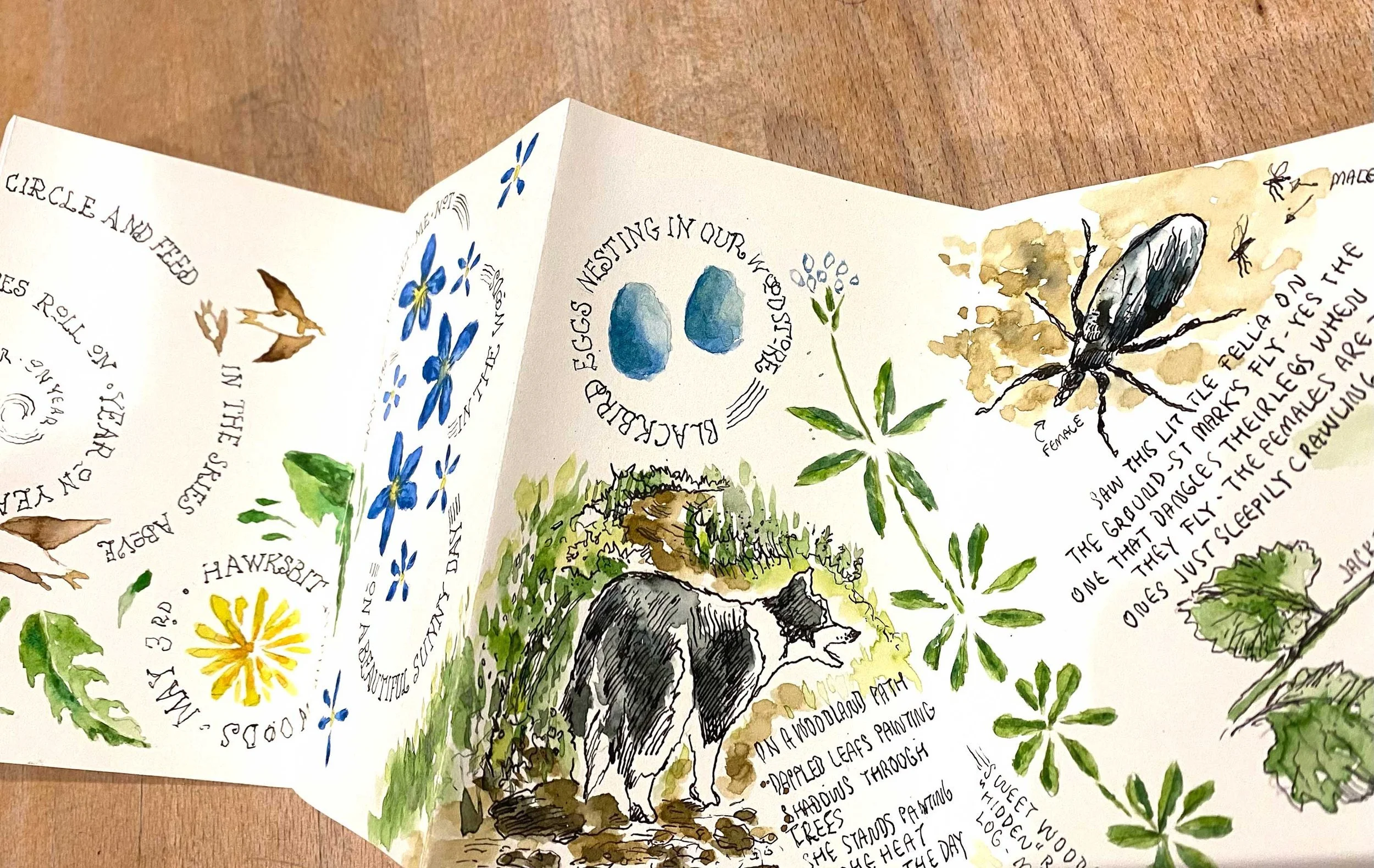
I study Jess and see what she sees and hear what she sees - I can’t smell what she smells though!